

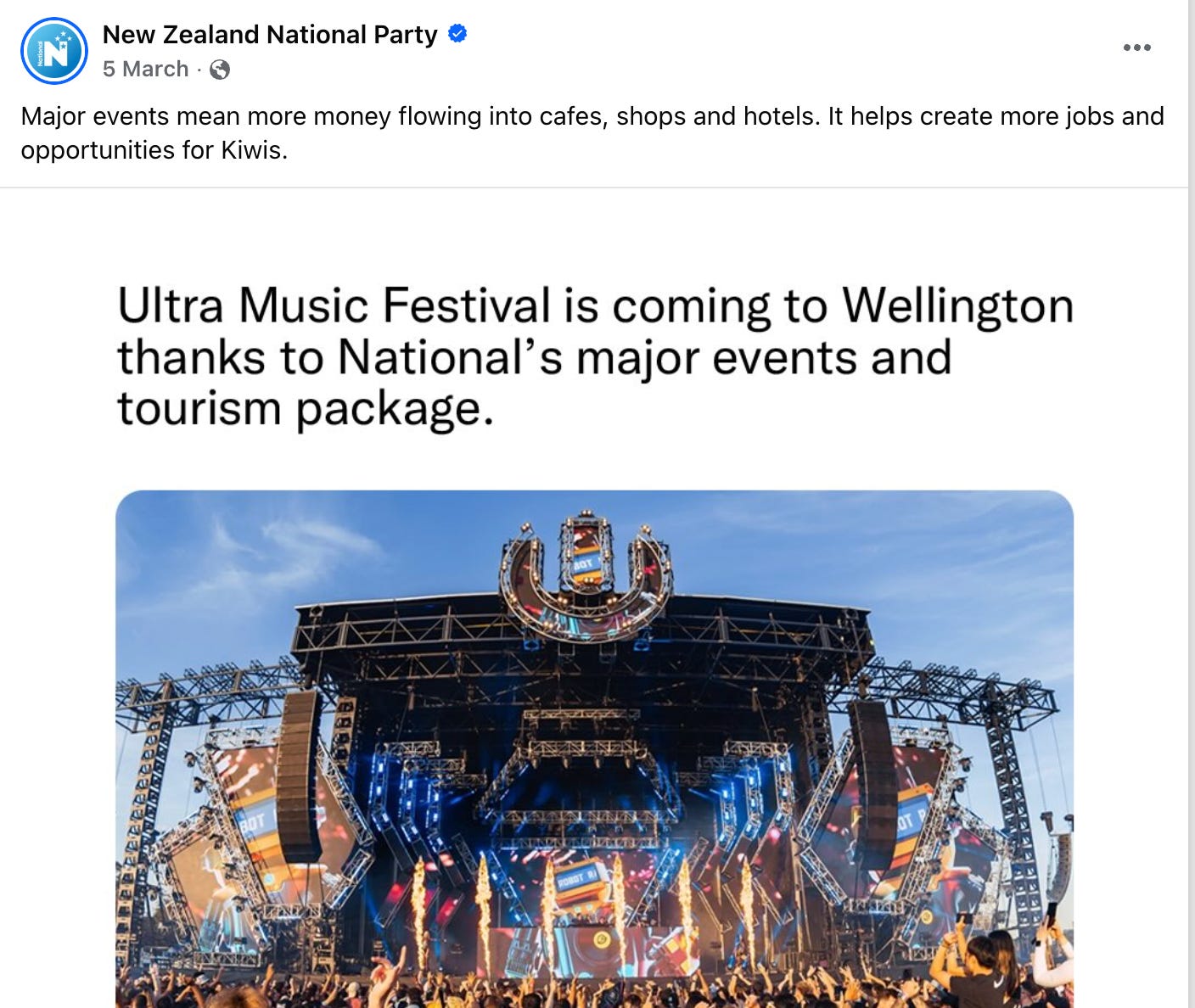
The Government is spending tens of millions helping international concert promoters bring acts to New Zealand that, in many cases, look like they would have come anyway. The process is closed. Ministers pick the winners. The sums are hidden behind claims of commercial sensitivity. And the economics used to justify it have started to fall apart on inspection.
Welcome to the $70 million Major Events and Tourism Package — the latest frontier of corporate welfare in New Zealand, brought to you by a coalition of parties that built their brands on opposing exactly this kind of thing.
Closed doors and ministers picking winners
Blayne Slabbert’s investigation for The Post, published yesterday, exposed the mechanics of how the money was allocated. The $40 million Events Attraction Package was not open to applications. It was designed from the start as an invitation-only process. MBIE and industry advisers drew up a long list, an independent panel shortlisted, and ministers — specifically Finance Minister Nicola Willis and Tourism Minister Upston — made the final calls.
That’s not how this Government usually talks about spending taxpayer money. It was neither contestable nor transparent. And the geographic skew was stark: of six events funded through the package, only one was in the South Island.
Cabinet papers obtained by Slabbert showed the package was built at speed. MBIE’s September 2025 briefing set a compressed timetable — identify potential events in September, refine the list in October, start contracting by early November. Treasury officials were still reworking the wider package as it headed to Cabinet. And $15 million of the $40 million headline figure turned out not to be new money at all but funding brought forward from a future tourism levy.
The International Visitor Conservation and Tourism Levy (IVL) was recently hiked from $35 to $100. The levy was supposed to fund future tourism infrastructure. Instead, $15 million of it was brought forward to subsidise the Events Attraction Package. In other words, tourists are being taxed at the border to cover Robbie Williams’ freight costs.
Caroline Harvie-Teare, the CEO of Venues Ōtautahi — Christchurch’s new stadium company — said it plainly in The Post: the process was “quite subjective” and “subjectivity isn’t always fair.” She warned the fund could create an unsustainable precedent, with the Crown now covering up to 75% of event costs rather than the more typical 50%, lifting expectations beyond what cities and venues could sustain without ongoing central government support.
She also posed the question nobody in Government seems keen to answer. If Robbie Williams is also touring Australia, is he really the kind of act that draws additional international visitors? Or is the Government paying to redistribute domestic audiences?
This is where the integrity problem becomes obvious. When you create a discretionary, invitation-only fund and then hide the amounts, you make scrutiny much harder. You make it easier for promoters and insiders to push their case behind closed doors. And the public is left guessing. But more generally, the problem is that the public simply can’t evaluate whether the funding given is value for money.
The paywall now starts at halfway through all Democracy Project newsletters. Please take out a paid sub if you want to support this service and access the full content, including the following sections: “Splore dies, Linkin Park gets a cheque”, “Even the right thinks it’s corporate welfare”, “The parties that hate subsidies — except when they don’t”, “Bread and circuses in election year”
