

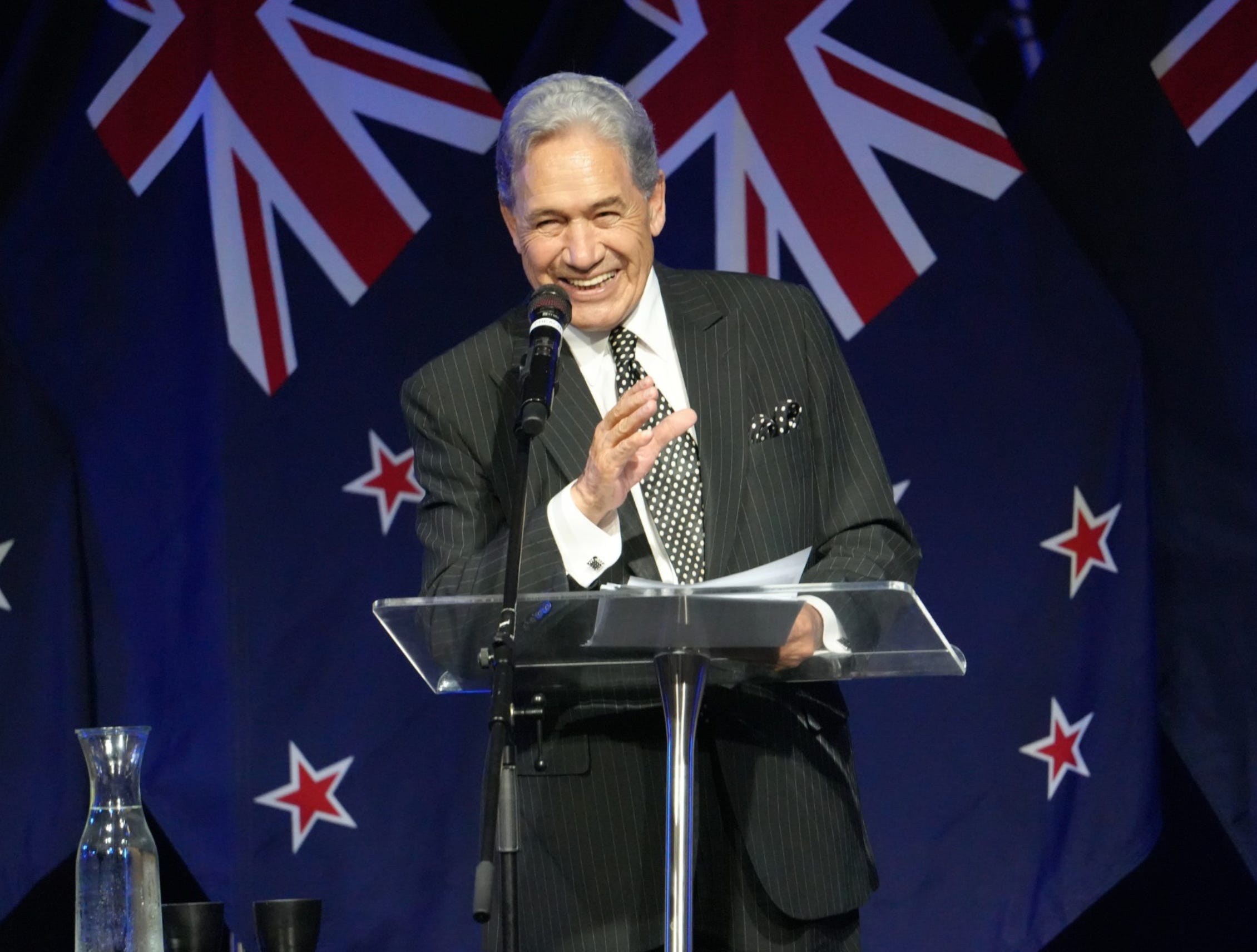
Winston Peters delivered his State of the Nation speech in Tauranga yesterday, and it told us something important about where NZ First thinks the 2026 election will be won. Not in the culture wars or in Covid grievances, but in the electricity bill sitting on your kitchen table.
Peters ranged across Fonterra’s sell-off, Te Pāti Māori, the India deal. Slipped up calling his party “socialist” — meant “socially conservative” — then declared NZ First “nationalist with a capital L”. Mangled Rod Donald’s name as ‘Rod McDonald’. Vintage chaos, but you couldn’t look away.
But the headline was energy. NZ First will campaign on breaking up the electricity gentailers, splitting the big four power companies into separate generators and retailers so they can, in Peters’ words, “no longer control both the power and the price.” This is the sharpest political instinct Peters has shown all term.
Why energy is the right fight
To understand why this announcement matters, you have to go back a few weeks. The government’s decision to build a new LNG import terminal in Taranaki, funded by a levy on electricity companies that will inevitably be passed on to consumers, was a disaster for National.
As Danyl McLauchlan wrote in the Listener recently, Christopher Luxon appeared at his post-cabinet press conference to announce the terminal and “seemed genuinely astonished by the questions that followed. Didn’t he promise the country no new taxes? And isn’t ‘levy’ the dictionary definition of a tax? And why were households paying, when the power companies had secured decades of massive profits by underinvesting in energy infrastructure, creating the very crisis the state was now solving?”
Peters and David Seymour both acknowledged it was a tax. Luxon insisted it was a levy. While National taxes households to bail out the energy sector, Peters now promises to restructure it entirely.
The gentailer model has been politically vulnerable for a long time. Peters opposed the partial privatisation of the power companies when National floated them in 2013. The Listener recently published a chart showing that $4.8 billion more has flowed to gentailer shareholders in cumulative dividends than those companies have invested in capital expenditure since the float. That is an extraordinary figure. Ordinary New Zealanders have been paying inflated prices so that shareholders can pocket the difference, while infrastructure has crumbled to the point where the state now has to step in with a billion-dollar gas terminal.
Meanwhile, the big four gentailers are reported to have raked in a combined $1.86 billion in operating earnings for the six months to December alone, roughly a 45% jump on the same period last year. As Duncan Garner thundered in the Listener, this is happening while families are choosing between heating their homes and putting food on the table. Power prices rose 12% last year, and more hikes are coming in April.
The system is broken and everyone knows it. Peters has identified the right enemy at the right time.
The Telecom precedent
Peters and Shane Jones drew an explicit parallel with the breakup of Telecom into Chorus and Spark, a structural separation widely regarded as successful. Liam Hehir, commenting on NewstalkZB, called the gentailer policy “pure populism” but conceded it would be “a real resounding line of attack on the campaign trail.” He noted that the partial privatisations “were never popular to begin with.”
That is the key political insight. It does not matter much whether the Electricity Authority would agree with Peters’ characterisation of the market. What matters is that voters are paying too much for power, they know it, and nobody else is offering to do anything structural about it. National is levying households to prop up the system. Labour has not yet articulated a clear energy position. NZ First is the party promising to break the system open.
The details remain thin. Pressed by media afterwards, Peters referred vaguely to “a paper” that was “pages and pages long.” As Stuff reported, Peters and Jones were “reluctant to give details.” Jones clarified it was a paper prepared by officials laying out options for the energy sector in 2024. That is not the same as a detailed policy. The promises of guaranteed fixed-price contracts for new-build generation and mandatory buyback of household solar at grid price sound attractive but raise questions about implementation and cost that NZ First has not yet answered.
Still, at this stage of the campaign cycle, the lack of detail probably does not matter much. What matters is the framing: NZ First as the party willing to take on the power companies. It is a classic populist move, and it is well timed.
Peters discovers conservatism
There was something else in the speech worth dwelling on. Luke Malpass of the Post picked up on it in his column today, noting that Peters referred to NZ First as “socially conservative” three times. “We are the only socially conservative party,” Peters declared. Malpass observed that this was different, and new. It is not that Peters has suddenly discovered social conservatism; that is how he has always operated, both in belief and instinct. But he has now positioned NZ First as an explicitly conservative party.
Malpass notes that the word “conservative” was used just once in last year’s State of the Nation, and not at all in 2024. There is nothing about conservatism in NZ First’s party constitution, or in its founding principles. “So this is a new thing,” Malpass writes. “And for a party that has always prided itself on common sense and pragmatism, if sustained, it will be a step in the direction of ideology.”
This matters because it shifts NZ First from an ideological blank canvas to something more legible. The party has always been able to play both sides because nobody quite knew what it stood for beyond Peters himself. Claiming the conservative label does not necessarily prevent NZ First from going with Labour after the election, but it lines the party up more clearly with one side of politics than the other.
Peters also used the label to pitch directly at disaffected Labour voters: “For all those conservative, old-school, egalitarian, common sense Labour voters out there who feel abandoned, you’ve only got one place to come.” Whether he can actually win them while simultaneously declaring a war on woke is the tension that will define his campaign.
From culture war to cost of living
The culture war material was present. Peters described the Greens as the party of “Palestine and pronouns,” called Te Pāti Māori “losers,” and railed against what he called the “insipid cancerous spread of the left-wing woke agenda.” He described Green supporters as “woke-obsessed students and weirdos with purple hair.” None of this is new.
But it was not the centrepiece. The economy was. Peters devoted the bulk of the speech to cost-of-living pressures, energy policy, the Fonterra sale, and opposition to selling the government’s Air New Zealand stake.
The war on woke that dominated NZ First’s first two years in government has been repositioned as a supporting act. Lyric Waiwiri-Smith captured this well in her Spinoff report, noting that “waging a war on woke may have been effective in making some noise in the first two years of a parliamentary term, but in an election year, you should expect bathroom politics to be shunted aside to make way for policies focused on financial relief.”
That shift is significant. NZ First voters, according to the RNZ-Reid Research polling data, are struggling with the cost of living more than National and Act voters, and they are more pessimistic about the country’s direction. Those voters want a change in direction, but they are not looking to the opposition parties. They are looking to NZ First. Peters has managed to position himself as the change candidate while sitting at the Cabinet table. It is a remarkable trick.
Peters also took some careful shots at his own coalition partners. He stressed that NZ First had always warned economic recovery would take more than three years, implicitly blaming National for overpromising. He called suggestions to sell Air New Zealand shares “economic neoliberal lunacy,” a clear dig at Act. Peters is trying to cast NZ First as the party that warned you all along, the voice of experience inside a government that has underdelivered.
Ngaro and the talent problem
The other announcement was Alfred Ngaro, the former National minister turned NewZeal party leader, who will stand as an NZ First candidate. It did not go smoothly. Ngaro neglected to introduce himself, prompting shouts from the crowd of “who are you?” Not exactly a triumphant entrance.
But the recruitment matters. Ngaro is a Christian conservative who spent nine years in Parliament and served as a minister under Bill English. In South Auckland, where Pacific and Pasifika Christian communities form a substantial constituency, Ngaro’s recruitment could help NZ First make inroads into territory that has traditionally belonged to Labour and National.
Beyond the Christian vote, there is a structural problem that Ngaro partially addresses. As Adam Pearse noted in the Herald, NZ First is polling at 9 to 11%, which would give it four to six more seats than its current eight. That means the party needs bodies. Aside from Peters and Jones, the current caucus lacks central government experience. If NZ First ends up with 12 or more MPs and another stint in Cabinet, it needs people who know how government works. Ngaro, whatever his awkward introduction, provides some of that.
The Unprecedented position
NZ First’s polling surge is being ignored, yet it is quite significant. In every previous government NZ First has been part of, its support collapsed during the parliamentary term. In 1996 and 2017, it was subsequently thrown out of Parliament altogether. This time, the party is growing from inside government.
Today’s RNZ-Reid Research poll has it at 10.6%. The latest Talbot Mills Research poll puts NZ First at 11%. The Taxpayers’ Union-Curia poll earlier this year had it at 11.9%.
Luke Malpass has described Peters as “the Keith Richards of New Zealand politics” who “cannot be killed by conventional methods.” Peters, Malpass writes, is “basically the only party leader to have improved his favourability with voters during this term of Government.” And as Toby Manhire noted in the Spinoff, “on some days, the 80-year-old looks like the most sprightly, vocal and effective opposition politician in New Zealand.”
The global context reinforces this. Reform UK is topping polls at 27%. Pauline Hanson’s One Nation is polling at 28% in Australia. Populist-nationalist parties are surging in country after country, and NZ First is riding the same wave, powered by the same cocktail of economic frustration, anti-immigration sentiment, and distrust of the political establishment.
What was missing
For all its discipline, the speech had notable gaps. Immigration barely featured until the final stretch, despite being one of the party’s strongest cards. The India free trade deal, which has been NZ First’s most effective wedge issue against National, was mentioned but not centred.
The energy policy, for all its populist appeal, came without a credible implementation plan. And the speech was, as it always is, fundamentally about Peters. NZ First remains a one-man show in a way that no other party in Parliament is. Peters hopped on a plane out of Tauranga as soon as he was done, leaving his caucus to work the crowd. The party’s succession question, which should be urgent given Peters is 80, went entirely unaddressed.
The verdict
This was not a speech that broke new ground. It was a speech that consolidated ground already won and pointed to where NZ First wants to fight. The energy policy is the most significant offering, not because it is fully worked out, but because it identifies the right enemy at the right time. New Zealanders are angry about power prices. They are suspicious of the electricity companies. And the Government’s own LNG levy debacle has handed NZ First a gift.
For readers of my recent “Broken New Zealand” series, there is a particular irony here. I have argued at length that crony capitalism, broken markets, and corporate capture are at the heart of New Zealand’s malaise, and that no party in Parliament has been willing to take on the vested interests responsible.
NZ First may be about to prove me partially wrong, at least on the rhetorical front. Whether they would follow through in government is another question entirely. Peters and Jones spent much of this term letting the gentailers bank record profits without complaint. The pivot to energy populism is well timed for an election, but the track record warrants scepticism about delivery.
Still, as a piece of political strategy, the speech was impressive. Peters remains the most formidable campaigner in New Zealand politics. His ability to run as an outsider from inside the government is unmatched, and the global populist tailwind is at his back. Whether he can translate all of this into the kind of result that would make him genuinely indispensable remains to be seen. But on the evidence of yesterday’s speech, the 2026 election is shaping up to be Winston Peters’ best shot yet.
Dr Bryce Edwards
Director of the Democracy Project
Further Reading: