

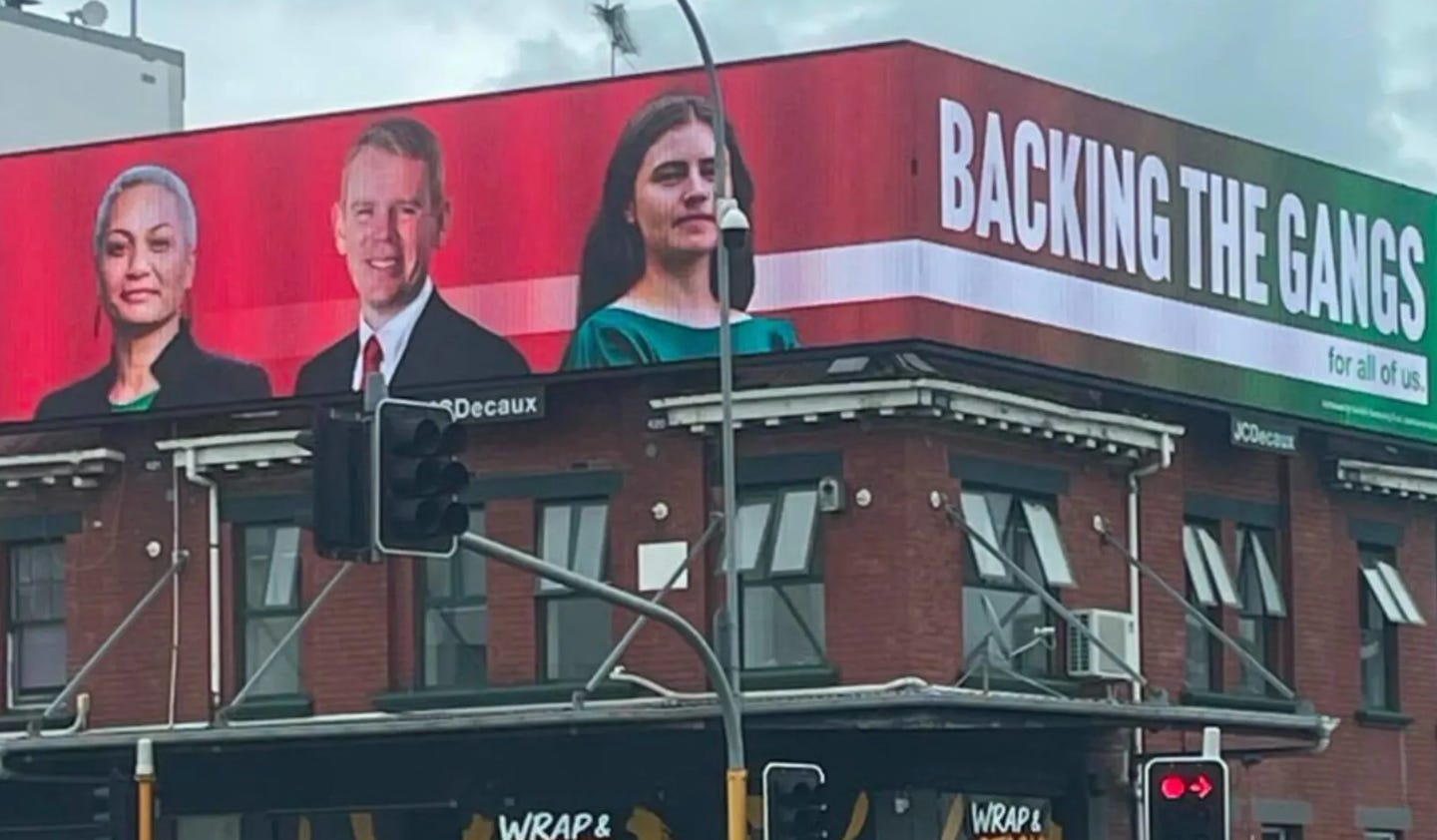
The billboards that went up this week show Chlöe Swarbrick, Marama Davidson and Chris Hipkins under the words “BACKING THE GANGS”, placed above the Greens’ own slogan, “for all of us”. They are the Sensible Sentencing Trust’s ads and, as RNZ’s Lauren Crimp reported today, were created by the Campaign Company, a firm owned by Taxpayers’ Union boss Jordan Williams. The Greens have complained to the Advertising Standards Authority that the ads impersonate their party, and the billboard owner, JCDecaux, has paused them while it reviews the concerns raised. Asked to respond to Swarbrick’s call for him to condemn the ads, a spokesperson for Christopher Luxon simply referred RNZ to the organisation responsible.
They are the latest low in a fortnight of gang photographs, and with 11 days until polling day the story is crowding out almost everything else. It is time for the parties to move on.
Fair questions at the start
The original controversy deserved scrutiny. When Green and Te Pāti Māori MPs and candidates posed, smiling and giving the thumbs up, with Mongrel Mob members at a gang pad gathering described as a whānau, health and wellbeing election hui, voters were entitled to ask about their judgement and about how those parties would deal with gangs in government.
Labour’s own problem was worse. Its Tāmaki Makaurau candidate, Kerrin Leoni, had publicly criticised her opponents’ visit, and when Te Pāti Māori’s Oriini Kaipara accused her in a televised debate of doing the same thing, she denied going to the gang pad. That was technically true, but it left out the fact that she had spoken at a whānau fundraiser in Papakura attended by Mongrel Mob members, wearing a Labour jacket and urging those present to enrol and change the government. Hipkins initially said he was taking her at her word. Once the video emerged, and having already condemned his allies, he had little choice but to accept her resignation.
These judgements were always going to be awkward. Many Māori politicians have whānau in gangs, and today’s editorial in The Post is right that those connections “cannot simply be severed along party lines”. Even so, campaigning at gang events, and being straight with your own party about it, were fair subjects for scrutiny.
The weekend photo war
What followed over Labour Weekend was different in kind. The Otago Daily Times imagined campaign operatives spending the holiday “trawling through the social media feeds of their political opponents” for pictures of them with gang members. On Saturday Stuff published a photo of Tama Potaka with patched Mob members at a Kīngitanga hui in 2024. National’s strategists responded by texting journalists a photo, posted by Harry Tam, of Hipkins with a man Tam says is a gang member. Tam then posted one of Luxon alongside Black Power members at the Crown’s apology to survivors of abuse in care.
Photos of Erica Stanford and Matt Doocey also surfaced. The Post has since reported that National’s Tāmaki candidate, Mahesh Muralidhar, told a youth podcast that a self-described gang member approached him at a street-corner meeting and told him, “I need you to get in.” By Muralidhar’s account, the man drove past, “took a U-turn” and came back to talk to him, and Muralidhar insists it was a plea for law and order and better schools rather than an endorsement. Almost none of these later episodes shows anything improper. As The Post said of the Doocey photo, it is “less evidence of scandal than of a minister doing his job”, and the same goes for a Prime Minister at the state’s apology to abuse survivors.
The ODT put it simply: “context is everything.” It also noted the irony that many of the people in the photographs aren’t identifiable as gang members “thanks to the ban on public wearing of patches introduced by this government.”
Labour must take some responsibility for the escalation. Hipkins set a hard standard to put distance between Labour and its likely partners, and then demanded that Luxon apply it to Potaka, whose case doesn’t come close to meeting it.
National has been more opportunistic still. Last Friday, Luxon’s answer on engaging with gangs was “No, no, no, no, no, absolutely no.” By Saturday, his police spokesperson Mark Mitchell was explaining, in Potaka’s defence, that politicians are photographed with thousands of people and “We don’t know their background.” On Sunday Luxon told a rally, “In two weeks’ time, the gangs will be voting for Labour,” and when asked if there was room for a more nuanced conversation about gangs, replied: “Absolutely not.” As I put it on Newstalk ZB on Monday, Luxon said there was no room for nuance in this debate, and is now finding that there is.
Guilt by association
All of this rests on guilt by association. The Post calls the weekend’s exchanges “something like McCarthyism”, and the comparison has some force. Avoiding gang members entirely, the editorial says, “would demand our politicians ask everyone they meet whether they are or have ever been in a gang.” As Anneke Smith wrote in the Sunday Star Times, in a country this small it makes sense that politicians have “only one or two, and sometimes zero, degrees of separation” from gang members.
Mike Hosking went furthest on Newstalk ZB this morning, declaring that all three parties of the left bloc now, “in some way, shape or form, associate with the gang culture, like and support the gang culture, or are not averse to funding the gang culture.” Hosking might be surprised by National’s own history. As The Press reported this week, Robert Muldoon met 20 to 30 Black Power members at a Wellington tavern in 1976 and carried on the discussion at a gang pad, and in 2009 John Key defended Pita Sharples’ meeting with Black Power and Mongrel Mob leaders.
The billboards
The billboards take the controversy further again. They come from a lobby group, and they borrow a rival party’s slogan to attack it. According to RNZ, the Sensible Sentencing Trust and the Taxpayers’ Union run a shared website called “We can’t afford Labour”, although the Taxpayers’ Union says it did not create these ads and the Trust’s spokesperson insists “We certainly aren’t TPU at all.”
The Advertising Standards Authority partly upheld a complaint about the Trust’s similar “Defund the police” billboards last year, ruling that the advertiser needed to make its identity clearer. The Trust’s response this time: “We’re not going to make any apologies for that at all.” Labour, which also features on the billboard, calls it “nasty and untrue” but says it is unlikely to complain.
Campaigning of this kind deserves public contempt. It comes straight from the playbook Nicky Hager described in Dirty Politics in 2014, and again in Dirty Work this year, in which a nominally independent group does the attacking and the politicians that stand to benefit keep their distance. But it should be pointed out that there is no evidence in this reporting that National or any other party commissioned or coordinated the ads.
A convenient distraction for National
I spend a lot of my time arguing that integrity scandals matter, so I am wary of calling any of them a distraction. But this one is now pushing aside the issues voters care about most. The Post/Freshwater Strategy study found that only 3% of New Zealanders rate law and order or related issues as their top concern. The ODT, borrowing from Bill Clinton’s 1992 campaign, puts it this way: “it’s the cost of living, stupid”.
National has an obvious reason to welcome a campaign dominated by gangs. It gets to question the judgement of a prospective Labour-led government while spending less time defending its own record on household costs, health and the economy. As Thomas Coughlan has pointed out in the Herald, law and order is one of the few policy areas on which the public “unambiguously rates National’s competence over Labour’s”. Even Chris Bishop told supporters in a newsletter, quoted by Graham Adams, that the controversy has “definitely distracted attention from what should be the major focus of the election”, before adding that it has “probably focused attention on just how crazy a Labour/Green/Māori Party government would be.”
It could still backfire on National. Voters worried about rent and power bills may tire of a governing party that would rather talk about other people’s photographs, especially when some of its attacks are so plainly disingenuous. Opportunity’s Qiulae Wong called the exchanges “tit for tat”. And when Leoni resigned, Winston Peters struck a different tone from his coalition partners, saying NZ First would not be “gloating” or “salivating over somebody else’s misery”.
Time to move on
The bigger danger is scandal fatigue. At least 200,000 eligible voters were still unenrolled when the electoral roll closed on Sunday. An election remembered for gang photos and lobby-group billboards risks persuading many of those who are enrolled that politics is a grubby business best avoided, and some of them may not bother voting at all.
The Post’s plea to Luxon and Hipkins this morning is to “quit the gang issue for now, and the quasi-McCarthyism of the weekend, and get back to explaining how they plan to tackle the issues that matter to most.” Both leaders should take that advice, and so should the lobby groups paying for the billboards.
Dr Bryce Edwards
Director of the Democracy Project
In the “Further Analysis” section beneath the paywall below: Kerrin Leoni resigned as Labour’s candidate saying the last thing she wanted was a National government. Three days later she was back in the race. Why her decision is bad news for Labour and the left, why the Māori electorates make an upset possible, what her win would do to the arithmetic of the next Parliament, and why she should tell voters not to give her their electorate vote.
