

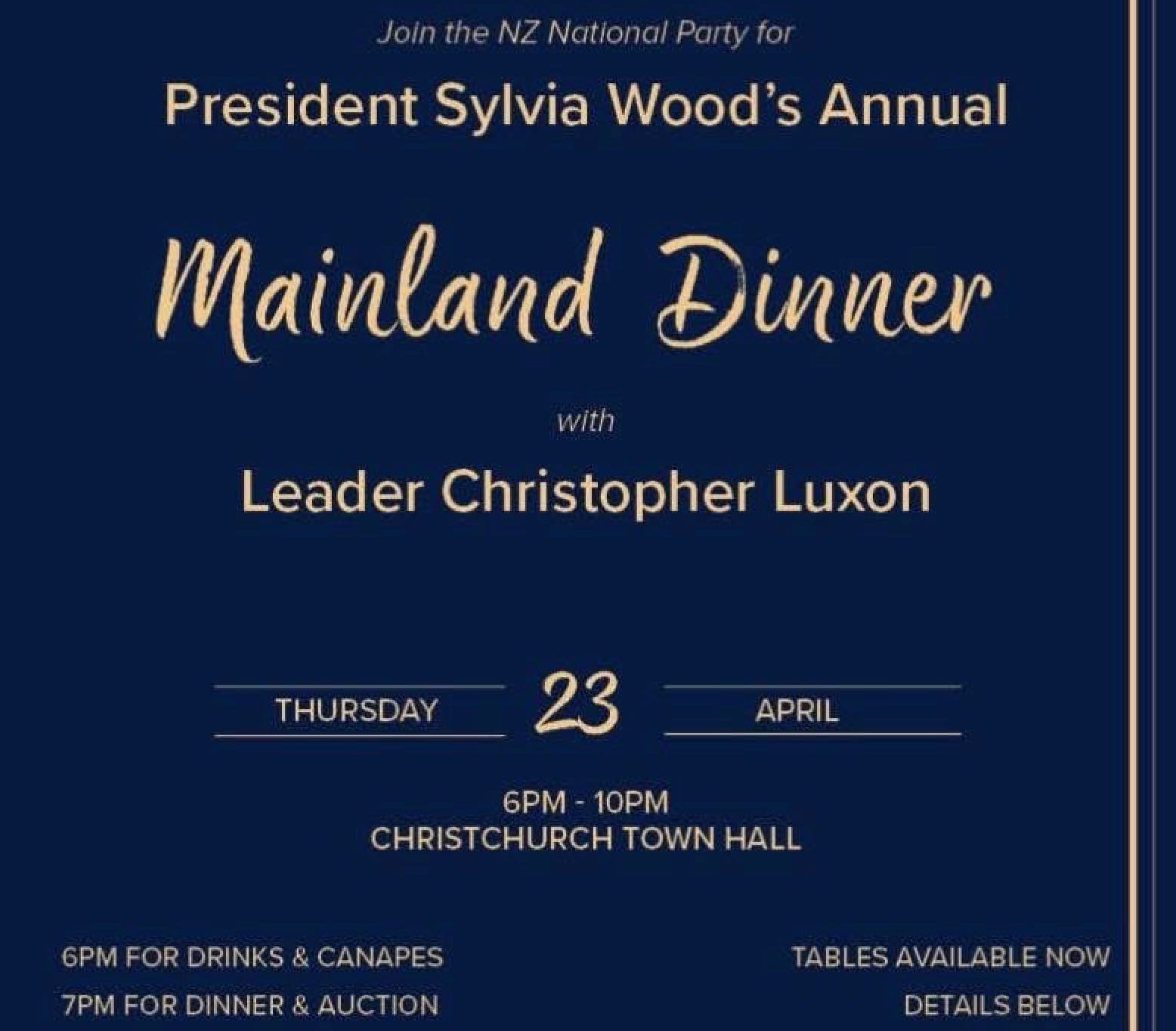
How much does it cost to sit next to the Prime Minister at dinner? In New Zealand, in 2026, the answer is $10,000.
The National Party is holding a “Mainland Dinner” at Christchurch’s Town Hall next month, hosted by party president Sylvia Wood, and the invitation was accidentally posted on Facebook by National MP Maureen Pugh before being swiftly deleted.
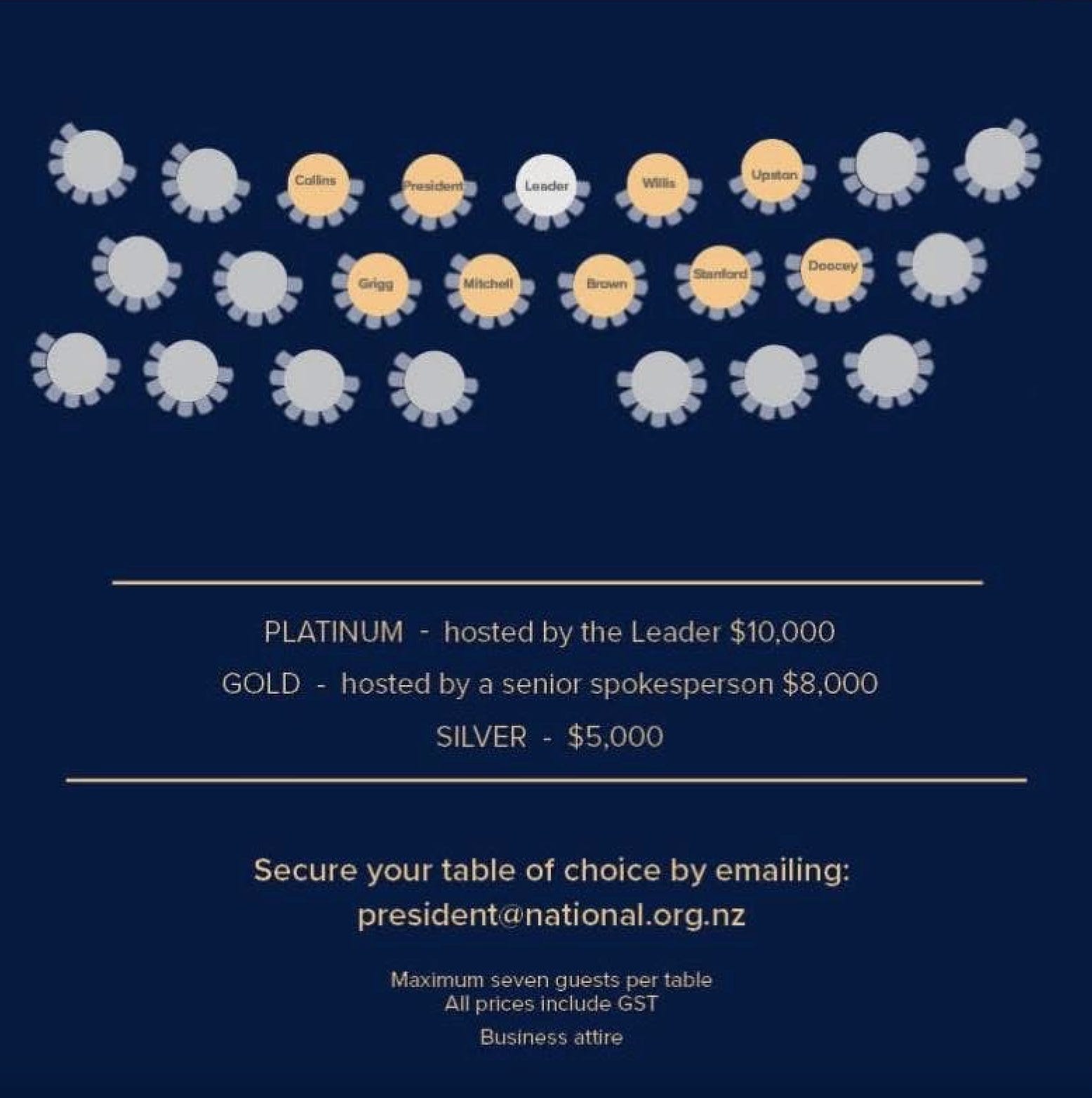
The invitation lays out the “price list for power” with remarkable clarity. For $5,000 you get a seat at the “silver” table. For $8,000, you sit with a Cabinet minister. And for $10,000 (the “platinum” tier) you get Christopher Luxon himself.
So, it’s a seating plan that doubles as a price list for political access. The more you pay, the closer you sit to the centre of power. Six of National’s twelve Cabinet ministers are on offer: Nicola Willis, Simeon Brown, Erica Stanford, Louise Upston, Mark Mitchell, and the outgoing Judith Collins. Ministers Matt Doocey and Nicola Grigg are also attending.
The invitation carefully refers to these figures by their party titles — “leader” and “spokespeople” — not their ministerial ones. That wording matters. Without it, National would be openly selling access to Cabinet ministers, which would cross a constitutional line.
But the distinction is farcical. These people are the Government. Everyone in that room knows it. Calling Christopher Luxon the “party leader” at a $10,000 dinner does not change the fact that he is the Prime Minister. The wealthy donors buying those tables are not paying for the company of a backbencher. They are paying for proximity to the most powerful people in the country.
A Long tradition of cash-for-access politics
Both major parties have been running these events for years. They just prefer that the public doesn’t find out about them.
National’s version used to be known as the “Cabinet Club.” For donations of $10,000 or more, members received exclusive dinners and meetings with Cabinet ministers. It was a literal price list for political access. Labour had its own equivalent, the “President’s Club,” and also ran a “Business Forum” where companies paid close to $2,000 a head to attend events with senior ministers. Different branding, same basic transaction: if you can pay, you get face time with people who make the decisions that affect your life, your business, and your industry.
What makes this latest National dinner notable is not that it is happening. It’s the brazenness of the tiered seating structure. As I told the NZ Herald’s Ethan Griffiths, who broke the story, previous events of this kind have typically charged a blanket fee. Everyone gets the same access. “Whereas in this way, you’re actually getting a visual chart. A map of the power. You get to choose which table you sit at and which minister you get the ear of.”
That’s a significant escalation. The transaction is no longer disguised behind a flat ticket price and a generic “evening with the party.”
The Hat trick
Here’s the constitutional sleight-of-hand: parties pretend ministers are just humble MPs at these fundraisers, “wearing a different hat” per the Cabinet Manual. Your $10,000 fee gets you to chat with the MP for Botany, the Leader of the National Party, not the Prime Minister. The Cabinet Manual requires ministers to keep those roles separate. When they attend party fundraisers, they do so as MPs, not as ministers. They are, in the jargon, “wearing a different hat.”
This is why the Mainland Dinner invitation lists Luxon as “party leader” and his ministers as “spokespeople.” If they were described as “Prime Minister” and “Cabinet ministers,” the event would be an explicit sale of access to the Executive — something that sits uncomfortably, at best, with the Cabinet Manual’s expectations about ministerial conduct. Section 2.105 acknowledges that ministers participate in party fundraising, but the broader framework of the Manual demands that ministers uphold “the highest ethical and behavioural standards” and avoid conduct that creates the appearance of improper influence.
So the parties work around it. They avoid the titles. They describe the events as “campaign dinners.” And they hope nobody notices that the people sitting at the $10,000 table will, the next morning, be exercising the coercive power of the state.
It’s a thin fiction. The wealthy donors in that room are not there because they’re interested in party policy platforms. The attraction is obvious: proximity to ministers who hold real power. Calling it a “party function” does not change what is being sold.
The Public was never supposed to see this
The story only surfaced by accident. Maureen Pugh, a National list MP, posted the invitation to her Facebook page. She quickly deleted it. That tells you everything you need to know about who this event was actually intended for.
My suspicion, which the Herald reported, is that this invitation was meant for a select group of people who could afford to pay, not for general public consumption. These events are designed for the donor class. They are not advertised on billboards or posted on party websites. They circulate through private networks and the business connections of the donor class.
That’s the real problem. This isn’t just a fundraiser, it’s a shadow system: a second track of political engagement that the public never sees. While ordinary voters get a handshake at a public meeting and a leaflet in the mailbox, the people who can make $10,000 payments or donations get dinner with the Prime Minister and a chance to bend his ear about whatever regulatory setting, consenting decision, or tax policy matters to their bottom line.
When a system like that exists but remains invisible to the public, democracy starts to look like a two-tier arrangement. One track for the people who fund politics, and another for the people who merely vote in it.
The Wider fundraising picture
This dinner sits within a much larger pattern of big money flowing into politics in 2026. As I’ve written in previous columns, the coalition parties have already declared $750,000 in large donations this year, dwarfing the opposition parties by a ratio of roughly ten to one. The donors include property developers, gas industry subsidiaries, and wealthy individuals who spread their cash across all three coalition partners on the same day, ensuring they are seen as friends of the Government, whichever minister happens to hold the lever they need pulled.
The Mainland Dinner is not an isolated event. It is a piece of a larger fundraising machine that binds wealthy donors to the parties of Government.
Meanwhile, in the Education Minister’s office…
The blurring of party and state takes another form entirely in a separate story that emerged today. Education Minister Erica Stanford sent an email from her ministerial address to school principals nationwide, urging them to share a video about the Government’s new SMART assessment tool with their teaching staff. The problem is that the video was hosted on the National Party’s YouTube channel.
The link took principals directly to the NZ National Party’s YouTube page, which is the same channel hosting Christopher Luxon and Nicola Willis’s response to the Middle East conflict, clips promoting National policies, and attack videos directed at Labour. At least one principal refused to show the video on the grounds that it came from a party platform rather than the Ministry of Education.
Stanford’s office called it “human error.” The video was taken down after the Herald made enquiries. A new email with the correct link was promised to be sent.
The ‘human error’ explanation may be true. But the mistake is still revealing. It shows how easily party material and ministerial channels can bleed into each other. So this is not an isolated incident in a political context where the line between ministerial communication and party communication is constantly blurring. Ministers use both parliamentary and ministerial resources. They produce videos, send emails, launch communications campaigns – all ostensibly for government purposes, but operating in an environment where the ministerial email lists, videos, staff time, and official communications and the party infrastructure increasingly overlap.
The Fading line between government and party
The Stanford video sits alongside the Mainland Dinner as an example of a broader integrity problem: the line between the party and the state is becoming dangerously blurred.
I’ve written at length this year about the use of parliamentary and ministerial resources for what amounts to electioneering. National MPs have been running a blitz of taxpayer-funded billboards and online ads. Paid content on the Stuff website has been formatted to resemble news articles, complete with editorial-style typefaces and layout, distinguished only by a small “Brand Content” label.
The Stanford incident is a more direct breach — a ministerial channel used to distribute party content to schools — but it sits on the same continuum. When ministers and their offices treat state infrastructure as an extension of the party apparatus, whether through uploaded videos, taxpayer-funded advertising, or ministerial email lists used for party purposes, then governing and campaigning become the same thing
This is not unique to National. For example, Labour spent $260,000 of parliamentary budget on Facebook and Instagram advertising in the first half of 2023. But the fact that it’s a bipartisan disease makes it worse, not better. It means the people who could reform the system are the very people who benefit from it.
What this says about New Zealand democracy
Look at these incidents together, and the pattern is unmistakable. Wealthy donors pay $10,000 for dinner with the Prime Minister, and the public only finds out because of a careless Facebook post. A minister’s office sends a party video to every school principal in the country using a Government email list. Taxpayer money funds billboards and online ads that are functionally indistinguishable from campaign material.
None of this is illegal. But all of it undermines public trust.
Nobody is passing brown envelopes under the table. They don’t need to. The system works perfectly well in the open. It seems that the rules have been written loosely enough that everyone can claim to be operating within them. The winners of this system are the parties already in power and the donors who fund them. The losers are ordinary citizens who are shut out of these arrangements and who, most of the time, don’t even know they exist.
Political fundraising needs better regulation. Cash-for-access events should be disclosed, with attendee lists and ministerial participation made public. The use of parliamentary and ministerial resources for partisan purposes needs a genuinely independent watchdog with real enforcement powers. And the Cabinet Manual’s distinction between ministerial and party roles at fundraising events needs either to be taken seriously or abandoned as the fiction it so plainly is.
Until then, the message from the Mainland Dinner is clear: if you’ve got $10,000, you get the ear of the Prime Minister. If you don’t, you get a pamphlet in the mail.
Dr Bryce Edwards
Director of the Democracy Project
Further Reading: