

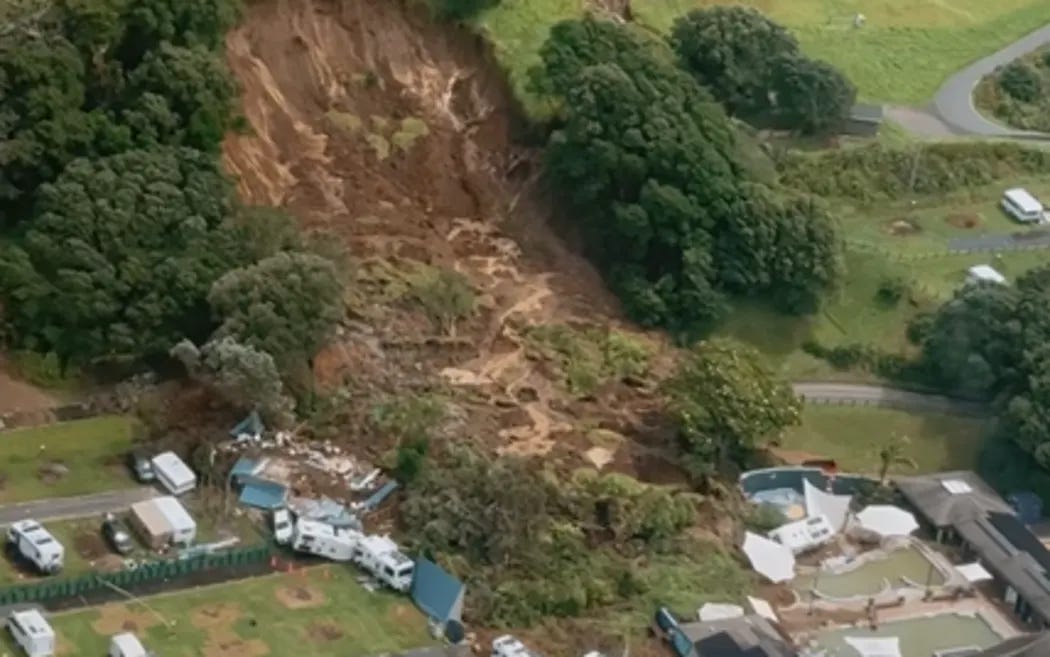
The search for bodies at the foot of Mount Maunganui is still going on, but the mood has clearly shifted. In the first 24 hours it was all shock and grief. Now, as more details emerge about what happened at the Beachside Holiday Park, shock is turning to anger, and with that anger comes politics.
There always comes a point, after a “natural disaster”, when someone says that it is “too soon” to ask hard questions. The Post’s editorial today predicted this perfectly: “There will be some who say it is too soon to talk about climate change while the search for bodies is ongoing. They will say the commentary is ‘politicising’ the tragedy. But the reality is that rather than too soon, it may be too late.”
That line will annoy people. But it’s still true: disasters are political, because the risks were set by decisions made long before the rain arrived. Such disasters are political because they occur when weather collides with decisions about land use, infrastructure, safety regulation, emergency management, and, increasingly, climate policy. When people die, the question is not whether politics is involved, but whose politics has been quietly shaping the risks in the background.
What happened at Mount Maunganui – and why the anger is justified
By now the basic outline of the Mount Maunganui disaster is clear. Around 9.30am on Thursday, after a night of record-breaking rain, a huge slip tore down the side of Mount Maunganui (or Mauao), smashing through the Beachside Holiday Park and burying at least six people. A child and his grandmother were killed in a separate landslide in nearby Pāpāmoa.
Officials have repeatedly described the event as “unprecedented”. It was certainly catastrophic. Tauranga recorded 198mm of rain in 12 hours – two and a half months’ worth, and the city’s wettest night on record. But “unprecedented” is doing a lot of political work here.
Because the signs were there, both in the long-term science and in the hours before the hillside gave way.
The Post newspaper’s detailed reconstruction by Mike White and colleagues today lays this out starkly: “the signs were there of a looming catastrophe”. A July 2025 landslide study, commissioned by Tauranga City Council and prepared by WSP, used detailed terrain mapping to identify high‑risk slopes on Mauao. The mountain was the case study for the wider project, and the report “clearly flagged the danger across Mount Maunganui”.
Yet for some reason, the mapped hazard boundary stopped at Adams Ave, just short of the holiday park. As The Post reports, experts suggest this was “likely because there are no permanent properties there requiring LIM notices”. In other words, because there were tourists rather than ratepayers, the risk effectively fell off the map.
The history of instability on that slope was not unknown. A 2014 scientific paper mapped landslides on Mauao back to 1943, including a major slip in 1977 in almost the same area behind the campground and hot pools. Andrea Vance notes that this long record of instability was precisely why the council started its city‑wide landslide mapping in 2023.
So this was not an invisible risk suddenly materialising out of nowhere. It was a known hazard, at a known site, in a week when MetService warnings and climate scientists alike were shouting about the severity of the incoming storm.
Then there are the hours immediately before the tragedy.
Residents describe a smaller slip around 5am that was serious enough to wake campers. Tauranga Mayor Mahé Drysdale now confirms there were reports of a small slip “from as early as 5am”. Local man Alister McHardy told the Herald he saw two big slips before 6am on the Maunganui Beach side, rang 111 at 5.47am to try to get campers and walkers evacuated, and was told to “talk to the council”. He started waking people up himself.
Another local, Colin McGonagle, was on the track above the campground around 7.45am and saw what the Australian Geomechanics Society would classify as textbook “telltale signs” of an active landslide: groundwater rushing through a wall of mud, trees already down, fresh soil that “came over about half an hour ago.” He warned a camper family that “this isn’t good”.
Campers themselves were uneasy. Auckland woman Karyn Henger, who fled with her teenage son, told the Herald she was “angry… because there are people that are not going to come out alive, and we could have been among them as well. Where were the campground staff? Where were the council? Where was anybody to warn us that we needed to get out of there?”
She expected staff would at least have spoken to guests on Wednesday morning, when it was obvious the rain was going to get worse: “When you’ve got families camping at the base of a mountain, you need to take responsibility for their safety.”
Despite this chorus of warnings, the only decisive official action on Thursday morning was at 8.56am, when the council announced the closure of walking tracks around the mountain because severe weather had “significantly destabilised the maunga, creating an ongoing risk of further slips and falling debris”. Yet there was still no order to evacuate the campground or the neighbouring hot pools. Half an hour later, the fatal slip came down.
This is why, as Tom Peters writes, “shock and grief” are “already turning to anger”, and why “critical questions are being raised” about why campers “were not evacuated despite severe weather warnings being issued well in advance”.
The ritual of reviews – and the politics of blame
Faced with this timeline, politicians have reached for a familiar script. Luxon, asked on site why campers were not evacuated after the first slips, replied that these questions would be answered after a “proper process”. The mayor likewise announced an “independent review” to establish “the facts and events leading up to the landslide” and to “ensure that in the lead‑up to this tragedy, everything was done that was appropriate”.
Reid Basher, an expert on disaster risk governance, has warned us about exactly this pattern. After every disaster, he notes, inquiries tend to “take a close‑focus approach and be preoccupied with finding out where laws were broken and who may have failed in their accountability. Too often the finger points at hapless, mid‑level functionaries who were tasked with too many responsibilities and provided with too little funding.”
He invites us to imagine an inquiry that instead “unveils the trail of accountability that reaches the very top”, exposing the “longstanding inadequacies in political commitment, laws, policies and public investment on disaster risk and its management”.
Tom Peters is more blunt about the likely purpose of the announced review: “Like countless other official inquiries following such tragedies, its purpose will be to make a show of ‘learning the lessons’ while deflecting calls for accountability.”
This is not cynicism for its own sake. It reflects long experience of how power protects itself after disasters. The real decisions that put hundreds of people in harm’s way – to allow a campground at the toe of a known instability; to draw hazard maps around ratepayer properties but not around tourists; to underfund local government and Civil Defence; to leave climate adaptation to a fragmented patchwork of councils – are all political. But they tend to sit beyond the narrow remit of post‑disaster investigations.
If the Mount Maunganui review follows the usual script, it will focus on who wrote which email at 4.57am and whether the right phone number was called at 5.47am. Those operational failings matter, but they sit inside a political and regulatory system that made such a failure almost inevitable.
Climate change as the backdrop politicians won’t name
The other way politics is being carefully fenced off is through the treatment of climate change.
The Otago Daily Times editorial today put it bluntly: “we need to stop and ask – yet again – why such tragedies are happening.” New Zealand has always been hazardous, but we now sit “at the junction of where our changing climate and its more extreme weather clashes head‑on with human habitation and activities”. Yet governments still “carry on much as normal”, watering down climate policy while flying around in helicopters, apparently bewildered at what could possibly be causing the damage.
James Renwick has been crystal clear. Dealing with climate change, he says, is not a “cost to the economy” but an investment; if we do not make it, “the future cost is going to be huge and, ultimately, it’ll be overwhelming. It will destroy our economy.” Kevin Trenberth points out that record ocean heat is loading the dice, making storms “more common and more extreme”. The Post’s editorial calculates that last week’s rainfall in the Bay of Plenty would have been 15–20 per cent less intense without global warming, and the most intense bursts 30–40 per cent lower.
Yet when Christopher Luxon gave his State of the Nation speech, “climate change” did not rate a single mention, while “economy” or “economic” appeared 18 times. The ODT calls this out as delusional politics: a speech “about wanting to ensure the best possible future for Kiwis” that “completely ignored the most pressing issue”.
Max Rashbrooke notes that media coverage is still reluctant to join the dots either. Journalists in the field focus rightly on human stories; editors, he says, are “mindful of not being seen to push an ideological stance”. The result is that, even when floods and slips are obviously supercharged by climate change, “you will find few mentions” of it. But the link between climate change and severe weather is “simply the scientific consensus”. Not raising it is, in its own way, a political decision.
As Rashbrooke argues, connecting this week’s floods and landslides to a government that is “failing calamitously on carbon reduction” is not “exploiting a crisis”; it is “simply telling the truth”. The Government’s current plan leaves us tens of millions of tonnes short of our own emissions targets. That shortfall turns into storms, slips, evacuations and funerals down the track.
Disaster as the price of our development model
Basher talks about “the deadly combination of climate change and ongoing exploitative or thoughtless land‑use”. That phrase captures the wider pattern that ties Mount Maunganui to the rest of this summer’s disasters in Northland, the Coromandel, Tairāwhiti and beyond.
We keep building and rebuilding in floodplains and at the base of unstable slopes. Councils, under pressure to grow their rating base and keep rates down, open up marginal land. Central government refuses to fix the chronic underfunding of local infrastructure or to set a serious, nationally coordinated framework for climate adaptation. Renwick has been calling for such a framework, instead of the current piecemeal council‑by‑council approach.
When storms come, ministers reassure us that “we have been aware that it’s coming” and that the country is “well prepared”, as Mark Mitchell told RNZ listeners the night before the Mount Maunganui slip. Local states of emergency supposedly give officials “the power to move people to safety”. And yet, as Peters points out, no one moved the hundreds of people camping directly below a sodden, historically unstable hillside.
Afterwards, we call it a “natural” disaster, even though both halves of the equation – the intensity of the weather and the exposure of people and assets to harm – are strongly shaped by human choices.
Tom Robinson, an expert in disaster risk and resilience, reminds us that, since European settlement, landslides have killed more people in New Zealand than earthquakes. Slips “take lives one or two at a time, often in places people think are safe.” That last phrase should haunt the political class. People at the Beachside Holiday Park did think they were safe. They assumed someone had properly assessed the risks of putting a campground there. They assumed that if the ground above them started moving by 5am, the authorities would not still have them in the firing line at 9.30am.
Those assumptions were not met. That is politics.
Too late to say ‘too soon’
Some will insist that we should wait quietly for the official review. That it is ghoulish or opportunistic to ask hard questions while families are still waiting for news. But the question is not whether we talk politics; it is whose politics gets a free pass.
It was not considered “too soon” for Luxon to use his State of the Nation speech – delivered as storms were already unfolding – to centre his preferred economic narrative and ignore climate. It was not too soon for governments of both colours, over decades, to deregulate land use, cut back civil defence capacity, and drag their feet on emissions reduction. Those were political choices made entirely on their own timetable.
The Otago Daily Times editorial suggests it is “finally, definitively, time” for governments to “wake up and realise climate change is the most important issue facing us all.” It even throws down a challenge to Labour, noting that National plainly will not lead on this: “It would be refreshing to see one of the larger political parties place climate change at the top of its election agenda. We already expect that from the Green Party, although it has allowed itself to be diverted into other matters. National clearly isn’t going to. But how about it, Labour?”
This is the deeper democratic question beneath the rubble at Mount Maunganui. Are we content with a political class that treats each new “unprecedented” event as an act of God, to be followed by a forensic but narrow inquiry and then a return to business as usual? Or do we demand what Basher calls a “trail of accountability that reaches the very top” – through council chambers, corporate boardrooms and Cabinet – and a fundamental reset of how we plan, build and govern in a warming world?
If we choose the first path, then “shock turns to anger” will become a permanent part of our summers. If we choose the second, then this tragedy might, in some small way, help force the changes that could prevent the next one.
Either way, pretending that disasters like the Mount Maunganui landslide are apolitical is no longer credible. The politics is already there. They are there in the hazard maps we draw, the campgrounds we allow, the budgets we cut, the emissions we keep pumping out. The only question is whether we are prepared to name it, and to hold those responsible to account.
Dr Bryce Edwards
Director of the Democracy Project
Further Reading:
