

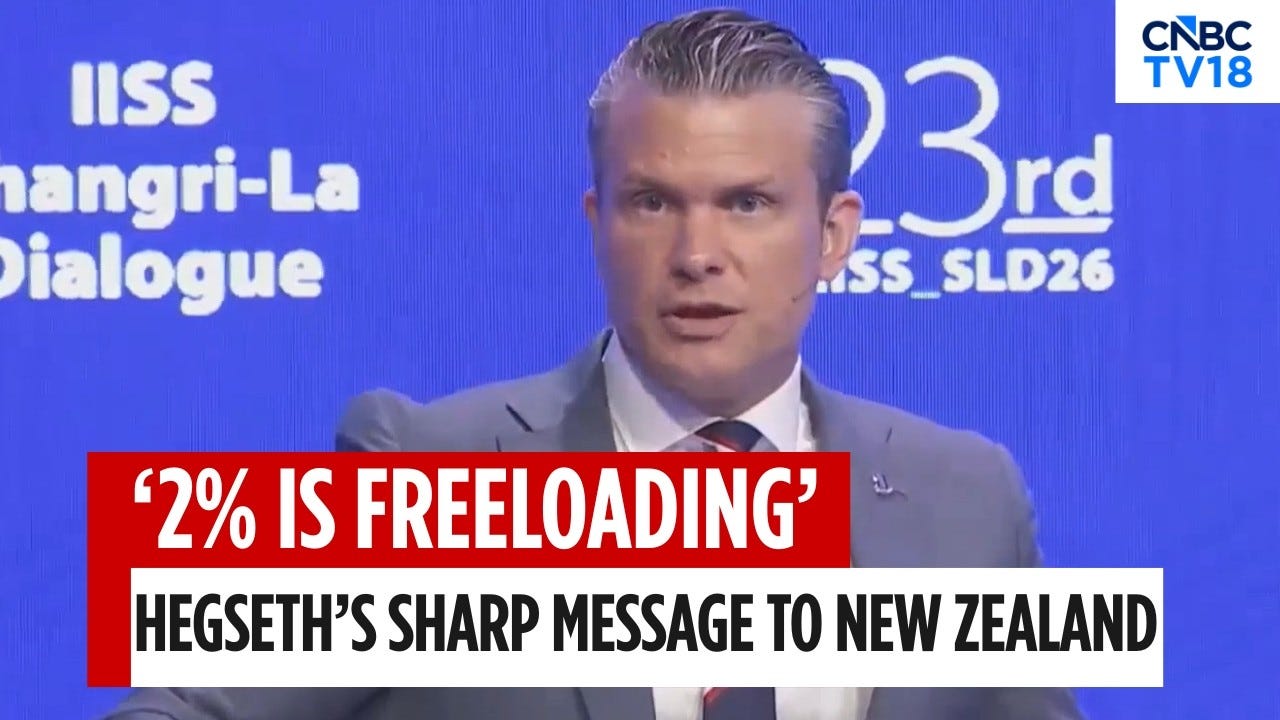
In a Singapore hotel ballroom this week, New Zealand’s defence debate was handed a new insult: “freeloader”. It came from US Defence Secretary Pete Hegseth, after New Zealand journalist Anna Fifield asked whether this country’s plan to lift military spending from 1% to 2% of GDP made us a “free rider.” Hegseth did not bother with diplomacy: “2 percent is not enough, and so 2 percent is freeloading.”
He went further. “You better have the same capabilities that we do,” he warned, “because if we don’t, our alliance is meaningless.” Earlier, in his set-piece address, Hegseth had told the region that spending 3.5% of GDP on defence should be treated as a “new global norm,” and that the US would no longer tolerate allies treating defence as “an afterthought.”
The Defence Minister Chris Penk, sitting in the front row, pushed back politely, insisting New Zealand was no freeloader and that “the trajectory mattered.” But the framing was already set. For days the question being asked across New Zealand media has been: how does the country prove it is not a freeloader? That is precisely the wrong question, and the more interesting one is who gets to decide what New Zealand’s security is worth, and on whose terms.
The insult that set the agenda
The revealing thing is how quickly Hegseth’s number became our problem. Hegseth’s 3.5% figure is not a strategic assessment of any threat to New Zealand. As Fifield herself reported, no country in the Asia-Pacific currently spends that much, according to data compiled by the International Institute for Strategic Studies. It is an aspiration, a number plucked to signal seriousness, and one that conveniently expands the market for American military hardware.
Even those in favour of spending more were unconvinced by Hegseth. Professor David Capie, director of Victoria University’s Centre for Strategic Studies, told The Post that Hegseth’s speech was “predictably transactional,” and that the freeloading comment “amounted to a storm in a tea cup.” “It’s no secret Washington wants all its partners to spend more on defence,” Capie said, “but he didn’t have New Zealand in his sights. The messaging from the bilateral meeting afterwards was all very warm.”
The Otago Daily Times, in a measured editorial today, conceded the charge had a sting of truth: “New Zealand’s defence has always, and will continue to be, dependent on others”, but concluded that pushing toward 3.5% would be “a whole other question entirely” in a country facing no obvious enemy and with “little appetite to be drawn into conflict.” New Zealand is not Poland. It is not Taiwan. It is not Ukraine.
None of this is to say New Zealand needs nothing. But Hegseth’s number measures loyalty, not need. Defence spending here is no longer just about what the country requires to look after itself. It is increasingly about what New Zealand must pay to remain respectable in the eyes of Washington, Canberra and London.
The language of defence has shifted. We are no longer simply discussing patrol boats, maritime surveillance, disaster relief, peacekeeping, fisheries protection or the ability to get people out of danger in the Pacific. We are talking about “interoperability”, “lethality”, “deterrence”, “integrated forces”, “advanced technologies”, “strike capabilities”, drones, missiles, space systems, AI and military-industrial partnerships.
Who is the real “hegemon”?
The sharpest rebuttal to Hegseth came from an unexpected source. Don Brash (former National Leader and former Reserve Bank Governor) is not a man usually accused of anti-American radicalism. Yet he took aim at the heart of Hegseth’s pitch. In his speech, Hegseth had declared the US “willing to work with all of you to ensure a Pacific free of any hegemon.”
Brash was incredulous: “How in hell’s name did he make such a statement with a straight face?... There is a hegemon in the Pacific right now, and it ain’t China!” He set out the asymmetry plainly: China, to the best of his knowledge, has one military base outside its own borders (in Djibouti) while “the US has military forces in South Korea, Japan, Guam, Palau, the Philippines, and Australia — and of course in hundreds of other bases around the world.”
Brash’s conclusion was not that New Zealand should spend nothing. “Should New Zealand increase its defence spending? That probably makes sense,” he allowed, citing the policing of a vast maritime zone against drug-runners and illegal fishing. But, he wrote, “spending 3.5% of GDP on defence would be nuts in current circumstances — and even more inexcusable if doing so implied we wanted to be in a military alliance with the hegemon of the Pacific.” That matters. It is much harder to dismiss this as leftwing anti-Americanism when the person saying it is Don Brash.
No enemy at the gate
So who, exactly, are we arming against? China is the implied answer, but it is rarely stated plainly. That is a problem. If the Government wants a generational defence build-up, it should be honest about the scenario it is preparing for.
Even the hawks struggle to name an invader. The former National defence minister Wayne Mapp, Minister of Defence from 2008 to 2011, argued that New Zealand’s geography “should negate the need” to spend at the level Hegseth demands.
“There’s no actual invasions like Ukraine or anything like that in our region,” Mapp told Newstalk ZB. “The pressures are different.” He went on: “New Zealand is also the most secure country in the entire planet … We’re further away from any other country. You would expect us to take at least some advantage of that fact.” Mapp does say he accepts that capability has not kept pace with the country’s growth, and that “we do need to step up” — but his benchmark is Australia, the only formal ally, not a number set in Washington.
There is also a more prosaic problem: New Zealand can buy equipment faster than it can rebuild a Defence Force. Capie warns that the binding limit is people, not platforms: last year’s Defence Capability Plan envisaged growing the Defence Force by 2,500 personnel, which he calls “a huge ask.” “We spend a lot of time talking about the need for new planes or ships,” he said, “but they are not much use unless you have the skilled personnel to operate them.” That warning is backed up by the recent frigate leaking oil into Akaroa Harbour, the tanker HMNZS Aotearoa sidelined for 139 days by contaminated fuel, and the HMNZS Manawanui driven onto a reef off Samoa. A spend-up that cannot crew or maintain what it already owns is its own kind of waste.
Follow the money
The freeloader debate is a democracy story. New Zealand is in the middle of the largest military build-up in a generation: a $12 billion Defence Capability Plan, and a further $1.6 billion in the latest Budget for drones, ship maintenance and naval upgrades, on a stated path to 2% of GDP. Penk calls that figure “a floor, not a ceiling.” That should have rung louder alarm bells than it did. Yet the public debate about whether any of this is necessary has been thin to the point of invisibility.
That vacuum is not accidental. As the writer Samuel Hume documented in the Australian journal Arena, New Zealand’s Defence Industry Strategy, which Hume shows closely resembles Australia’s, is explicitly designed to plug local firms into the supply chains of “multi-national Defence suppliers.”
The industry has not been waiting politely outside the door. Iron Duke Partners, the lobbying firm run by Phil O’Reilly, has promoted the defence budget as “a big opportunity…” while the New Zealand Defence Industry Association has secured “workshops” with officials before the capability plan was even released
And then there is the old-fashioned schmoozing. As I covered last year in the column, Democracy Briefing: Gifts, Graft, and a $12bn defence spend-up, an Auditor-General’s inquiry found that between 2016 and 2025, Defence Force personnel accepted more than 2,500 gifts and hospitality offerings from commercial suppliers — worth close to $419,000 — including international sports tickets, days on America’s Cup yachts, concert passes and smartwatches. Nearly 80% were justified as “building business relationships.” The Auditor-General, John Ryan, warned that “the practices we have seen … risk the public and Parliament losing confidence in the decisions made to contract with those suppliers.”
Then there is the revolving door. Air Marshal Kevin Short moved directly from Chief of Defence Force to Managing Director of Lockheed Martin New Zealand — one of the suppliers angling for the contracts now on offer. With billions on the table, the firms doing the lavishing are the firms doing the bidding. None of this proves that a contract was bought. That is not the point. The point is that the people selling the hardware have had years to build relationships with the people buying it. And now the bill is enormous.
The rest of this column is for paid subscribers, whose support keeps the Democracy Project going. It looks at Aukus by stealth, Pacific opposition to militarisation, the defence industry’s interests, and the choices now facing New Zealand
