

“Thought Covid was bad? If New Zealand runs out of diesel, Covid will look like the rehearsal.” That line from Matthew Hooton in the Herald this morning lands like a slap. Not because it’s designed to alarm, but because Hooton is making a precise argument, not a rhetorical one. During the pandemic, the circulatory system of the economy kept pumping. He explains today that trucks still delivered to supermarkets, harvesters still picked crops, milk tankers still collected from farms, and ambulances still ran. None of that is guaranteed now.
The Government today released the details of its National Fuel Plan — the alert-level framework for managing any move towards rationing. That is the right thing to do. But the real question is whether this Government, and the political class more broadly, has actually grasped the scale of what may be heading our way. There are growing signs it hasn’t.
The Delusion of distance
One of the most enduring myths in New Zealand politics is that geographical isolation is a form of protection. Hooton’s takedown today is brutal. He lines up Christopher Luxon’s boast that New Zealand was “incredibly well positioned” alongside Chris Hipkins’ claim during Covid that we would be “at the front of the queue” for vaccines. Different eras, but it’s the same instinct of Kiwi self-delusion.
The reality, as Hooton argues, is the reverse: “Being the last station on the southern line makes New Zealand more vulnerable to disruptions to supply lines, not less.” We are not a big enough economy for anyone to prioritise us when the queue forms.
According to Hooton, Australia gets this. Canberra is using its leverage in coal and iron sands to push to the front of the queue for diesel and petrol. Hooton describes it in brutal terms: “You want coal? Then gizza your diesel.” According to reporting in BusinessDesk today, Australia has already secured fuel shipments from the US Gulf — the most shipped from there in a single month in more than three decades.
Murat Ungor, a Senior Lecturer in Economics at the University of Otago, has described New Zealand’s exposure as “double”: higher global prices, and the risk of delayed supply, because the refineries in Singapore and South Korea that supply our fuel depend on crude oil that travels through the Strait of Hormuz. The closure of Marsden Point in 2022 stripped away the last buffer between us and that exposure. We now import every litre of refined fuel we use.
The problem is diesel, not petrol
Too much of the political conversation has been about petrol prices. That misses the point. Diesel is the crisis. And diesel shortages are going to be more than just inconvenient or expensive.
Associate Energy Minister Shane Jones has been appropriately blunt, telling Newsroom: “A shortage of diesel would literally bring the economy to its knees”. On CNBC, he put it plainly: “You cannot have a food industry, you cannot have a forestry industry, you cannot have a fishing industry, you cannot have a horticultural industry unless you’ve got significant security and robustness about diesel supplies.”
Luisa Girao’s reporting from rural New Zealand this week conveys the pain and problems. A North Canterbury cropping farmer burning 1,500 litres on a typical harvest day, a bill that has more than doubled in weeks. A Reefton construction business owner describing his situation by saying he was “just sitting in the corner crying.” A North Canterbury farmer: “We’ve already taken all the fat out of the system. There’s nothing left to cut.”
Transport Minister Chris Bishop told an Infrastructure NZ conference in Auckland yesterday something that politicians rarely say: “It’s a scary prospect and I’m not 100 per cent sure the public have quite worked it out yet” – as reported by Dileepa Fonseka for BusinessDesk. Bishop added: “We do not want to get into a situation where the worst arrives, and we are doing everything that we can to make sure that doesn’t happen, but the reality is, it could happen.”
Politicians do not normally say things like that. When a minister says the reality is that the worst could happen, and the public hasn’t yet understood, that is a significant admission. It suggests the Government privately understands the situation more clearly than its public messaging has indicated.
Bishop also let slip something quietly extraordinary about the Government’s signature transport policy. Asked whether the fuel crisis would affect the Roads of National Significance programme, he conceded: “To fully fund the 17 roads of national significance requires putting up petrol tax by 70 cents a litre. It’s not going to happen, is it? It wasn’t going to happen anyway, certainly isn’t going to happen now.”
Supply chains people haven’t thought about
Thomas Coughlan has reported something that has not received nearly enough attention. Health Minister Simeon Brown is seeking advice on the supply of helium — which is essential for MRI machines, because liquid helium cools the superconducting magnets that make scanning possible. Between a quarter and a third of the world’s helium comes from Qatar’s Ras Laffan facility, which has been struck. That supply has dried up. MRI scans are a frontline tool in cancer diagnosis. If helium runs short, cancer care gets delayed. This is no longer a hypothetical.
Then there is what Jonathan Milne’s Newsroom reporting revealed from the trucking sector. The Wareing Group, a major South Island logistics operator with 270 drivers, has been hitting fuel outages since Tuesday. Truck stops in Taupō, Sanson, parts of Christchurch, Ashburton, Oamaru, and Winton have been running dry. The company is paying $10 million more than it expected for fuel.
Z Energy chief executive Lindis Jones agreed the crisis demands something approaching wartime cooperation between business and government. “I heard it described as the biggest energy shock in the history of the world,” Jones told Newsroom. “It certainly feels like it.”
These supply-chain risks extend further than most people have considered. The Strait of Hormuz carries significant volumes of Fertilizer. Higher fuel costs plus higher Fertilizer costs are squeezing farm margins from both ends simultaneously. Food prices will follow.
Is the Government doing enough?
On the evidence so far, no. But it’s not all bad, and it’s worth saying where they’ve got things right
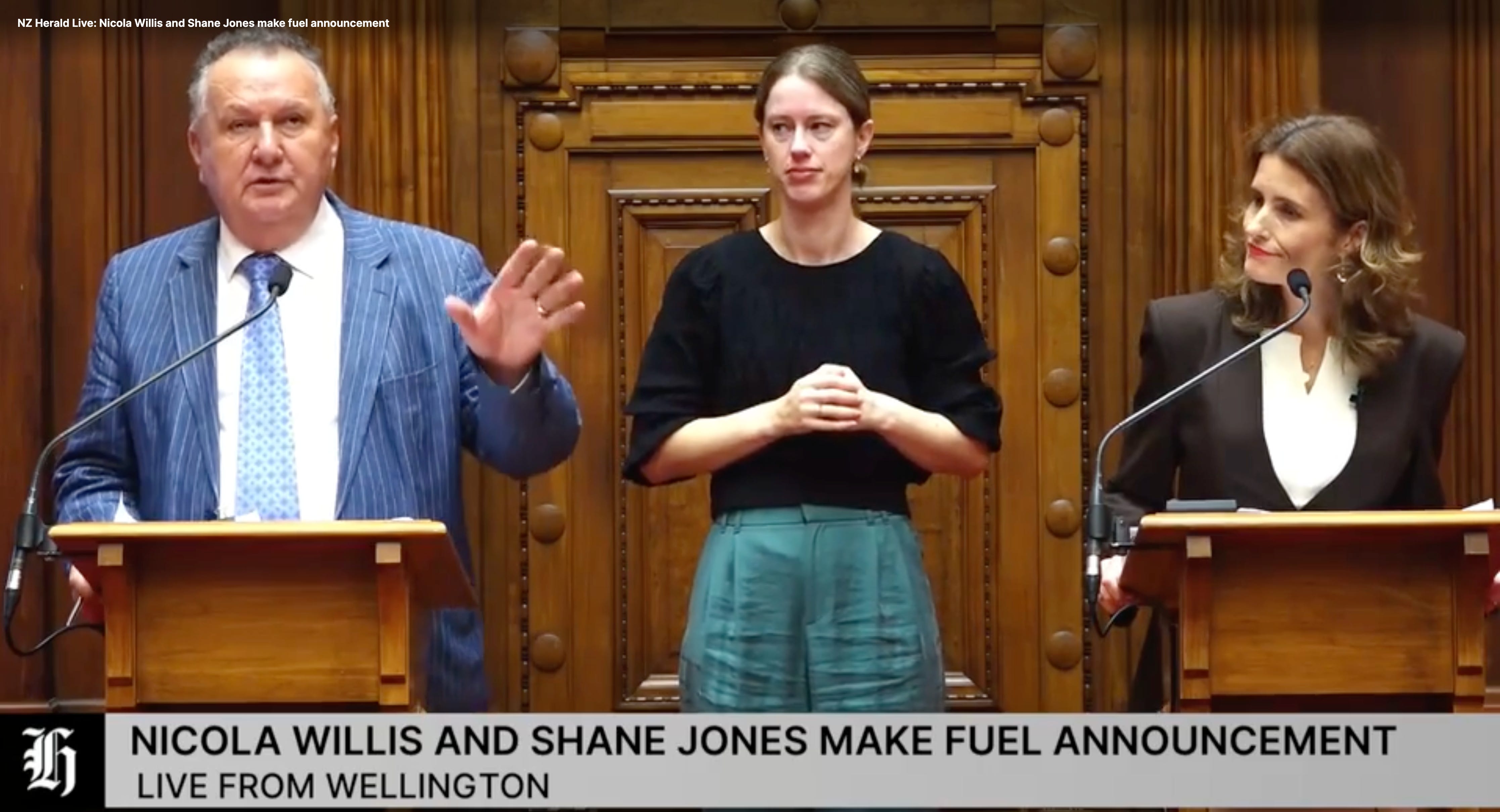
The Government has moved on fuel specifications, aligning them with Australia’s to broaden supply options. The National Fuel Plan announced today is the kind of infrastructure that should have existed before any crisis arrived, but at least it exists now. And in making their announcement today, Willis and Jones exuded confidence and proficiency (in a way that their bosses, Luxon and Peters, probably couldn’t have).
Nicola Willis has shared data, acknowledged uncertainty, and avoided the “everything is fantastic” style that often characterises this Government’s economic messaging. Hooton praised her earlier in the week, noting she “has discussed matters concerning global supply chains better than Luxon ever could, despite his professed background in logistics.”
Audrey Young, in her Herald politics newsletter yesterday, concluded the Government “hasn’t put a foot wrong” on the mechanics: the specification changes, the diplomatic outreach, the targeted relief. But she also flagged the persistent bug: Luxon’s “repeated claims that fuel stocks are healthy.” The Government has not wanted to produce panic, but “painting the picture as rosy is close to misleading,” Young writes
Janet Wilson, writing in The Post, was more generous, arguing Nicola Willis has emerged as the de facto crisis leader, projecting authority while Luxon’s own political standing has taken a hit. Wilson drew the comparison to Jacinda Ardern’s Covid crisis management.
This Government has leaned heavily on reassurance. Its instinct has been “keep calm and carry on.” And there is a logic to that, because nobody wants panic buying to drain stocks faster. But there is a difference between managing public communication responsibly and downplaying a crisis.
Gordon Campbell put his finger on it. The Government is “talking optimistically, while trying to ease the public gradually into a sense of crisis.” He called the current mood a “phoney war”: war declared, but the real shocks not yet fully landed. The messaging, he suggested, amounts to “Panic yesterday and panic tomorrow, but not today.”
That is a rational short-term strategy. It is also, depending on how this unfolds, a recipe for a credibility collapse.
Hooton’s challenge: Act now, and act hard
Hooton’s core argument is not a critique of competence in managing spreadsheets and communications. It is a challenge about scale and speed.
He wants diesel rationing now, while it might still make a difference. He wants the Government to behave like a state in an emergency rather than like a market-respecting coalition that is allergic to the optics of another Ardern-style intervention. He draws the Covid parallel explicitly: “Just as it would have been better had Jacinda Ardern acted against Covid in late February or early March rather than wait, the sooner tough measures are taken, the better off we will all be.”
His more provocative proposal involves food. New Zealand has something other countries want. Hooton suggests Luxon should be using that leverage with counterparts in Singapore, South Korea and Malaysia: “We’ve got food, and if you want some, your money’s no good here — the price is diesel, jet fuel and petrol.” He acknowledges this would require “some sort of state control over international trade that we haven’t seen since 1984.” But, he argues, the scale of the potential crisis justifies it.
The timeline matters here. Hooton cites prediction markets giving the Strait only a one-in-three chance of reopening by the end of April, odds that don’t improve much beyond that. He says: “FuelClock.nz that indicated New Zealand had just 14 days’ supply of diesel onshore, plus another seven days confirmed as on its way” and “New Zealand could run out of diesel on April 16 under business-as-usual. Even with an emergency lockdown, it suggested diesel stocks might run dry as early as the end of next month.”
In a “Mad Max world,” Hooton writes, “it’s always a race to the bottom.” Australia has already lowered its fuel standards once. When New Zealand followed, Australia had lowered them again.
The Transparency problem
Richard Harman’s reporting for Politik this week exposed a more troubling dimension to all of this. MBIE was forced to issue an embarrassing out-of-cycle update after independent analysts, using ship-tracking data, pointed out that its official figures on incoming fuel supplies were wrong.
A website run by a BNZ financial markets analyst had better data than the ministry charged with managing the crisis. The Taxpayers Union’s FuelClock.nz was similarly more accurate, suggesting significantly less diesel cover than MBIE’s official numbers. Harman asked the obvious question: what aren’t we being told?
That question is not merely rhetorical. Harman also revealed that the Prime Minister held a private webinar briefing for top business CEOs (with MBIE officials and the head of DPMC) while media were excluded. That is the kind of insider access that should raise eyebrows in a democracy, especially when the public is simultaneously being told stocks are “healthy.”
The political incentives here are obvious. The Government does not want to trigger panic buying, which can turn a manageable shortage into a crisis. That is a legitimate concern. But there is a line between responsible communication and misleading reassurance. If New Zealand ends up at Level 2 or Level 3 of the fuel plan in a few weeks, having been told the situation was fine, public trust will be difficult to rebuild.
A Reckoning for energy policy
Whatever happens with the immediate supply question, this crisis has already exposed years of policy failure that span both sides of politics.
As economist Murat Ungor has noted, since Marsden Point closed in 2022, New Zealand relies entirely on imported refined fuel. New Zealand also has one of the highest car ownership rates in the world (815 light vehicles per 1,000 people) and road transport consumes nearly 40% of all energy used in the country.
Jonathan Milne’s Newsroom analysis this week drew the Norway comparison: a similar population, similar coastline, 98% EV uptake for new passenger car registrations, and electricity that is 99% renewable. No carless days for Norway. Meanwhile, academic Robert McLachlan has pointed out that New Zealand’s oil consumption is currently at a five-year high, driven largely by the rollback of EV incentives, public transport cuts, and rising road user charges.
The Government’s proposed response — a $1 billion LNG import terminal — was already facing serious questions before a single missile was fired. Simon Upton, the Parliamentary Commissioner for the Environment, had warned Energy Minister Simon Watts in a letter that the terminal risked being “the worst of both worlds”, locking New Zealand into higher emissions while potentially raising energy prices.
Only 17% of respondents in a Horizon Research poll supported the electricity levy to fund it. Now the Qatar facility that would have been a key source of supply has been struck, Asian countries are locking up long-term shipping contracts, and global LNG prices have more than doubled since the war began. Yet Watts insists the project remains “on track.” One wonders whether anyone in Cabinet has reconsidered the assumption that cheap global gas will be available for import when the infrastructure that produces it is being bombed.
The international picture is grim. Sri Lanka is rationing fuel, with motorists limited to 15 litres a week. The Philippines and Pakistan have moved to four-day working weeks. South Korea has introduced five-day vehicle rotation schemes. More than 500 petrol stations in Australia have run dry. The scale of the global disruption is not a backdrop to New Zealand’s crisis, it is the reason the queue for fuel will not move for us simply because we’d like it to.
Margaret Cooney, Chief Operating Officer of Octopus Energy, has argued in The Post that this crisis should accelerate a shift to electrification, not deepen dependence on imported fossil fuels. “Waiting for incumbents to voluntarily disrupt their own profitable status quo is not a strategy,” she writes. “It is wishful thinking.”
Timothy Welch from the University of Auckland has made the case for free public transport for at least three months. His argument is not sentimental: three months of free fares would cost roughly $80 million in forgone revenue, less than a quarter of the Government’s $373 million in-work tax credit package. Unlike the cash transfer, it would actually reduce fuel consumption rather than simply cushioning households against the cost. Auckland recorded 2.25 million public transport trips in a single week (a seven-year high) as fuel prices rose. But the Government appears ideologically allergic to the idea.
What genuine seriousness looks like
Hooton’s column today ends with a striking personal admission. He would rather his call to action become as embarrassing as Luxon’s unfortunate “incredibly well positioned” reassurance than face the alternative: “where our ability to feed even ourselves, let alone our export markets, comes into question over the next 21 days.”
The test of democratic governance in a crisis is not just competence in managing the immediate mechanics. It is whether the Government is honest about the risks, fair about who bears the cost, and brave enough to act before it’s forced to. So far, the record is patchy.
Between the data debacle at MBIE, the private CEO briefings, the repeated assurances about healthy stocks, and a relief package that excludes beneficiaries — including more than half of children in material hardship — the Government’s credibility is more fragile than it seems to realise.
Chris Bishop has been honest enough to say the public hasn’t worked out how bad this could get. The Government should trust the public enough to tell them.
A Government that is genuinely taking this seriously stops managing the optics and starts managing the crisis: visibly, urgently, and with a great deal less spin.
Dr Bryce Edwards
Director of the Democracy Project
Further Reading: