

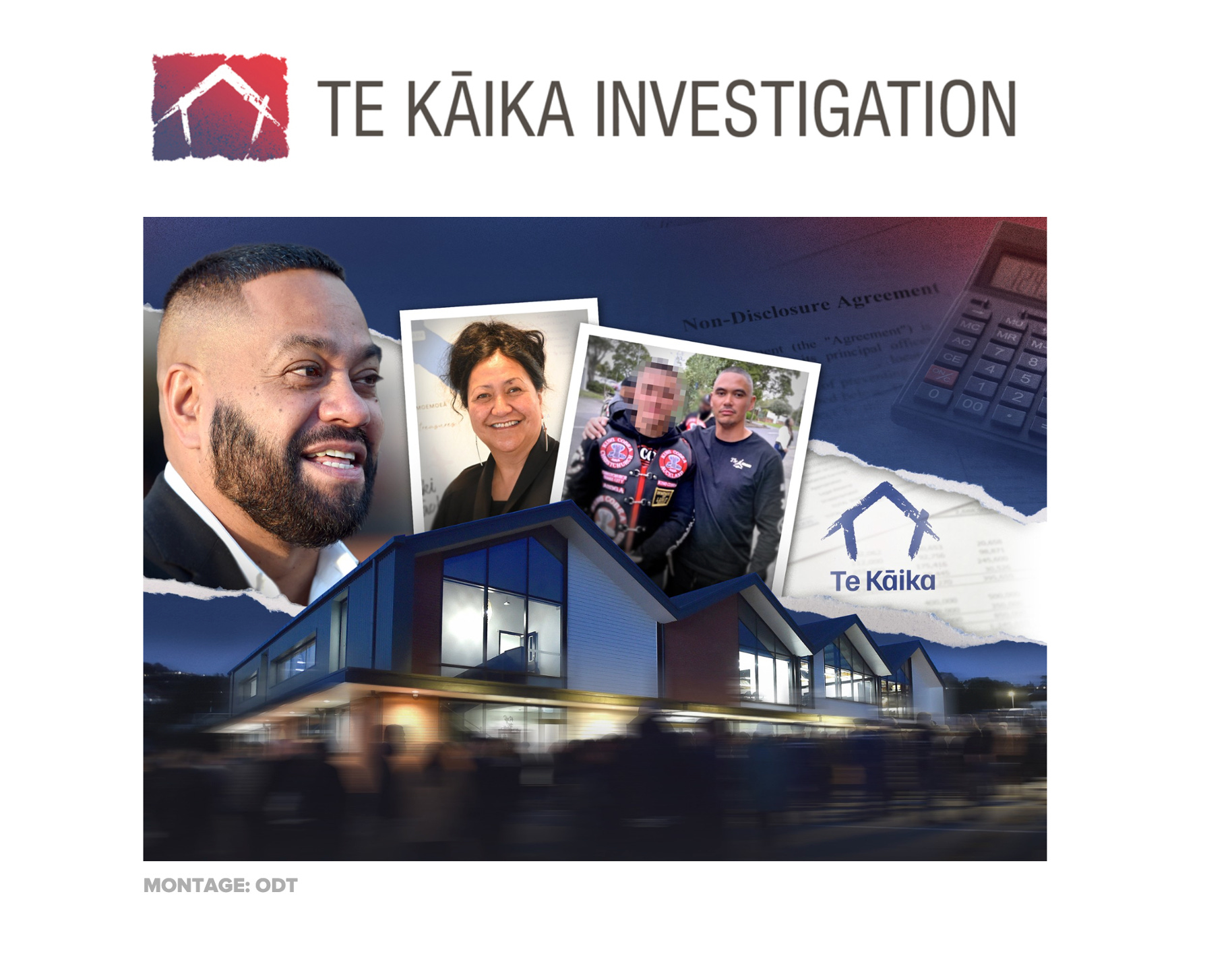
In Dunedin, a charity called Te Kāika has been receiving tens of millions of dollars in government funding to provide health and social services to some of the city’s most vulnerable people. Over the past year, the Otago Daily Times has been methodically pulling back the curtain on what is going on inside this organisation. The picture is not pretty: nepotistic governance, unexplained payments to the leadership, staff fleeing in droves, government contracts unfulfilled, a youth facility shut down over abuse allegations, and a senior manager convicted of domestic violence. The Department of Internal Affairs is now investigating.
And yet, almost nobody else in New Zealand media or politics has said a word about it.
That silence matters too. Because this is no longer just a story about one Dunedin charity going off the rails. Te Kāika shows what can go wrong when the state hands over essential services, then barely checks what is happening on the ground. It’s a story about a gap between the language of empowerment and what actually happens on the ground.
It should make people far less comfortable about the bipartisan faith in outsourced social services
How Te Kāika went off the rails
Te Kāika – meaning “the village” – was established in Caversham, South Dunedin, in 2015 as a GP practice aimed at Māori, Pasifika, and low-income whānau. The kaupapa made a lot of sense: low-cost primary care wrapped around the needs of poorer Māori and Pasifika families. For a while it worked. During Covid-19, Te Kāika ran the South Island’s first mass drive-through vaccination centre. The Otago Daily Times (ODT) editorialised about its “remarkable rise.” People were impressed.
Then it grew extremely fast. Revenue trebled in a single year, from $4 million to over $12 million between 2021 and 2022. Staff went from about 20 to 120. The charity took on dozens of government contracts for everything from addiction services to youth justice. It opened satellite clinics in Queenstown and Oamaru. It built a $10-million-plus “Wellbeing Hub” in Caversham. It even spent $606,000 sponsoring the Highlanders rugby team.
But the governance was flimsy. For nearly five years, the board consisted of just two people: chairwoman Donna Matahaere-Atariki and Matapura Ellison – a breach of the charity’s own constitution, which requires a minimum of three. The University of Otago, which had been involved early on, withdrew its shares in 2020, and all the outside voices on the board departed.
Then in June 2022, founding CEO Albie Laurence was abruptly replaced by Matt Matahaere (the chairwoman’s son). Her daughter, Winnie Matahaere, manages social services. When the board was eventually expanded to three members in 2023, the new addition was an accountant who had previously been suspended from practice for two years for breaching the chartered accountants’ ethical code.
Ask yourself the obvious governance question: how could the chief executive be independently held to account by the board, when the board chair is his mother?
What the ODT uncovered
The Otago Daily Times, principally Rob Kidd and Mary Williams, has been digging into this story for more than a year. The December 2025 series, headlined “Trouble in the Village,” ran across four broadsheet pages – a rarity in modern New Zealand journalism.
The ODT revealed unsecured, interest-free loans to board chair Donna Matahaere-Atariki and to chief executive Matt Matahaere. One former employee’s grievance alleged he had been “bullied and ridiculed… to breaking point.” The charity spent $260,000 on “termination benefits” in a single year.
The ODT also reported on Rema Smith, Te Kāika’s former manager of social practice, who was convicted on charges including burglary, unlawfully taking a vehicle, assault in a family relationship, and breaching the Search and Surveillance Act. He turned up at his victim’s home with patched gang members driving his work vehicle.
Te Kāika’s chief executive sought name suppression for Smith to protect the charity’s reputation. Matt Matahaere also gave Smith a glowing reference to support his move to Dove Hawke’s Bay, a domestic violence support organisation. Dove’s CEO later said he felt “misled”: “If I had all the facts, I wouldn’t have taken him on.”
One Te Kāika youth remand home was shut for nine months after allegations that caregivers had abused young people there. A Te Kāika youth justice worker punched a teenager up to 15 times, stomped on him, then lied to police about it. A doctor allegedly supplied cannabis to a patient in the carpark. The charity’s own GP was convicted of evading nearly $140,000 in taxes, attributing it to “self-entitlement and greed.”
The Story gets worse
To its credit, the ODT has kept digging this year. And the newer material may be even worse, because it goes to the most basic issue of all: are the services actually being delivered?
Over the weekend the ODT reported that Te Kāika’s main site appeared to have just one part-time GP serving thousands of enrolled patients. The Royal New Zealand College of General Practitioners recommends a ratio of about 1,000 patients per GP; Te Kāika’s Caversham hub reportedly has one doctor working four days a week for 5,000 to 6,000 patients.
Clinical consultations plummeted by nearly two-thirds in a single year (from 44,939 to 15,874), while patient registrations (and the government capitation payments that come with them) kept climbing. That matters because capitation funding follows enrolled patients, not the number of times they are actually seen.
Te Kāika has also refused to define what it regards as “clinical consults”. One case reported by the ODT tells you a lot. A patient, Rochelle Hodge, told the ODT she only discovered she’d been seen by a nurse rather than a doctor when she read the signature on her prescription for anti-inflammatories. She had come in with a painful foot. The nurse’s treatment didn’t help. A pharmacist later suggested she see a physiotherapist, who organised an X-ray that found her foot was broken. When she returned to complain, she was told that seeing the nurse was “just like seeing a doctor.”
The charity’s latest accounts revealed that $123,000 was paid to a company wholly owned by the board chairwoman, for “research services.” A separate $20,000 contract was also paid to her. Board member James Hennessy received $61,000 into his private company for rental of Queenstown premises. The conflict-of-interest problems are obvious for an organisation funded overwhelmingly by public money and charitable support.
Te Kāika has also again missed a deadline to file its annual financial return with Charities Services. In ten years it has never filed on time. Over the past decade, the DIA granted the charity 17 deadline extensions. And it often missed those too. When confronted by the ODT about the latest failure, Te Kāika claimed it had “mutually agreed on arrangements” with the DIA. The DIA flatly denied this: “No arrangement has been entered into with the company.”
The DIA investigation has now widened to include what it calls “a number of more substantive concerns.” Its charities services manager warned that “being a charity is a privilege that comes with obligations and responsibilities.”
The Failure of government oversight
But Te Kāika is only part of the story. The other part is the state agencies that kept funding it without asking enough questions.
Health New Zealand funded Te Kāika nearly $1.8 million for an alcohol and drug service that was supposed to employ seven full-time qualified staff. The ODT eventually extracted the staffing data through OIA requests: Te Kāika had only 5.8 FTE for most of 2024. HNZ’s own reporting template didn’t even have a field for the charity to report on staffing. When the ODT compared quarterly performance reports a year apart, they found identical text saying group therapy sessions were still “ready to commence,” clinical groups still “planning to commence.” It was just copied and pasted. A year had passed and nothing had happened.
A $587,000 gambling addiction contract required clinical staff. Quarterly reports showed an employee “looking forward” to clinical staff coming on board, which was the same phrase repeated across multiple reports. HNZ said it had “no reason to believe” the service wasn’t being clinically led, but admitted it didn’t collect the data.
Oranga Tamariki funded eight Te Kāika contracts worth over $3.5 million for 2023–24. Six had “funds reconciled due to underutilisation.” The Ministry of Social Development gave $2.7 million in contracts. A Te Kāika social worker raised safety concerns about doing home visits alone in a family violence role, then left. The client feedback section of their report was blank.
One Dunedin social sector leader told the ODT you could “drive a bus” through some charities’ reports. Another said they were “rarely read” by civil servants. Charity governance expert Garth Nowland-Foreman put it bluntly: “When a board is weak and compromised there are likely to be other accountability failures and in far too many cases we need smarter oversight by government.”
Why this is bigger than Te Kāika
The tempting response to all this is to write Te Kāika off as an outlier: one rogue charity, exceptional in its dysfunction. The specific combination of allegations at Te Kāika is certainly vivid. Family governance, interest-free loans, copy-pasted performance reports, a domestic violence conviction in a family violence service, gang affiliations, covered-up youth abuse – it is quite a list. But the underlying structural conditions that allowed all of this to happen are not exceptional at all. They are features of the system.
The Waipareira Trust case makes this plain. Auckland-based Waipareira, led by CEO John Tamihere, faced a years-long investigation by Charities Services over allegedly using charitable funds to support his mayoral campaign and related political activities. Executive pay at Waipareira reached an average of $510,679 – the highest in the New Zealand charity sector. In December 2025, the Charities Registration Board decided not to deregister the trust after it undertook remedial action, but the board’s chair noted plainly: “Had significant remediation not been taken, the Board’s decision would likely have been different.”
Similarly, the Manukau Urban Māori Authority (where Labour MP Willie Jackson’s wife succeeded him as CEO) has faced a number of concerning allegations recently. So, all three of these state-funded charities (Te Kāika, Waipareira Trust, Manukau Urban Māori Authority) have featured what looks like nepotistic governance structures.
The Auditor-General flagged systemic problems with the Whānau Ora programme as far back as 2015, finding the programme “confusing, bureaucratic and poorly administered” and noting that nearly a third of its $140 million in early funding went to administration rather than to helping whānau. A follow-up report in December 2024 found insufficient progress on accountability. The programme was substantially restructured from July 2025, with new commissioning agencies, stronger conflict-of-interest provisions, and enhanced audit powers. Whether that restructure holds is another matter.
The Te Kāika case also shows how badly government agencies can handle outsourced public services, and how rarely they are held accountable when they fail. Health New Zealand, the Ministry of Social Development, and Oranga Tamariki were all channelling millions to Te Kāika. None of them had adequate oversight mechanisms in place.
This goes beyond Te Kāika. It reflects the way the system now works. This is close to what some scholars call the “shadow state”: charities and NGOs taking over public functions, but without the same transparency or discipline expected of government. The state has outsourced enormous amounts of social provision to NGOs, and has simultaneously failed to build the monitoring, auditing, and evaluation capacity necessary to ensure that outsourcing serves the public interest.
So, the state has become very efficient at shovelling money out the door. It has been far less effective at proving what that money achieves. And in a culture where questioning the kaupapa of Māori service providers has become politically sensitive, the space for honest scrutiny has narrowed further.
Why has everyone else looked away?
Broadcaster Peter Williams – not someone whose overall worldview aligns with mine, it should be noted – described the ODT’s December investigation as “the most substantial piece of investigative journalism produced by a New Zealand newspaper this year” and wrote with evident astonishment the near-total silence that followed. Williams noted the total absence of follow-up: not from RNZ, Stuff, the Herald, Newsroom, or The Spinoff.
Williams put forward one explanation: discomfort with stories that cut close to Māori political power. “Transparency is not racism,” he wrote. “Accountability is not colonisation.” I think that captures part of it. There does seem to be a widespread reluctance in New Zealand media and political culture to subject Māori-led organisations to the same scrutiny applied to other publicly funded entities.
The result is ugly. Māori communities end up with weaker accountability, while a small group of insiders can thrive in the gaps, extracting income and status from state contracts that are nominally directed at the most disadvantaged.
But there are other reasons the story has stayed so contained. Newsroom capacity has been gutted at many outlets. Stories that require months of OIA requests and legal risk don’t fit well into the economics of modern digital journalism. And there is a broader tendency, cutting across the political spectrum, to treat the charitable and community sector as beyond criticism. There’s a notion that it is a realm of good intentions that shouldn’t be subjected to the same scrutiny as business or government.
That is a mistake. Once an organisation is heavily funded by the taxpayer, scrutiny should be non-negotiable. When a charity receives $17.5 million a year, mostly from government contracts, there needs to be accountability. The ODT has demonstrated, painstakingly, that this isn’t happening.
What this says about “Broken New Zealand”
I’ve written a lot about what I call Broken New Zealand: a country where institutions increasingly fail at the job they claim to do, while well-connected interests keep doing nicely out of the mess. I’ve spent a lot of time lately examining the broken state of our economy, our monopolistic markets, our captured political institutions. The NGO and charity sector, however, has largely escaped that kind of scrutiny.
Yet Te Kāika is exactly the sort of case I have in mind. Here is a charity receiving over $17 million a year in public funds, run by a family, with a board that broke its own rules, paying its chairwoman’s company $123,000, failing to deliver on contracted services, unable to keep staff, missing every filing deadline for a decade. One staff member designated “chief operating officer” was paid $213,000.
And yet government agencies have kept making their payments. Health New Zealand, MSD, and Oranga Tamariki collectively poured millions into the organisation without apparently reading the performance reports or checking whether contracted staff had actually been hired.
That is institutional failure. And it has become far too normal in New Zealand. This is not the cinematic version of corruption. It’s a slow rot: vested interests insulated from scrutiny, performance never meaningfully measured, public money siphoned through networks of related parties and family connections, with everyone from government funders to media outlets looking the other way. It’s ticket-clipping dressed up as community empowerment.
Others have used stronger language. And in the private sector or economics profession, it’s called “rent-seeking”. Whatever label you prefer, the end result can be the same: money meant to relieve hardship gets absorbed by managers, insiders, and bureaucracy.
What makes this area worth looking at is how little serious political disagreement there is about it. Unlike debates about the banks, the supermarkets, or the electricity companies, where there is at least some cross-partisan agreement that something is wrong, the contracted-out NGO model has largely escaped critical scrutiny. The political right has always liked contracting out as an alternative to state provision; the left liked the community-empowerment language, and in a Māori context, the alignment with tino rangatiratanga. Both sides found it ideologically convenient, and so nobody asked hard questions.
The result is that too many people keep quiet. And that silence has real costs – borne mostly by the people who depend on these services.
The ODT’s own editorial acknowledged the tension: “Te Kāika needs to succeed.” And that’s true. The communities it was set up to serve genuinely need these services. But the organisation cannot succeed with this governance setup and this level of accountability. DIA charities services manager Helen Steven was right: being a charity is a privilege, not an entitlement.
New Zealand needs to think much harder about how it now delivers social services. Contracting out has become almost unquestioned across the political spectrum. But belief in the model is no substitute for evidence that it works. When government hands millions to an NGO, the public has a right to know whether services are being delivered, whether the money is being spent properly, and whether the people running the show are fit for the job. On all three counts, Te Kāika raises serious doubts – and it is almost certainly not alone.
The ODT has done the work. It’s time the rest of the country paid attention. And it’s time MPs started asking questions.
Dr Bryce Edwards
Director of the Democracy Project
Further Reading:
