

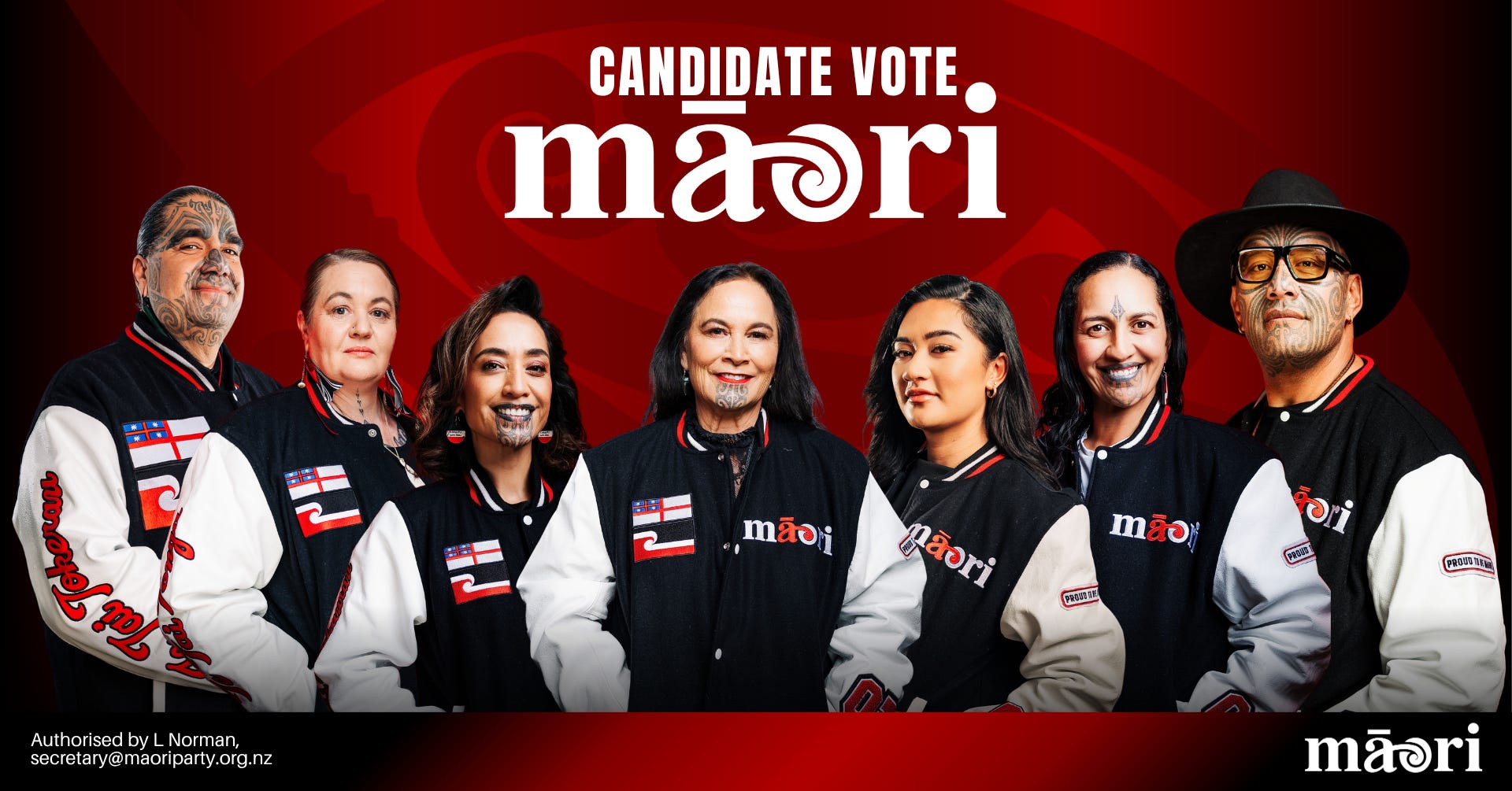
At Te Pāti Māori’s August campaign launch, Debbie Ngarewa-Packer told Māori voters: “You have the power to bring this government to its knees.” Two months later, her party keeps supplying National with material for its campaign against a Labour-led government.
It is unsurprising, therefore, that National is recovering in the polls: it is up four points to 32% in tonight’s 1News–Verian poll, which was taken between 15 and 19 October as the backlash over the gang-pad visit played out, while Te Pāti Māori remains under 1%.
Meanwhile, today’s Whakaata Māori–Curia poll also has a surprise result: the Green Party’s Hūhana Lyndon is ahead in Te Tai Tokerau, suggesting that Te Pāti Māori has lost its grip on the seat. Lyndon is on 24%, followed by Labour’s Willow-Jean Prime on 18%, Te Pāti Māori’s Aperahama Edwards on 17% and former Te Pāti Māori MP Mariameno Kapa-Kingi on 12%.
A Lyndon victory would be a first for the Greens in a Māori electorate. It is far from assured: 22% were undecided. The poll surveyed 500 enrolled voters between 5 and 15 October, with a maximum margin of error of 4.5 percentage points. But Te Pāti Māori now has to defeat the MP it elected in 2023 as well as Labour and the Greens. It also suggests that Te Pāti Māori’s candidate-vote-only strategy might be backfiring.
Te Pāti Māori keep gifting to the right
The Mongrel Mob controversy shows how Te Pāti Māori’s problems become problems for the whole left. My column last week focused on what the Mongrel Mob photos meant for the Greens, but since then Te Pāti Māori has done most of the talking. A video emerged of the party’s Tāmaki Makaurau MP, Oriini Kaipara, telling gang members that her party’s policies would “reinstate what should have always been”, and yesterday she told RNZ, “you see Mongrel Mob, I see whānau.”
The party’s general manager, Kiri Tamihere-Waititi, called the backlash “manufactured outrage” and mocked Labour’s leader: “It puts old Chippy under pressure and he’s fallen for it”. Having helped create a problem for Labour, Te Pāti Māori’s response is to ridicule the man it wants to lead the next government.
Kerrin Leoni, Labour’s candidate against Kaipara in Tāmaki Makaurau, says the photos are “basically their primary ammunition at the moment, from what I can see on social media”. Similarly, Richard Harman concluded in his column today that “Luxon can thank the Greens and Te Paati Māori for a brief respite from being on the back foot.”
In the Herald leaders’ debate, Luxon said Hipkins had “a new coalition member today, it’s the Mongrel Mob”, and Hipkins responded by ruling Te Pāti Māori and the Greens out of the police and corrections portfolios. Te Pāti Māori is supplying the material for an attack on the entire prospective government.
Te Pāti Māori has made a Tiriti Commission, with the ability to stop Cabinet decisions, a bottom line in post-election negotiations with Labour, which gives National another line of attack. Hipkins has rejected that power. Audrey Young wrote of the demand, “That’s not only a coalition killer, it will make it less likely the parties of the left are elected.”
Two years of dysfunction
These failures come after an extraordinary opportunity. Te Pāti Māori won six Māori electorates in 2023 and reached 7% in a December 2024 1News–Verian poll, following the mobilisation against the Treaty Principles Bill.
By November 2025 it had expelled two MPs, Kapa-Kingi and Tākuta Ferris. The High Court subsequently ruled Kapa-Kingi’s suspension and expulsion unlawful because the party failed to follow its own constitution and tikanga. A party demanding stronger constitutional accountability from the Crown should be able to follow its own rules. Kapa-Kingi now leads her own party, while Ferris is standing as an independent in Te Tai Tonga, so the leadership has turned two of its electorate winners into opponents.
Former co-leader Te Ururoa Flavell, who lost his seat when the party was wiped out in 2017, warned in July that it had “lost its way” and “risks being punished once again”. Aaron Smale, a journalist who specialises in te ao Māori issues, argues in the Listener that “The failure was at the top.” Power remains concentrated in one whānau, with Tamihere as president, his son-in-law as co-leader and his daughter as general manager, part of what I described last year as “a Māori-branded variant of elite capture”.
Out of step with Māori voters
Every Whakaata Māori–Curia poll of the Māori seats has found the cost of living to be voters’ biggest issue, at between 29% and 42%, with Te Tiriti named by only 5% to 13%. Yet Te Pāti Māori chose constitutional transformation, rather than economic policies such as its $1 billion energy fund or no tax on the first $30,000 of income, as the thing it won’t trade away.
Even the Tamihere-linked Waatea News published Matthew Tukaki’s warning that “constitutional transformation will mean considerably less to a whānau struggling to pay the rent if nobody in the household can find secure employment.”
Smale notes another telling choice of priorities: when survivors of abuse in state care marked the anniversary of the Royal Commission’s report at Parliament, every party sent a representative except Te Pāti Māori, which told another reporter its MPs had other appointments or were on leave, although “About 80% of the tens of thousands of state abuse victims are Māori.” Yet this week Kaipara told RNZ that “gangs exist because of systemic failures, because of the government of the time creating state care abuse”, in defence of the visit to the gang pad.
Outmanoeuvred by Labour and the Greens
A Mata Reports–Horizon poll of party-vote intentions among Māori roll voters puts the Greens on 28%, Labour on 27% and Te Pāti Māori on 16%, down 14 points since 2023. Tamihere credits the Greens’ surge to his party’s decision to seek only the candidate vote, but the Spinoff’s Liam Rātana argues that the infighting explains more of it.
The overhang-one-tick strategy was meant to help the left bloc win government, with the idea that it could deliver more seats to the left, even if the parties of the right won more votes. An editorial in the Post said the strategy was “within the rules” but “best described as cheating”, once more tarnishing the name of the party. Of course, part of the motive was also to improve Te Pāti Māori’s chances of retaining its Māori seats. Yet the Greens are now competitive in seats like Te Tai Tokerau, and Labour leads in Te Tai Tonga in the Curia poll.
Labour has also become much more aggressive towards Te Pāti Māori. Its campaign chair Kieran McAnulty says, “We’re trying to form a parliament after the election that doesn’t have Te Pāti Māori in it”, and he prefers Opportunity as a partner. Labour is hardly a disinterested judge, since it wants the party’s seats, but the question it is asking is a fair one: even if the overhang strategy produces extra seats, could a Labour-led government rely on the MPs who hold them?
Still in Parliament, but diminished
A repeat of Te Pāti Māori’s 2017 wipeout looks unlikely. Waititi is on 42% in Waiariki, Hana-Rāwhiti Maipi-Clarke on 45% in Hauraki-Waikato and Ngarewa-Packer on 38% in Te Tai Hauāuru, and polls in the Māori seats have been wrong before.
Survival, though, is a low measure of success for a party that entered this term with six electorate seats and a Government that gave Māori voters every reason to mobilise. Last November I wrote that “The demise isn’t just likely — it’s already underway.” The polls suggest I was right about the direction and too pessimistic about how far the party would fall.
The likeliest outcome is a party of three or four electorate MPs with a tiny party vote and only one possible partner, which is campaigning to wipe it out. Its overhang strategy may yet leave Labour needing its votes, which is one reason National is happy to keep Te Pāti Māori in the headlines. If the right is narrowly re-elected on 7 November, the dysfunction of the party that set out to make this a one-term government will be part of the explanation.
Bryce Edwards
Director of the Democracy Project
If Labour needs TPM’s votes, what would it have to offer – and how much of TPM’s constitutional bottom line would survive? In the “Further Analysis” section after the paywall I examine the possible deal, the difference between funding a discussion and enforcing Treaty obligations, and whether TPM’s leaders could carry their own party through a compromise. Paid subscriptions support this work.
