

Most political obsessives struggle to understand how late ordinary people tune in to an election. For many New Zealanders, the campaign will only begin to feel real in its final fortnight, when the leaders’ debates are under way, political advertising becomes inescapable and candidates finally encounter voters who have paid little attention until then.
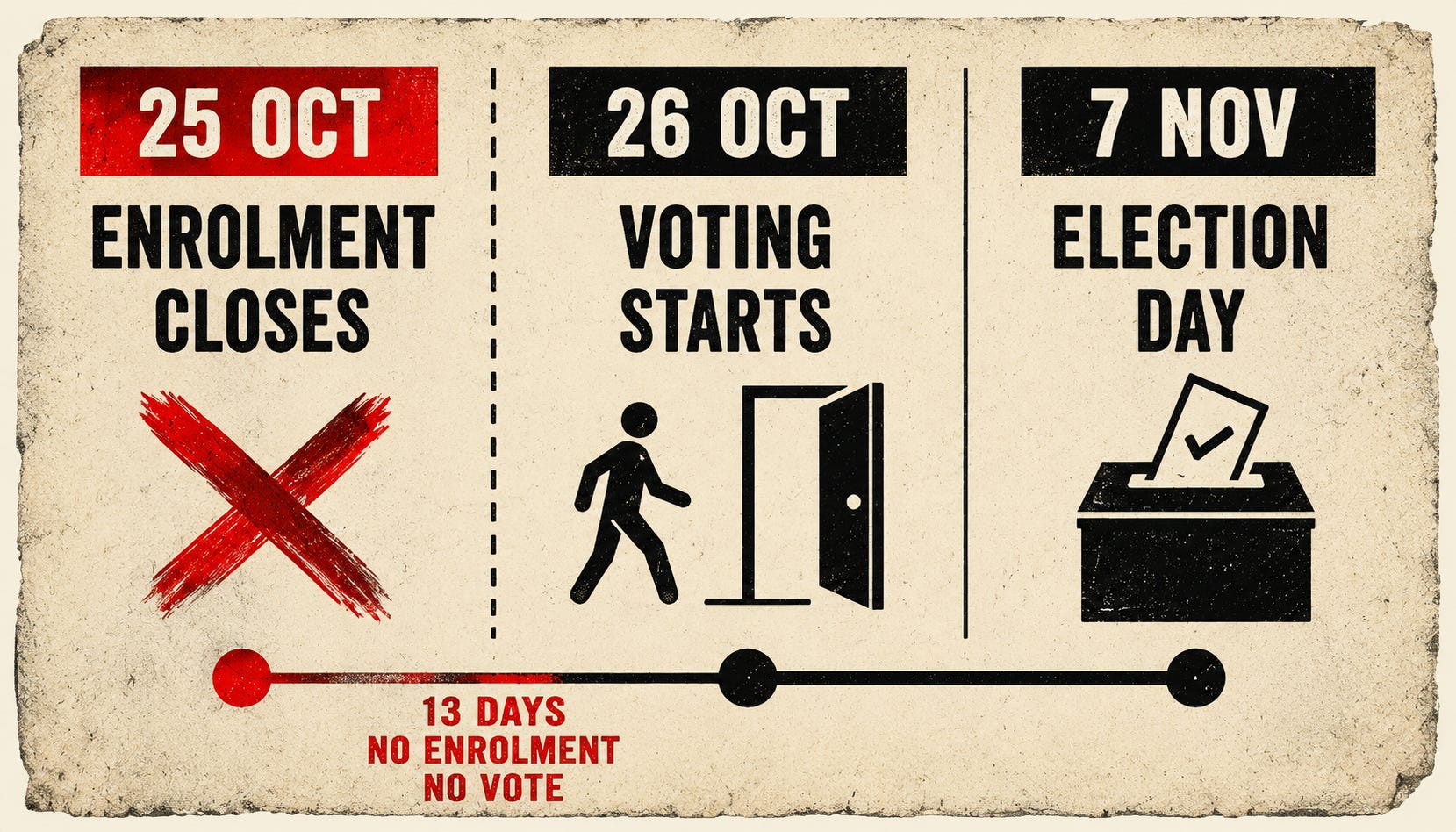
Yet the Government’s has changed the law on when the electoral role closes, meaning that this final fortnight will be too late for some to enroll to vote. Anyone who is not enrolled by midnight on Sunday 25 October will be unable to vote in the general election on Saturday 7 November. Those enrolled at an old address may still have their party vote counted, but could lose their electorate vote. Advance voting starts the morning after the roll closes and continues for almost two weeks.
The Government calls this change of date the end of “election-day enrolment”. That is misleading. Before Labour introduced enrolment on polling day in 2020, people could still enrol throughout the advance-voting period. The coalition has abolished that too. Electoral law expert Graeme Edgeler traces the right to enrol close to election day back to 1948, with broad access continuing through the voting period since 1990. National, Act and NZ First have not restored the old rules. They have imposed the tightest enrolment deadline New Zealand has had in decades.
The decision-making process used to reach this point has been poor. The Ministry of Justice had considered an earlier closing of the roll and declined to recommend it, warning that any changes affecting democratic rights “should be enduring and only occur following careful consideration and a consultative approach”. There has been little sign of either quality here. The law was passed under urgency in December, without Opposition agreement, and will apply to an election only 11 months later.
Labour is entitled to attack the change, but it should not pretend it had no part in the breakdown of consensus over electoral law. It introduced election-day enrolment without National’s support and now sounds rather more attached to bipartisanship than it did in government. I will return to that. It does not let the coalition off the hook. Labour made it easier to enrol; National, Act and NZ First have made it harder.
Thirteen days, not one
If the Government had simply abolished enrolment on election day, there would still have been an argument. It would at least have been a return to the system that operated before 2020. Closing the roll before advance voting begins is something else.
The figures being thrown around have sometimes added more heat than light. At the 2023 election, the Electoral Commission processed about 450,000 enrolments or changes to enrolment details during the voting period, including roughly 110,000 on election day. That does not mean 450,000 votes are certain to disappear this year, as some of Labour’s earlier rhetoric implied. Kieran McAnulty initially talked about as many as 400,000 ballots being voided before retreating from the claim.
The Commission’s estimates are still large enough to matter. It expects about 55,000 party votes could be disallowed because the voters are not properly enrolled. Another 73,000 people could lose their electorate vote because they remain registered at an old address. Their party vote may still count, but their ability to choose a local MP will not.
Henry Cooke asks readers to imagine the coalition finishing with 61 seats while 55,000 attempted party votes have been rejected. “Slowly, people on social media start to do the maths and find 55,000 votes is worth two seats,” he writes. Nobody would know where the missing votes would have gone, but that would not prevent the losing side claiming it knew. “The election was stolen, the meme will go.”
Cooke’s imagined protests may be at the dramatic end of the possibilities. His basic warning is harder to dismiss. The accepted votes would still have been counted properly, but a result that close could become very difficult to defend once tens of thousands of voters had been turned away under a law passed by the parties clinging to power.
Plenty of time for whom?
Justice Minister Paul Goldsmith says the change is about getting the result faster. “The final vote count used to take two weeks, last election it took three,” he said when the legislation passed. He described the new deadline as “a significant, but necessary change” and argued that voters have “plenty of time to get organised and enrolled”.
There is a real administrative problem here. The 2023 count was slow, the Electoral Commission was under severe pressure and Labour had been warned that introducing election-day enrolment would increase the workload. Special votes have to be checked carefully. Nobody should want speed to come at the cost of an accurate result.
The question is why voters should bear the cost of the Commission’s difficulty processing those votes. Parliament could have funded a larger operation and required more work to be done earlier. The Government has instead reduced the number of citizens the system needs to accommodate.
Nor has the Commission promised a substantially faster declaration this year. Chief Electoral Officer Karl Le Quesne says special votes will still need integrity checks, and the published timetable retains the same 20-day period used in 2023. Election day is 7 November. The official result is due on 27 November. Perhaps the process will become quicker in later elections, but the loss of enrolment rights starts now.
Goldsmith keeps his case largely administrative. His Act Party colleagues have been more candid about the voters they believe the system should accommodate. Todd Stephenson complained that it was “outrageous that someone completely disengaged and lazy can rock up to the voting booth, get registered there and then, and then vote to tax other people’s money away”. David Seymour said he was “a bit sick of dropkicks that can’t get themselves organised to follow the law”.
The revealing words in Stephenson’s statement are “tax other people’s money away”. He has already constructed a political profile of the late voter: disorganised, undeserving and likely to support redistribution. This is not simply irritation at a slow count.
Newstalk ZB’s Kerre Woodham put the wider exclusionary argument even more plainly: “If you can’t manage to enrol and it’s beyond you to check your details are correct, you know what? Stay home. We don’t want you voting.” Mike Hosking told his listeners that “the fact you can’t rock up on the day is only going to ‘disenfranchise’ you if you are a bit disorganised”. The logic is that some people should not be voting.
Who does the deadline catch?
The 2023 figures give a reasonable indication of who is most exposed. Mike Smith has set out the 2023 figures: a third of voters aged 18 and 19 enrolled or updated their details during the voting period. Among Māori voters of the same age, the figure was 48%. More publicity about the deadline may reduce those numbers this year, but it is difficult to look at them and pretend the impact will be evenly spread.
The deadline is unlikely to trouble someone who has owned the same house for 20 years and has voted in every election. It is more likely to catch a student who has moved since leaving home, a renter changing flats, or a family shifted between temporary accommodation. Some people will assume their enrolment is correct and discover otherwise only when they arrive to vote.
This is why the Attorney-General’s Bill of Rights assessment and the Human Rights Commission have warned about the disproportionate effect on younger and more mobile citizens. Māori, Pasifika and Asian voters are also more likely to be among the groups caught by enrolment problems. Housing insecurity and weak contact with government agencies now carry an additional electoral cost.
The term “voter suppression” will strike some New Zealanders as excessive. It evokes US battles over identification laws, polling-place closures and partisan purges of electoral rolls. Nothing as aggressive is happening here. But the essential claim is not difficult to understand: a government has knowingly made it harder for eligible people to vote, despite knowing which groups are most likely to miss out.
Political scientist Grant Duncan, who sets out the Government’s case more fairly than many of its critics, reaches that conclusion. Because the coalition knows special votes lean left and knows the 13-day deadline will fall unevenly, he writes, “it does look as though the government’s proposal amounts to intentional voter suppression”. His bluntest line is also the hardest to answer: “They know exactly which kinds of voters are most likely to miss out.”
The paywall now starts partway through all Democracy Project newsletters. Please take out a paid sub if you want to support this service and access the full content, including the following sections: “Did the coalition do it to favour itself?”, “How electoral law used to be made”, “Labour helped create the conditions”, “Keeping watch”, and “Count the votes in public”.