

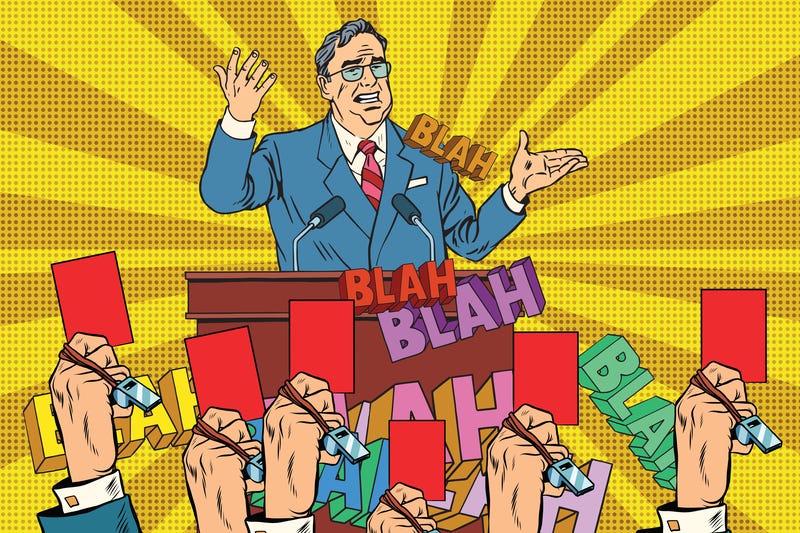
The starting gun has been fired on the 2026 general election. There are now 277 days until voting starts in the New Zealand general election. And it’s 290 days of campaigning to endure, until voting closes. Then there’s the weeks of waiting for official results after polling day, and probably weeks more of coalition negotiations. It’s going to be a long year of politics.
Prime Minister Christopher Luxon confirmed yesterday that the election will be held on 7 November 2026. Under the Government’s new voting rules, advance voting will start on Labour Day, 26 October, giving New Zealanders two weeks to cast their ballots. The campaigning has already begun.
Craig McCulloch at RNZ reminded readers of a 2011 Waikato Times cartoon capturing “a reeling voter despairing ‘296 days of campaigning’“ when John Key announced an early November election that year. At least this time, he noted dryly, “our emblematic voter has just 290-odd days to endure.”
Thomas Coughlan at the Herald has characterised it as “a very, very, long campaign by New Zealand standards.” He warned that “MPs will be exhausted by polling day, increasing the likelihood of missteps and blow-ups.”
One clear consequence of a marathon campaign is the increased importance of money. A campaign that runs the better part of a year favours those with deep pockets. There are strict spending limits that kick in for the regulated campaign period (the last three months of the campaign), but before that, parties can spend freely on advertising.
As Coughlan observes, such a long run-up “gives parties with more money extra opportunity to spend it, flooding the country with advertising before spending regulations kick in.” We can expect an arms race of billboards, social media ads, and taxpayer-funded government PR rolling out for months on end. The extended fundraising and spending window undoubtedly benefits larger and wealthier parties, tilting the playing field. It’s the kind of protracted electioneering that can intensify public cynicism, as voters see millions spent on marketing while their own economic woes linger.
Is November really that late for an election, though? McCulloch makes the fair point that “one would not want to overstate the lateness of the date.” Since MMP began, New Zealand has held “one election in July, three in September, three in October and three in November. So November is not exceptional.” Still, it sits “on the later side of the ledger” and “leaves a long runway” before polling day.
It’s the Economy, stupid
Why would any government choose such a marathon campaign? The short answer: the economy, stupid. Most pundits agree that economic factors will underpin the whole campaign. As Coughlan put it: “Most pundits, including those inside our main political parties, reckon this election will be won and lost on the issue of the economy.”
Newstalk ZB’s Ethan Griffiths summed it up neatly: “Everything relies on the economy. It’s the biggest issue for voters. They vote on how they’re feeling in their back pocket.”
The coalition parties are banking on economic improvement translating into votes. Luxon has been saying “every day makes a difference” in the kind of recovery currently underway. Treasury forecasts are picking GDP growth in the second half of the year, with unemployment beginning to trend down. House prices are expected to rise, and lower interest rates are already filtering through.
Justin Hu at 1News noted that November is “the latest an election has been held since 2011” and suggested the Government is “giving his economy more time to get back on the much vaunted track.”
Of course, there’s a risk in this strategy. Hu points out that “a bigger risk for Luxon is what happens if the economy does not turn as promised.” Henry Cooke at The Post observed that the October 28 Reserve Bank decision on the Official Cash Rate “will come right in the thick of the campaign.” Given how crucial “lowering interest rates” has been to National’s narrative, “a hike then would be tricky to manage.”
A Contest between dull and duller?
What kind of election can we expect? Grant Duncan has labelled it the “Dull & Duller” election, and he’s probably right. He wrote: “At this stage, it’s looking like it could be a close contest – between dull and duller.”
Duncan pointed to Auckland mayor Wayne Brown as the template for modern political success: “He’s won two elections in a row by large margins – on very low turnouts. He bored the people of the country’s biggest city into handing him victory, and then he got on with the boring work of fixing potholes.” Luxon’s state-of-the-nation speech had the same energy. Duncan wrote simply: “He couldn’t have been less inspiring.”
It’s a brutal summary, but it rings true because both major parties seem determined to play it safe and steady, offering what looks like a relatively conservative, policy-lite contest.
This might make the election particularly tough on the public. They face a marathon of political bombardment. There’s a real danger of voter fatigue setting in long before November. The length of this campaign could stretch the attention span of anyone. By the time spring rolls around, many voters could be utterly over it, which might dampen turnout or simply leave people numb to the policy arguments.
An Unusual election
Richard Prebble argues that this election is genuinely unusual in New Zealand’s political history. “We have never seen an election like this year’s,” he wrote. “The closest parallel is 1993, when a government elected with a landslide majority survived by a whisker.”
His argument is that New Zealand’s normal election cycle has been inverted. Usually, Labour campaigns for change with a charismatic leader, implements unpopular reforms, and then National returns to manage those reforms better. But this time, he writes, “politics has inverted itself. A Labour Party with little policy is running against one of the most reforming governments ever.”
Prebble identifies only two genuinely reforming National governments in history: the 1990-93 Government and the current coalition. This Government, he says, “is reforming on a scale rarely seen in New Zealand politics: repealing the Resource Management Act, fast-tracking project approvals, scrapping Three Waters, ending co-governance, passing the Regulatory Standards Bill, restoring Three Strikes, and putting reading and arithmetic back at the centre of education.”
Meanwhile, Labour is “borrowing a playbook perfected elsewhere” by the Australian Labor Party, whose “success rests on running policy-light campaigns” that make the “party a small target.”
Prebble’s advice to Luxon? Forget trying to emulate John Key or Jacinda Ardern. “His model should not be John Key or Jacinda Ardern, but Keith Holyoake.” Holyoake, who won four general elections, “was never accused of being a visionary. His slogan – ‘Steady does it’ – reassured a cautious electorate.” National can now campaign to “Keep New Zealand on track.”
Expect an intense campaign
Richard Harman suggests the campaign will be “more intense than we have seen over the past two elections” because “the centre-right and the centre-left parties are evenly balanced.” Unlike recent elections “where one bloc had established a clear lead early in the election year,” this one is “either side’s to win.”
He also notes, however, that it might not be a super negative campaign, as both major parties are pivoting away from negativity: “Now they are starting to talk about the future”, with National moving “away from the repetitive ‘blame Labour’ mantra.” Meanwhile, “Labour has obviously identified National’s negativity as a weak spot, and it too is starting to talk about aspiration and hope.”
Ryan Bridge at Newstalk ZB is more bullish about National’s prospects, declaring “this election is National’s to lose.” But he acknowledges “the crucial point” that “Winston Peters cannot, politically, enter a deal propped up by or supported by the Greens or Te Pāti Māori.” In most polls this term, “Labour has needed both of them to get close to the magic 61 seats.”
Parliament will grind to a halt
A campaign this long also squeezes the life out of actual governing. Once an election date is announced so far ahead, everything in politics shifts into campaign mode. Parliament will sit for a truncated 51 or so days before rising in late September, and after that no new laws will be passed until well after the election. In effect, government policy-making will grind to a halt months early.
Peter Dunne has written today about what the election date means for the machinery of government. Parliament is scheduled to sit for 22 weeks before rising on 24 September and being dissolved on 1 October. But with the “Period of Restraint” commencing three months before the election on 7 August, only 51 sitting days are actually available for the Government to progress new legislation.
Once set-piece debates are factored in, the time available “could reduce to much nearer 42 to 45 sitting days.” The Government will focus on “clearing its legislative decks” rather than introducing anything new. There’s a loaded agenda to get through, including replacing the RMA and reforming regional councils. Hu notes this “may have also given the Prime Minister pause in selecting an earlier date.”
Taking into account this three-month “Period of Restraint” and then post-election delays and negotiations, Dunne warns, “the period of caretaker rule could be up to five months or more, to the bureaucrats’ delight.” Dunne is scathing about this arrangement. The Period of Restraint “completely overlooks the reality that governments are elected to govern for a full three-year term and that they retain their full authority until election day.”
For voters, there’s one important change: under amendments to the Electoral Act, “voters will now no longer be able to enrol to vote on election day.” The closing date for voter enrolment will be 26 October, the same day early voting begins.
The Year ahead
So here we are: 277 days until advance voting opens, with an election that will almost certainly come down to how New Zealanders feel about the economy by November. The coalition parties are betting that improvement will translate into re-election. Labour is hoping voters are ready for a change.
As Prebble put it: “In the end, better than any campaign is a growing economy.” The big question is whether Luxon will get one and whether it will translate into voters feeling better off than they were before.
All up, the 2026 election is going to be a marathon grind. It will be 290 days of continuous politicking, mostly revolving around the economy. As Thomas Coughlan’s headline put it, at this rate the campaign could become a contest of “big budgets and political stamina”. Rather than being a grand contest of ideas, it’s more likely to be a marathon based on whoever can outlast and outspend the other.
Dr Bryce Edwards
Director of the Democracy Project
Further Reading:
