

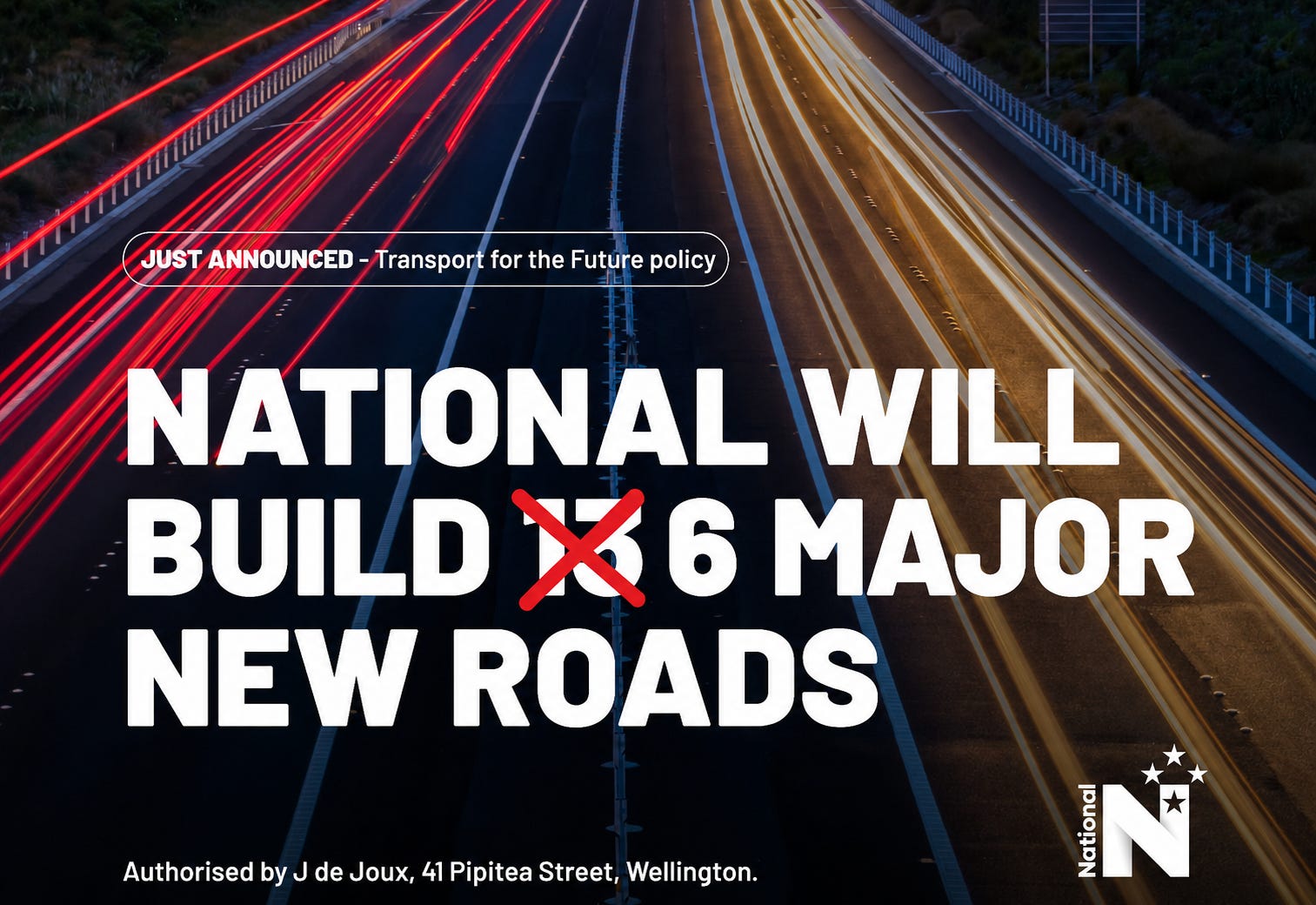
National’s flagship roading programme has crashed into reality.
On Thursday Transport Minister Chris Bishop unveiled his Government’s long-awaited “Major Transport Projects Pipeline”. The title suggested movement. What it actually delivered was a large-scale retreat from the roads National promised voters at the last election.
National campaigned in 2023 on 13 new Roads of National Significance. Once in government, the programme expanded to 17. Only six are now in construction or procurement. The remaining eleven have been sorted into the consolation categories: preparing for construction, route protection and continuing more slowly. Several have no construction date. Some may not even receive route protection until beyond 2037.
In normal language, many of these roads have been “cancelled”. Bishop calls it “an attempt to recalibrate people’s expectations”.
The pipeline to nowhere
There is a well-established political vocabulary for killing a project without admitting it. Roads don’t get cancelled. They get moved into a “future pipeline”, or sent away for “further investigation”.
This was spotted straight away by Herald political editor Thomas Coughlan who also saw the precedent starting with the previous government. Bishop, he wrote, “was positively Ardern-esque in his denial that the pipeline amounted to a whole lot of cancelled roads”. In 2018 the Ardern Government “rephased” and “rescoped” National’s roads. Of one project, Ardern insisted, straight-faced, that “essentially the process continues as is”. Bishop has now run much the same play.
But Coughlan’s verdict on the latest exercise is blunt: “Make no mistake, those delayed roads are as good as cancelled.”
Wellington provides the clearest example. National campaigned on beginning construction of its State Highway 1 improvements, including a second Mount Victoria tunnel, within three to five years. It promised “spades in the ground” during its first term.
The project now has no construction start date. Preparatory work may continue deep into the 2030s. According to Henry Cooke, Bishop argues that geotechnical investigations mean spades are technically in the ground. But geotechnical investigations do not amount to beginning construction on a motorway tunnel.
Heather du Plessis-Allan, who has strongly supported the project, calls it what it is: “That is now a broken promise.”
Petone to Grenada and the Cross Valley Link have suffered much the same fate. National said construction would commence within four to ten years and cost about $1.8 billion. The latest estimate is between $2.1 billion and $2.7 billion, and actual construction may be more than a decade away.
Wellington Mayor Andrew Little describes the revised programme as “more pipedream than pipeline”.
A fantasy from the beginning
The Government’s defence is that the world changed after the 2023 election. Bishop has pointed to Donald Trump’s tariffs, the war with Iran and the resulting economic disruption. Borrowing costs are higher than they were during the years of nearly free money. The Crown accounts are ugly. Competing demands from health, defence, superannuation and other infrastructure are growing.
None of this explains the original recklessness. The roads were unaffordable before the latest international crises. Treasury and the Infrastructure Commission were warning of the mismatch between transport ambition and transport revenue back in 2024. NZTA’s projected investments were running tens of billions of dollars ahead of likely income.
By November last year, Bishop publicly acknowledged that delivering the full programme would cost about $56 billion over 20 years. To fund it entirely through petrol tax and road-user charges would have required a one-off increase of about 70%, equivalent to 49 cents a litre in fuel tax.
And even that would have paid only for the Roads of National Significance. It would not have covered the second Waitematā Harbour crossing, the North-West Busway or the many other transport projects the country needs.
New Zealand does not have the traffic volumes for tolling to fill the hole. Public-private partnerships (PPPs) can shift the timing of payments but they do not make roads free.
The political contradiction was obvious: Cheap petrol, but expensive highways. National wanted expensive new roads while resisting the taxes and charges required to pay for them.
Du Plessis-Allan has dismantled the excuses from the political right: “They cannot blame Trump. They cannot blame tariffs. They cannot blame the conflict with Iran. They cannot blame inflation. They cannot blame the Labour Party.”
She says the programme was too ambitious when National promised it in 2023. She points out they were warned at the time, and the warnings were correct.
What ministers knew
The most damaging evidence concerns what happened after National took office. The Post political editor Henry Cooke has reported that in July last year Bishop received a Ministry of Transport briefing that cut directly across the Government’s public position.
Officials described the Roads of National Significance as “relatively low value”. The Ministry’s initial information indicated that all the RoNS had benefit-cost ratios below 3.0, with some below 1. A ratio below 1 means the assessed benefits do not cover the costs. On the conventional economic test, the road does not stack up. The officials went further, warning that whatever growth and productivity benefits the programme delivered would likely be “outweighed by the financial burden placed on households”.
They also noted that the whole thing cut against the National Infrastructure Plan being prepared by the Infrastructure Commission while Bishop was Infrastructure Minister, which wanted less money going into shiny new state highways and more into keeping the existing network from falling over.
This was the Government’s own transport ministry, writing privately to its minister almost a year before the briefing became public.
Thursday was the last step of a retreat that began a year ago in the Minister’s own office. Yet still Bishop denied it was a backdown.
The paywall now starts partway through all Democracy Project newsletters. Please take out a paid sub if you want to support this service and access the full content, including the following sections: “Is this Simeon Brown’s mess?”, “Some credit, but not absolution”, “The voters who were sold certainty”, and “Labour cannot prosecute this case”.
