

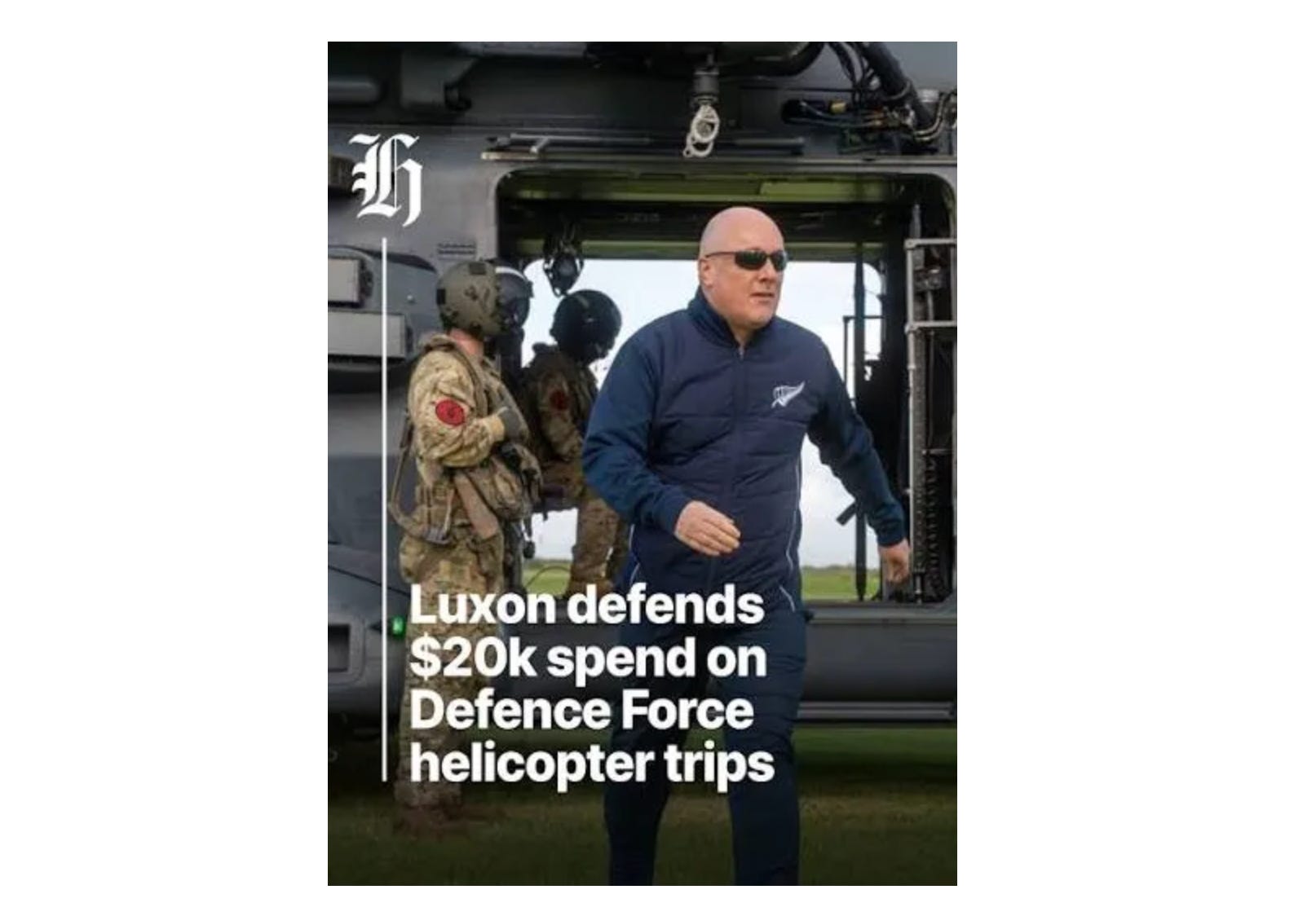
This week Prime Minister Christopher Luxon has been receiving criticism for his extensive use of Air Force transport to get around the country. Stuff journalists Jenna Lynch, Emma Ricketts and Glenn McConnell have published a run of stories about the Prime Minister’s use of military aircraft for domestic travel, pointing out that the trips do not involve emergencies or disasters. Using Defence Force documents obtained under the Official Information Act, they have counted 41 such flights over this term of government so far.
Luxon is not the first to use the Air Force to fly around. Previous governments have also hitched such rides around the country. But the recent stories highlight that there is a need to create better rules and transparency around the use of such public assets. For although some have characterised the mini-scandal as trivial, the use of military craft for politics relates to some important issues about the potential use of state resources for electoral gain. After all, the Air Force belongs to the state, not to the party temporarily running it.
The real scandal here is bigger than Luxon, and it will outlast him. New Zealand has no clear rules about when a prime minister may use a military aircraft, and no routine way for the public to find out how those aircraft are being used.
Not everyone thinks this matters. Luxon says the planes have to fly and the pilots need the hours, so carrying him made no difference to the bill. Former prime minister John Key says successive prime ministers have all used military assets. Heather du Plessis-Allan says the whole thing is “nitpicking”. We’ve got to stop nitpicking legitimate uses of things like Defence Force flights, for God’s sake,” she said. Labour, for its part, says the Prime Minister is treating the Air Force as his “personal taxi service”.
Luxon’s defenders are right about one thing. Prime ministers sometimes need to travel in ways that would look excessive for anyone else. Their schedules move without warning, and commercial timetables were not designed around them. It would be silly to insist that a prime minister spend half a day in the back of a Crown car to prove he is careful with money.
Which is precisely why the rules matter. If military transport is genuinely necessary at times, and if it hands a prime minister a scheduling advantage no opponent can match, then somebody other than the beneficiary has to be able to say when it was justified. At present nobody is. The only answers the public gets come from the politicians who benefit from them.
The meeting that was a fundraiser
Of those 41 flights, one stands out, and the details of it were published on Wednesday. Luxon spent Thursday 23 July in Feilding and Whanganui. He had government engagements through the day, then dinner at the Whanganui Golf Club, then a Defence Force King Air to Auckland.
Defending the flight on Mike Hosking’s Newstalk ZB programme, he described the end of that day in notably loose terms: “The other day, I am in Whanganui, I finish a meeting at 10:30pm at night. I get on a little six-seated King Air plane from the Air Force.”
Calling the fundraiser “a meeting” was too cute. It obscured the one fact that made the flight contentious. The Herald’s Thomas Coughlan later found a special liquor-licence application from the golf club venue describing the event as a “fundraising dinner for the National Party with the Prime Minister in attendance”, running from 5pm until 11.45pm. Luxon’s office would not confirm that this was the meeting he had in mind, though it did confirm he attended a National Party event that evening.
His office says he had originally intended to stay overnight and fly back on Air Chathams the next morning, and that his plans changed because he had to represent the Government at the funeral of Bill Birch, the former National finance minister. That pushed a Simpson Grierson engagement in Auckland to 7.30am. Luxon says he uses commercial flights where he can, and that on this occasion none was available.
But it’s hard to imagine National accepting the same explanation from a Labour prime minister who had stayed late at a Labour fundraiser. National would be asking whether the party had benefited and whether it should be paying part of the cost. And it would be entitled to ask that.
Chris Hipkins says the Prime Minister could have left the dinner and taken an earlier commercial flight, and that in any case “he could have chosen not to attend a National Party fundraiser if attending Bill Birch’s funeral was that important to him”. On the principle, he is unequivocal: “Once you start doing campaigning and fundraising events for your political party, that’s a bright line, and Air Force resources should not be used for that under any circumstances.”
That is perhaps too rigid. Prime ministers do not stop being party leaders, and no workable rule can require that political and official business never occur on the same day. The better question is whether the party event helped create the need for the military flight.
On the face of it, it did. The aircraft allowed Luxon to stay at a National Party fundraiser late into the evening and still make Auckland by morning. Without it, National might have had to shorten the dinner or pay for a charter.
Even Luxon’s most prominent defender concedes the principle. Using a Defence Force flight to get to a party fundraiser, du Plessis-Allan says, “would be a big no-no”, because “you can’t use Defence Force aircraft to get yourself re-elected, can you?”
The paywall now starts partway through all Democracy Project newsletters. Please take out a paid sub if you want to support this service and access the full content, including the following sections: “What the flight records say”, “Who decides?”, “National and Labour swap arguments”, “When the state becomes a party resource”, “The problem is wider than one aircraft”, and “Rules before the next flight”.