

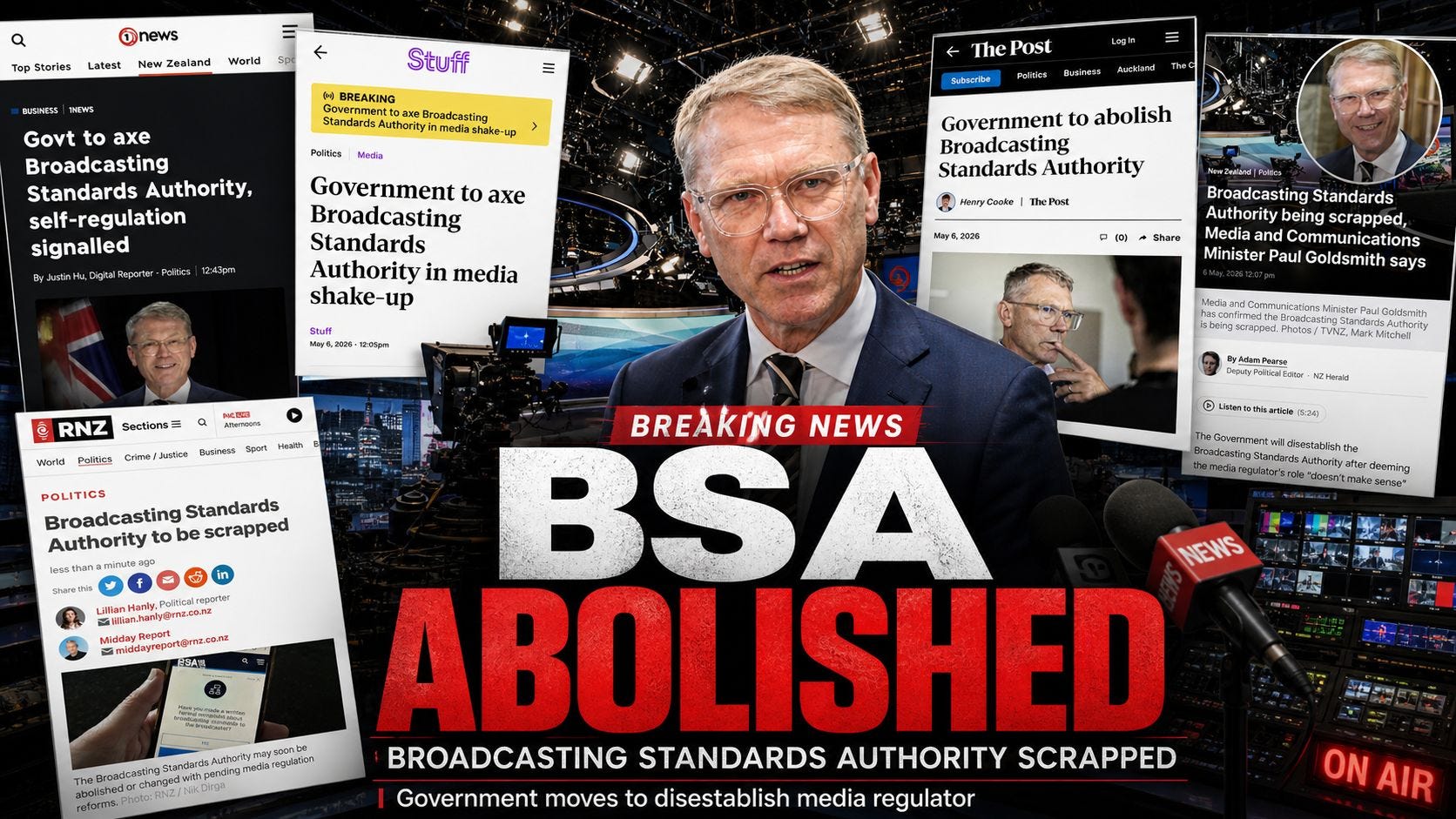
The announcement was brief: a ministerial press release, mid-afternoon, a few paragraphs. The Broadcasting Standards Authority, a body that has existed since 1989, is to be abolished. Paul Goldsmith described it as a logical response to a changed media landscape. Sean Plunket called it a birthday present. Winston Peters, who had spent the preceding weeks denouncing the BSA as a “Soviet-era Stasi” that “bordered on fascist,” was presumably more measured in private.
And that was more or less that. A regulator gone, legislation to follow, the New Zealand Media Council to pick up whatever it can carry. No public consultation. No white paper. No select committee. Just a press release and a handwave at self-regulation.
The decision is probably the right one. But the way it was done, why it was done, and what replaces it should disturb anyone who takes democratic accountability seriously.
The regulator that time left behind
Let’s be honest about what the BSA had become. Established under the Broadcasting Act 1989 — legislation written when New Zealand had three TV channels and Video Ezy was a thriving business — it was always going to struggle with a 2026 media ecosystem. The BSA itself had been pleading for legislative reform for fifteen years or more. Nobody in Parliament listened.
The Authority itself had stopped pretending otherwise. Its own 2025 annual report described the legislative model as “obsolete and out of step” with the contemporary media environment. So, here was a regulator publicly conceding that the law it was asked to enforce had been overtaken by reality.
By the time the end came, the Authority was processing fewer than 100 formal complaints a year (the lowest figure since 1990–91). It had eight staff. It spent roughly $1.67 million annually. Meanwhile, New Zealanders were spending most of their media time on platforms the BSA had no jurisdiction over whatsoever. Netflix, YouTube, Spotify, TikTok, all sitting beyond the perimeter of a regulator designed for linear broadcasting. The regime had become, as Goldsmith observed, arbitrary. A panel discussion on RNZ: regulated. The same conversation on a podcast: not.
David Seymour called the BSA “a creature of 1989, before the internet existed.” He’s not wrong about the date. That’s about as far as it goes.
The fight it picked, and lost
What finally killed the BSA, though, wasn’t the anachronism of its founding legislation. It was the Authority’s decision, in March 2026, to assert jurisdiction over Sean Plunket’s The Platform.
The complaint itself related to Plunket describing tikanga Māori as “mumbo jumbo.” Someone lodged it. The BSA — having quietly opened the door to digital complaints in 2020 — determined that The Platform’s live online talkback fell within its remit under the Broadcasting Act. Online content that resembled traditional broadcasting, it said, was broadcasting. The Platform, meet the BSA.
The legal argument was not completely without merit. Steven Price, who knows media law more than anyone in New Zealand, has argued the decision was a defensible purposive reading of the 1989 Act. The Authority wasn’t trying to police the entire internet — it was trying to cover a specific category of live, New Zealand-produced, advertising-funded broadcast content that happened to be online rather than over the airwaves.
But, even granting all of that: the political judgment was indefensible. The BSA chose, for its precedent-setting foray into digital jurisdiction, the loudest, best-funded, most politically connected antagonist available. Sean Plunket had Caniwi Capital money, Free Speech Union air cover, and the active sympathy of two of the three coalition parties. The BSA walked into a culture-war ambush and seemed not to notice.
Gavin Ellis, former editor-in-chief of the New Zealand Herald and the most authoritative independent voice on media regulation in this country, called the Platform decision “an attempt to ram a round peg into a mouldy square hole.” The BSA, he wrote, “was forced to squeeze every last morsel of possible meaning out of its empowering legislation.” David Harvey, who spent eighteen years teaching media law at Auckland Law School, described the decision as “self-serving and naïve,” and argued the BSA had made itself “judge in its own cause” by ruling on its own jurisdiction.
Plunket’s verdict was characteristically blunt: “I find it amazing that the BSA decided to pick a fight which ended up in its own demise.”
He’s right. The BSA brought some of this on itself. As du Plessis-Allan put it, the new rules “just happened to net the subject of the complaint that had landed before them.” If Plunket recorded the show and released it as a podcast, she pointed out, he was fine; if he did it live, he was caught.
Chris Trotter described the BSA’s approach as “a naked power-grab by a statutory authority with a strong aversion to untrammelled political expression.” When critics come from both left and right, you’ve usually got a problem.
But the BSA didn’t bring this on the rest of us
Here’s where the official narrative deserves scrutiny. Because the Government’s line — that the BSA was an outdated regulator the market no longer needed — slides past a more inconvenient truth. This was not the conclusion of a principled regulatory review. It was the output of coalition politics. Act had a member’s bill ready. NZ First had been denouncing the BSA as fascist. National, which has spent three years trying to avoid culture-war fights, eventually caved.
Follow the money, then follow the lobbying. Last October, after the BSA’s provisional ruling, businessman Troy Bowker told the New Zealand Herald’s Shayne Currie that he was prepared to bankroll a legal fight, and that BSA chair Susie Staley and her board “should all be sacked by Minister [Paul] Goldsmith for stupidity immediately.” Bowker is not an outraged citizen; he is a wealthy man with a friend at the microphone. An Act MP lodged a private member’s bill. An Act MP lodged a private member’s bill, while Winston Peters supplied the rhetoric. It was coming from a small, well-connected, well-funded group of operators with a direct material interest in lighter rules.
Goldsmith’s own evolution tracked that pressure rather than any independent ministerial reasoning. He moved from “tempted” on Ryan Bridge’s morning show, to “leaning towards” abolition at a Waikanae public meeting, to firm confirmation in May. The Post’s Henry Cooke has reported that Goldsmith’s office quietly delayed an OIA request about the BSA’s future by an additional month.
Earlier in April, after the BSA’s final jurisdictional ruling, Plunket had told his audience that Luxon assured him personally a year ago, “Don’t worry mate, we’ve got your back on this.” Luxon denied saying it. “I don’t recall every conversation I have with everybody, but I can’t imagine that’s something I’ve said,” the Prime Minister told reporters. The decision in May was then briefed to Plunket before being announced publicly.
No public consultation was held. Chris Hipkins described the decision as “marching headlong into abolishing basically a consumer protection without any clear sense of what’s going to replace it.” That framing is, on the facts, largely accurate. Goldsmith’s reasoning — that different platforms are currently subject to “inconsistencies and unfair outcomes” — is correct, but it’s an argument for reform, not abolition. And as the Ministry for Culture and Heritage’s 2025 reform package demonstrated, the problem had already been mapped. Solutions had been proposed. A decision was being worked toward. That is the appearance of regulation, not regulation itself.” Or just delete; the surrounding paragraph already makes the point.
The decision also came without any signal about what specifically replaces the broadcasting-specific functions the BSA performed. Not just complaints about accuracy, fairness, privacy, or taste and decency. Or the ability to appeal a decision to the High Court. All of that vanishes under the new model, and no one in Government has explained what fills the gap.
The paywall now starts at halfway through all Democracy Project newsletters. Please take out a paid sub if you want to support this service and access the full content, including the following sections: “The watchdog without teeth”, “Who loses”, “The reform nobody is offering”, and “The vacuum”.