

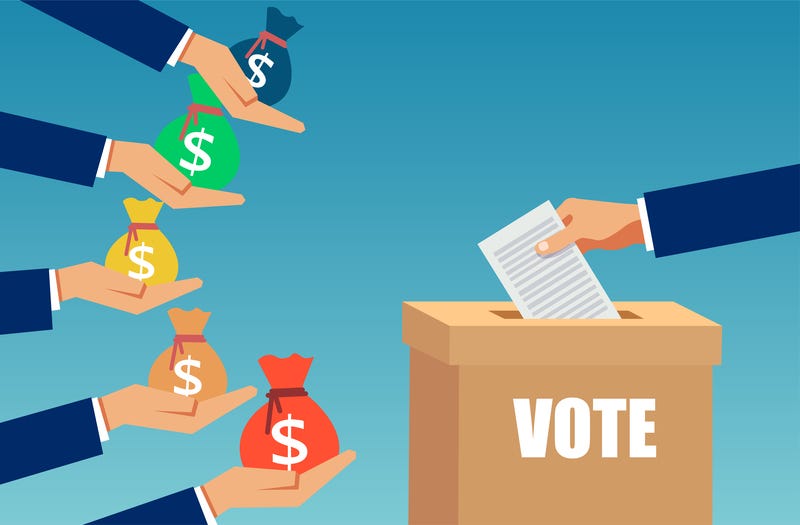
Campbell McManaway is unusually frank about what a political donation is worth. His company, Cando Fishing, gave New Zealand First $30,000 in August, and he told Newsroom’s Andrew Bevin it was a modest outlay: “$30,000 is not much when you’re talking a $200 million industry.” I suspect plenty of this year’s big donors have done the same sums, even if they keep the working to themselves.
The best guide to where the money is going is RNZ’s data journalist Farah Hancock, who has tracked every large donation declared this year. Her latest piece turns to the other side of the ledger: what a campaign costs, and how the parties scramble to pay for it. It’s the best thing I’ve read on campaign money this election.
I’ve been writing about political donations all year, and most of the coverage, mine included, has tracked how much money is flowing and to whom. Much less has been said about what the money is for, and the evidence suggests it isn’t buying many votes.
The wealth primary has already been run
The American legal scholars Jamin Raskin and John Bonifaz coined the term “wealth primary” for the contest held before any voter goes near a ballot box. Parties first have to win over the people with money, and only those who succeed get to compete seriously for votes.
New Zealand’s version is all but over. My calculation from the Electoral Commission’s current large-donation register, up-to-date as of this afternoon, puts disclosed contributions at more than $7.5 million, already above the whole of 2023 with a month of campaigning left.
Act leads with approximately $2.37 million, followed by National on $2.29 million. Labour has $890,000, NZ First $833,000, Opportunity $492,000 and the Greens $447,000. The governing parties together account for about $5.5 million, against $1.45 million for Labour, the Greens and Te Pāti Māori. In these filings, that is almost four dollars for every opposition dollar.
Between them, Graeme Hart’s Rank Group and Zuru’s Nick Mowbray account for more than $1.1 million. Rank Group has put $500,000 into National and $200,000 into Act, and Mowbray $250,000 into National and $225,000 into Act. Each has backed both horses.
Hot chips, pizza and a $500,000 cheque
Labour president Jill Day told Hancock that “An election costs us around about $5 million to run”, plus up to $2 million a year in running costs, against a state broadcasting allocation of about $900,000. “It’s fairly obvious that it’s not an even playing field,” she says.
The Greens face similar pressures. Party secretary Miriam Ross says their 2023 campaign cost $2 million, with running expenses adding another $2 million that year. She expects this campaign to cost a similar amount, “but adjusted for inflation”.
Ross argues that the broadcasting allocation formula reinforces the advantage of established parties because previous results, parliamentary representation and public support help determine what they receive. Funding should reflect some evidence of public support. But voters also need an opportunity to hear new parties before deciding whether to support them. A system that heavily rewards previous success makes that harder.
Labour’s volunteers run on what Day calls “hot chips and pizza”. Ross says small donations are the Greens’ “bread and butter”, but the cost of living is biting: “All the indicators are that people are struggling, able to give less.”
So it’s no surprise Labour wheeled out Dame Jacinda Ardern at the weekend, in a video emailed to supporters asking for money. “Every single pledge, regardless of the dollar amount, is someone putting up their hand and saying they support you,” she said. The Spinoff’s Henry Oliver judged her “very much a fundraising asset rather than a political one”.
Hancock found Labour’s small donations in 2023 averaged $50. At that rate, the party would need around 14,000 of them to match what Rank Group alone has given this year.
Hart also received a timely tribute last week, when Sir John Key, who opened National’s campaign, used the Herald’s Future of New Zealand debate to mock the idea that being a billionaire might be morally questionable: “If you’re Graeme Hart and built the best packaging business in the world, that’s morally offensive? That is nuts!” None of the coverage I’ve seen mentions that Rank Group had given National $500,000 this year.
Money that doesn’t buy votes
Act has drawn more than five times the Greens’ large donations this year, despite winning a smaller share of the party vote in 2023 (8.6% against 11.6%), a mismatch Maria Armoudian, Ben Dekker and Timothy Kirpal Kuhner highlight in The Conversation. The Post’s Harriet Laughton found the Greens outspent National on digital advertising in the first week of the official campaign, with a fraction of its donations.
Kim Dotcom put $3.5 million into the Internet Party in 2014 without winning a seat. Even Garth Barfoot, who has given National $50,000 this year, told Stuff’s Glenn McConnell that “Winston has shown that money isn’t everything.”
Political scientist Grant Duncan has been wondering about this on his Substack. He says there’s “no known correlation” between what parties raise and the votes they win. “What value for their money are these donors getting?” he asks of Act’s backers.
The paywall now starts at halfway through all Democracy Project newsletters. Please take out a paid sub if you want to support this service and access the full content, including the following sections:
“A chat about life”
“The donors’ veto”
“Promises with a donor’s postcode”
“What you won’t see before you vote”
“Will the winners change the rules?”
