

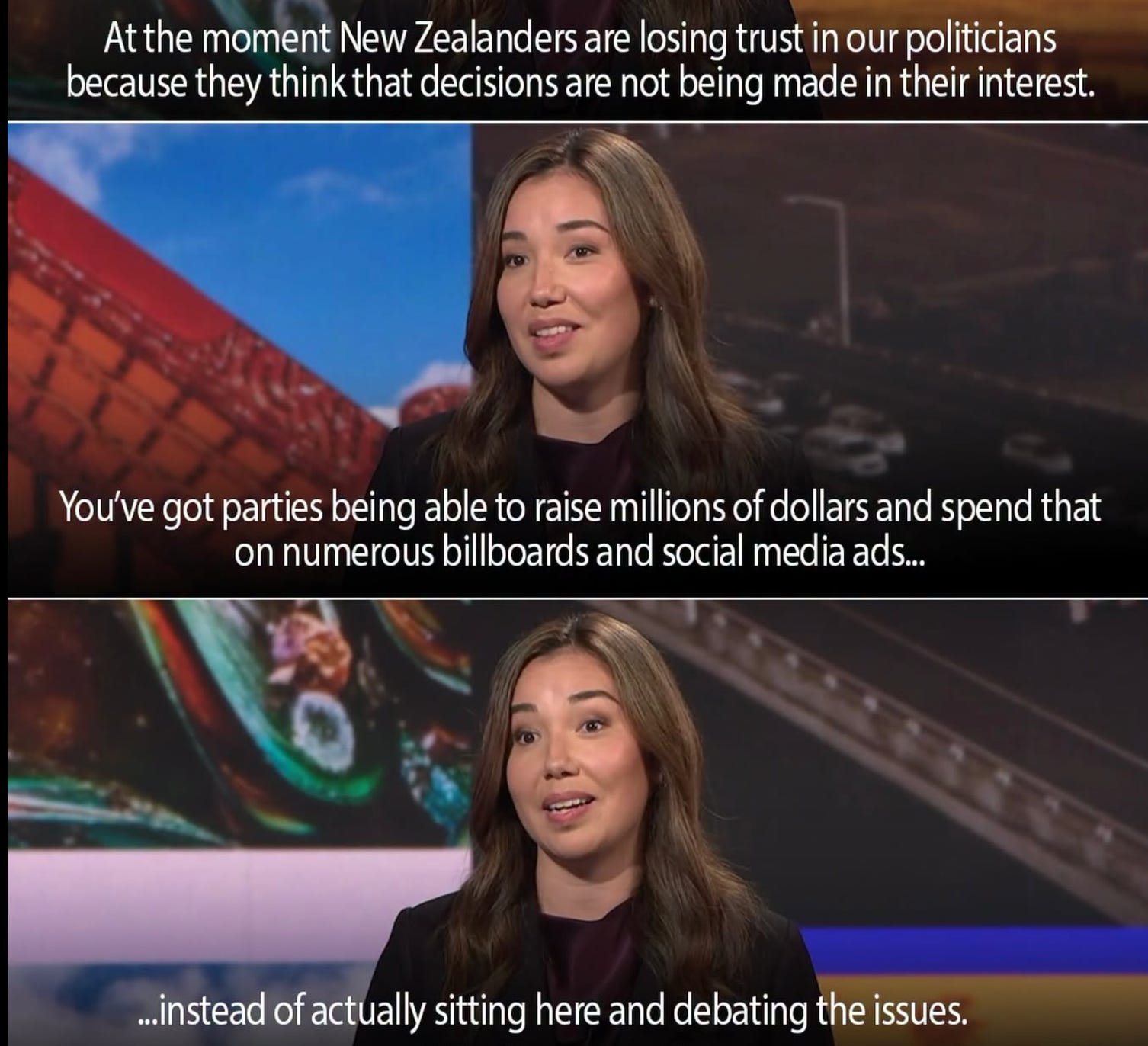
The party that has never had an MP could now decide which Chris becomes prime minister after the election.
Last night brought that possibility into sharper focus. The latest 1News-Verian poll put Opportunity on 8%, with ten projected MPs. Party leader Qiulae Wong then spent the multi-party leaders’ debate demonstrating why the established parties are finding her increasingly difficult to dismiss.
Winston Peters and David Seymour had both predicted this week that Opportunity would fail to enter Parliament. By the end of the evening, the more pressing question was what would happen to their influence if Wong’s party did make it.
Opportunity is increasingly the party around which National’s and Labour’s options revolve. Wong is contesting the position Peters has occupied at crucial elections: the politician whose support determines who governs.
The party neither side can ignore
National and Labour are both on 28%. National’s current partners, Act and NZ First, are each on 10%. In the Post political editor Henry Cooke’s calculation, which assumes no overhang, those three parties would have 58 seats, three short of a majority.
Labour and the Greens would have 52 seats in that calculation. Adding Opportunity’s ten seats would give either bloc a majority. Electorate results could change Parliament’s size and the majority required, but the scenarios reported by 1News also leave both existing blocs short. Cooke concludes that the poll “suggests there is no path to power for Christopher Luxon if he does not pick up the phone to Opportunity”.
Opportunity is smaller than Act and NZ First in this poll, but could have more room to bargain. Both of those parties are committed to a National-led government. Wong wants the option of negotiating with either major party. Whether that gives her a choice between governments depends on National being willing to deal.
Entry to Parliament is not assured. Stuff’s Sam Smith has counted “all but two of 13 political polls” since the start of August with Opportunity at or above 5%. Last week’s Taxpayers’ Union-Curia poll had it on 4.8%. Without an electorate victory, that would leave the party outside Parliament.
Getting in would itself be a significant breakthrough. No new party has entered Parliament since the first MMP election without already having a sitting MP.
The latest poll was completed before the debate, so it tells us nothing about the effect of Wong’s performance.
The position Peters has opened up
It is tempting to describe Opportunity’s rise as the end of three decades in which New Zealand voted and Winston Peters chose the government, but that gives Peters too much credit. Reporting Peter Dunne’s argument about the “kingmaker myth”, the Spinoff’s Toby Manhire notes that only two of the ten MMP elections have given a single party a clear choice between National-led and Labour-led governments.
In 1996 and 2017, Peters negotiated with both major parties while voters waited weeks to learn who would govern. At other elections, minor parties have been necessary to a coalition without being able to choose between governments.
Peters remains powerful. NZ First is polling above Opportunity, and he could return to Cabinet with considerable influence. Yet Labour and NZ First have ruled each other out. And Peters said last night he would be comfortable working only with the existing coalition parties. Peters has narrowed his options. Wong is trying to keep hers open.
Luxon still says he will not work with Opportunity. In the unlikely event that National maintains that refusal and these numbers hold, Wong’s viable route into a governing arrangement would only be with Labour. She would have a choice between governments only if National changed its position and its partners accepted a deal.
National’s position is awkward. At last week’s leaders’ debate Luxon insisted, “I’ve been clear about Opportunity.” Last night, Wong admitted she did not have his phone number. “I’m sure anyone can hand it over,” she said, gesturing at the other leaders, according to 1News.
RNZ political editor Jo Moir doubts Luxon would maintain his refusal: “There is no planet on which Christopher Luxon does not pick up the phone if he needs to.”
The pressure is already generating discussion inside National. Politik’s Richard Harman reports that influential party voices favour a deal with Opportunity “even if that meant having to replace Luxon with another leader”. How much support that view has remains unclear. But it shows how a party outside Parliament can become a problem for the leadership of the party in government.
Wong stakes her claim
At the first multi-party debate, the Herald’s Adam Pearse described Wong as the quietest participant, although she still led its unscientific online audience survey.
Last night she stood beside Peters, who first took his seat in Parliament in 1979 and repeatedly questioned her political credentials. She was much more willing to interrupt and challenge her opponents.
The clearest distinction between Opportunity and the Greens emerged in her exchange with Chlöe Swarbrick. Swarbrick said her party was “not interested in reinstalling Christopher Luxon as Prime Minister”. Wong replied: “Imagine how many of those most egregious things that have happened in the last three years the Greens could have stopped if they were willing to work with National.” Swarbrick shot back: “And allow the vulnerable to be punched down upon.” Coughlan read Wong’s answer as a description of Opportunity’s role in a National-led government: “That role is to be the handbrake.”
Wong was offering to restrain a National-led government. Swarbrick was offering to replace it. For voters who want Luxon gone, Wong is asking a lot: trust her to improve a government they want removed. Still, the exchange gave viewers a reason for Opportunity’s existence beyond a different leader delivering a broadly similar policy programme. Stuff’s Jenna Lynch thought Wong’s “strongest moments came in positioning her party”. Her verdict was emphatic: “This debate was hers.” Coughlan preferred Swarbrick overall, with Wong a close second. He remained sceptical about how convincingly Opportunity had demonstrated policy centrism.
McCulloch captured the significance for the newcomer: “The latest poll suggests the party has momentum, but last night’s debate proves it has some muscle too.”
The paywall now starts partway through all Democracy Project newsletters. Please take out a paid sub if you want to support this service and access the full content, including the following sections:
“The opening left by the major parties”
“What kingmaker power could change”
“A new kingmaker needs scrutiny”
