

Arguments about the current energy crisis have shifted. It is no longer just about what ministers are doing now. It is also about what they chose not to do when they had the chance.
This morning brought the clearest accountability journalism to this debate. Kate MacNamara in the Herald and Edward Miller in The Post both zero in on the same issue: New Zealand was left more exposed than it needed to be, and ministers were warned about the country’s lack of fuel reserves.
The Diesel reserve we scrapped
Kate MacNamara’s Herald investigation published in the Herald today lays out the timeline with forensic insight. After Marsden Point’s refinery closed in 2022, the Labour Cabinet agreed that a 21-day minimum diesel stockholding was not enough. They committed to a government-contracted public reserve of an additional seven days. That’s 70 million litres of diesel to be stored in the old crude tanks at Marsden Point. MBIE issued a request for proposals in late 2023. The plan was to have fuel in the tanks by early 2025.
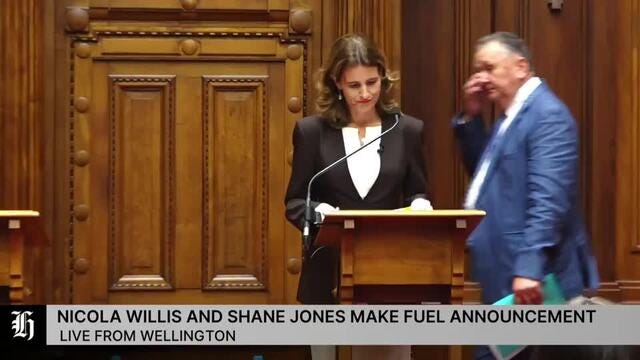
It never happened. First, Labour left the capital costs (in the region of $100 million) unfunded. And while the incoming coalition made plenty of noise about fuel security, Associate Energy Minister Shane Jones then killed off the plan in a July 2024 Cabinet Paper.
His reasoning was laid bare in the document: “Procuring reserve diesel is expensive. At current prices, 70 million litres would cost $84 million. As the current fiscal environment constrains our ability for new capital investment, I seek your agreement to stop work on securing tank storage and purchasing diesel through this arrangement.”
The paper acknowledged the consequences plainly: “This will prolong our vulnerability to a diesel supply disruption until potentially 2028 but this is unavoidable without committed funding.”
That $84 million figure — roughly $1.20 a litre stripped of taxes and levies — has been, as MacNamara puts it, “thoroughly flattered” by a Middle East war that has doubled the price. The price tag that ministers balked at last year now looks cheap. And now the country is scrambling without the reserve it rejected.
After axing the plan, MacNamara explains that Jones commissioned fresh consultants (Castalia and Enerlytica) who duly reached the same conclusion their predecessors had: diesel would likely run short in a 90-day disruption. The Government’s response was to push the obligation onto fuel companies, requiring them to build reserves to 28 days. The deadline? July 2028. That pushed the problem onto industry but gave them a major extension of time.
MacNamara’s summary is withering: “For years, New Zealand’s diesel dilemma has been whether to pay for extra stockholdings for use in the case of emergencies or risk it. So far, we’ve been risking it.”
Edward Miller’s companion piece in The Post today is the insider’s version of the same story. Miller fought from the union movement side to keep Marsden Point’s refining capacity operational, and his account of the decisions that followed its closure carries particular weight.
He notes that MBIE itself verified that the refinery could have been retained as emergency resilience capacity: producing fuel inefficiently but indefinitely in a worst case, enough to keep ambulances and food trucks running. The owner of Marsden Point is Channel Infrastructure, and its CEO Rob Buchanan told Newstalk ZB last week that two recommissioned crude tanks at Marsden Point — holding some 90 million litres — could be ready in two to three months. Jones had this option available. Miller points out that he did not take it.
Miller’s verdict is blunter still: “You can’t call the insurance company after you’ve crashed your car and request a policy. Your best bet might then be to blame the other driver, which may help explain why Jones has been particularly vocal of late on the question of who is responsible for our precarious fuel security position.”
Miller’s retrospective account of the diesel reserve decision is damning in the same way MacNamara’s is, but sharper: “Having been told that increased diesel storage was the cheapest option to safeguard resilience, Jones’ failure to pursue that option in the last year has left us dangerously exposed.”
Labour bears plenty of blame. It let the refinery close and didn’t properly fund the reserve plan. But the decision to actually kill the reserve, in writing, sits with this Government.. Jones is now hinting at using regional development funds to buy the very diesel storage he scrapped eighteen months ago.
What if the forecasts are wrong?
Richard Harman’s Politik column today explains that the Government is quietly preparing to access 40 days’ worth of emergency fuel stocks held in the UK, the US and Japan under International Energy Agency agreements. Jones confirmed it at Friday’s briefing: “The Minister of Finance and I are taking advice from the officials as to the most efficient and effective way to use those options to bolster a buffer for New Zealand.”
Harman points out that the fact that this is being discussed tells you something the public messaging doesn’t: the Government believes this crisis will last months, not weeks. And there is a logistical problem nobody has solved: Marsden Point has storage capacity for only about a week’s use of any procured IEA reserves. One option being floated is chartering a tanker and mooring it at the port as floating storage. The fact ministers may need to park a tanker off Marsden Point because there isn’t enough onshore storage tells you how badly basic resilience planning has failed.
Harman’s sharpest insight concerns the data. The entire crisis management apparatus rests on forecast data supplied by the fuel companies themselves. At Friday’s briefing, Jones was careful to note: “The fuel companies have not once confirmed with us that they believe that they’re going to suffer any supply problems.” But the Government is simultaneously preparing for the possibility that those forecasts prove wrong. You can’t simultaneously assure the public nothing will go wrong while chartering floating storage tankers for when it does. That contradiction is getting bigger.
Nathan Surendran, an energy systems engineer writing on Substack, makes the most pointed version of this argument. The Government published six triggers for moving from Phase 1 to Phase 2 of its fuel plan. The first is export restrictions imposed by countries whose refineries supply New Zealand. South Korea imposed mandatory export caps on 13 March, and China banned fuel exports entirely. Thailand followed by banning most refined product exports. By the Government’s own published criteria, the trigger for Phase 2 was crossed weeks ago. Surendran’s contrast is sharp: New Zealand launched an EECA advertising campaign urging people to carpool, while every country in our supply chain declared some form of emergency.
Meanwhile, the Government’s billion-dollar LNG terminal is its signature answer to the electricity dry-year problem is starting to look dead on arrival. Energy Minister Simon Watts said in February that Cabinet had made “a definitive decision to build.”
Beehive sources now say the economics have “fundamentally changed” with LNG prices more than doubling since the war began, and ministers are privately considering walking away. The terminal was designed on the assumption of cheap Qatari gas. Qatar’s Ras Laffan facility, which is the source of a fifth of the world’s LNG, has been hit in strikes and may be partly offline for three to five years. In other words, ministers backed an electricity-security fix that depended on a global gas market now in chaos.
Who’s actually leading?
Luxon’s absence has become part of the story now. That is not just media froth. It matters. A Prime Minister doesn’t get to vanish into the background while his Finance Minister becomes the public face of a national fuel emergency.
The paywall now starts at halfway through all Democracy Project newsletters. Please take out a paid sub if you want to access the full content and support this service.