

A year ago, breaking up the electricity gentailers was protest-chant politics. Consumer advocates pushed it. So did some unions and the odd contrarian academic. It sounded too “radical”, too “anti-market”, too likely to be swatted away with the ritual phrase “investor confidence”.
Over the past week, the proposal to break up New Zealand’s gentailers — splitting the big four power companies into separate generators and retailers — has gone from fringe idea to something approaching a national conversation. And the people driving it aren’t leftwing agitators or fringe populists. They include the founder of Xero, the former leader of the National Party, the managing director of New Zealand’s largest KiwiSaver provider, and the chief operating officer of an independent power company.
That’s the story this week. Not the policy itself — I wrote about that when Peters announced it last Sunday — but the strange new coalition forming around it. And what it tells us about the growing chasm between the political establishment and everyone else.
The Telecom moment, again
The comparison everyone reaches for is Telecom. In 2006, the Government forced the separation of Telecom’s network infrastructure (Chorus) from its retail business (Spark). The same objections were made then: too disruptive, would chill investment, uncertain outcomes. It happened anyway. Broadband improved.
Peters and Shane Jones have both been invoking this comparison since February. Peters told RNZ that the current electricity system was set up 28 years ago, there was always a proviso that prices would be regulated if they failed to plateau, and that proviso was never used. “New Zealanders are being screwed,” he said.
NZ First has also quietly published an actual policy paper. Titled “Fixing a Rigged Game: A New Electricity Era for New Zealanders and New Zealand Businesses,” it runs to 18 pages. No media outlet has reported on it, but the paper is worth reading. It goes well beyond stump-speech rhetoric. See the file here:

One figure stands out: in the decade to 2023, the gentailers paid total dividends of $10.7 billion — including excess dividends of $4.2 billion — while investment on plant, property and equipment came to only $4.5 billion. For every dollar invested in actual infrastructure, $2.41 went to shareholders. The paper calls this the predictable result of a system that rewards scarcity and punishes supply. It also deploys a phrase that deserves wider use: the electricity sector, it claims, has relied on “weaponised complexity” to stagnate any reform process. If the jargon is thick enough, the theory goes, the public gives up.
It also raises the solar buyback issue, which hasn’t attracted nearly enough attention. Peters noted that households wanting to feed excess solar power back into the grid are “just being ripped off” on buy-back rates. The paper backs mandated net metering in which households pay the same rate for exported power as they pay when they buy. This single change, the document argues, could mobilise mortgage capital into rooftop solar at scale.
Whether the detail survives scrutiny is another question. But the document exists, and that counts for something. When I wrote last week that the energy policy came without a credible implementation plan, NZ First has at least tried to fill the gap. The other parties should be held to the same standard.
Danyl McLauchlan’s diagnosis
The sharpest analysis of what’s happening here comes from Danyl McLauchlan in this weekend’s Listener, in a piece called “Fuel for a Crisis.” It deserves reading.
McLauchlan sets the scene: Fitch has revised New Zealand’s credit outlook to negative. GDP per capita continues to slump. The country has borrowed its way through four once-in-a-generation shocks in 18 years and the room to do it again is running out. Against that backdrop, Peters picks up what McLauchlan describes as “the most dumbfoundingly obvious cost-of-living policy during an energy crisis because none of the other parties seem to notice it lying there.”
His framing for why it happened, and why none of the other parties got there first, is cutting. Napoleon, McLauchlan writes, apocryphally said he simply found the crown of France in the gutter and picked it up. Peters has done something similar. There was even, McLauchlan notes, “a hint of bafflement to his announcement. Why don’t his political rivals do any politics?” It’s actually a devastating question.
McLauchlan’s explanatory framework in the Listener is the concept of the “Stakeholder State,” which he borrows from Paul Ovenden, Keir Starmer’s former head of political strategy. Ovenden described it as “the gradual but decisive shift of politics and power away from voters and towards groups with the time, money and institutional access to make themselves too important to ignore.” Ovenden described Westminster as captured by “a complex coalition of campaign groups, regulators, litigators, trade bodies and well-networked organisations.”
McLauchlan’s observation is simple: “This is a perfect description of Wellington.”
He then lands a detail that deserves far more attention than it has received. Christopher Luxon’s chief of staff is the former chief executive of the Electricity Retailers and Generators Association, which is the industry’s own lobbying group. That is not a conflict of interest you can hand-wave away.
McLauchlan’s verdict on the two major parties is bleak. National and Labour have spent a decade “flailing about for energy policies — any energy policies! — that could protect the electricity cartel.” He lists them: pumped hydro at Lake Onslow, an LNG terminal in Taranaki, a polite letter from Nicola Willis to the gentailers suggesting they might like to build more supply. McLauchlan imagines the gentailer executives in their boardroom, shaking with laughter, commanding an underling to read the letter aloud one more time.
His conclusion is devastating. The implicit pitch from both Labour and National is managed decline. Hipkins might accelerate it with more borrowing. Luxon offers a slower, more cautious collapse.
When the Business Establishment breaks ranks
Here’s what makes this political moment genuinely strange.
Rod Drury — Xero founder, recently crowned New Zealander of the Year — published a detailed LinkedIn paper on structural separation this week. Drury has been pushing this for some time, but the NZ First move prompted him to lay it out formally.
Drury’s argument isn’t mostly about bills. It’s bigger. Strategic opportunity. He thinks New Zealand’s electricity market is failing to deliver affordable, competitive, renewable energy, and that structural separation would unlock something: real competition, lower costs, innovation, faster decarbonisation.
He envisions a National Electricity Infrastructure Company, which would be something like Chorus but for generation, attracting capital from global super funds, mandated to overbuild toward 100% renewable electricity. The goal, in his framing, is “the lowest cost renewable energy in the world.” He even suggests New Zealand could become an exporter of clean energy to offshore AI data centres. “There hasn’t been much excitement for New Zealand voters for a decade,” Drury wrote. “Perhaps the vision of Lowest Cost Renewable Energy in the World becomes our next nation-building project.”
His post was liked by the Reserve Bank’s chief economist Paul Conway, David Cunliffe, Paddy Gower, and Sam Stubbs.
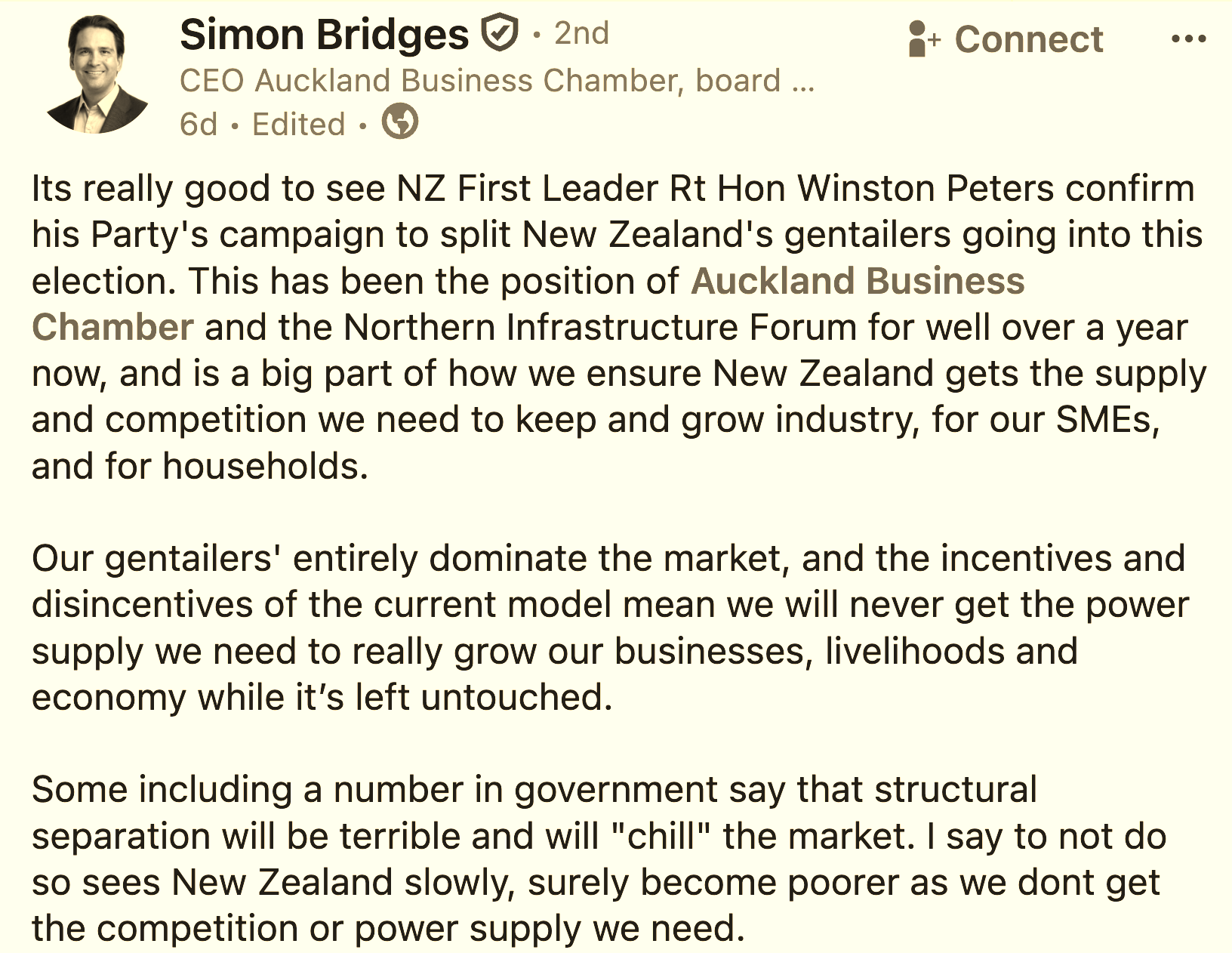
Simon Bridges went further. The former National Party leader and current CEO of the Auckland Business Chamber said NZ First’s policy was right. On LinkedIn he was explicit this week: “It’s really good to see NZ First Leader Rt Hon Winston Peters confirm his Party’s campaign to split New Zealand’s gentailers going into this election. This has been the position of Auckland Business Chamber and the Northern Infrastructure Forum for well over a year now.”
Notably, his post was liked by Rod Drury, Sam Stubbs, Fran O’Sullivan, Paul Conway (the Reserve Bank’s Chief Economist), and Tex Edwards, among others.
These are not radicals. Simon Bridges ran the country’s largest political party. Drury is the most celebrated tech entrepreneur New Zealand has produced. When figures like these start calling for structural separation, and doing so publicly, the Overton window doesn’t just shift a little, it cracks right open.
Stubbs, Cooney, and the other voices
Sam Stubbs, managing director of Simplicity KiwiSaver, has a sharp column in today’s Sunday Star-Times that takes a slightly different angle. His target is politicians, not gentailers. Governments have maintained 51% ownership and 100% control while refusing to fund new generation. The result is textbook rent-seeking. Build less, raise prices, pay dividends. Treasury estimates cumulative gentailer dividends since listing at $5.4 billion.
Stubbs nails the ugly irony: politicians who oversaw this dividend addiction now publicly blame the companies’ management for high prices. “It’s like your manager making a mistake, but publicly shaming you.” His solution is to allow New Zealanders to own more of the government’s stake, diluting Crown control while keeping a blocking stake. His solution differs from NZ First’s, as it’s more cautious, less radical. But he’s pointing the finger at exactly the same place: successive governments that created this mess.
Margaret Cooney, chief operating officer of Octopus Energy, wrote in the Post this week that politicians should “go bold and fast on electricity.” Her argument: you cannot rely on the incumbent gentailers to lead the transformation. They are rational businesses built for steady-state growth, managed risk and reliable dividends. Dry year risk went unmanaged. The decline of domestic gas went unplanned. The Huntly firming deal only happened under political pressure. As Cooney puts it: “Waiting for incumbents to voluntarily disrupt their own profitable status quo is not a strategy. It is wishful thinking.”
She also flags a structural absurdity: gentailers can cross-subsidise their retail arms at prices that independent retailers cannot replicate. The two companies that won Consumer NZ’s People’s Choice award in 2025 — Flick Electric and Frank Energy — have since closed or been absorbed by the very gentailers they were competing with. That’s not a competitive market.
Three parties, and a squiggly piece of paper
As Mandy Te reported for Interest.co.nz, NZ First, the Greens and Labour are now all now eyeing changes to the gentailer model. But most importantly, Green MP Scott Willis has had a Members’ Bill in the ballot since early 2024 that would enforce corporate separation. When Peters announced the NZ First policy this week, Willis promptly wrote to him suggesting NZ First could simply support the existing bill and get it done now.
Peters responded by holding up a piece of paper with crayon squiggles on it, claiming his team was trying to figure out what it said. It was humourous, but also revealed something real: Peters wants to own this policy, not share it. If Willis’s bill is sitting there, ready to go, why not just say yes? Because NZ First needs this as an election platform, not a legislative achievement. Fair enough politically. Less fair to the households paying the bills in the meantime.
Chris Hipkins told reporters he was “absolutely leaving the door open to fundamental changes to our electricity market.” That is the political version of a holding statement. But it is further than Labour has gone before.
Luxon shut it down: splitting the gentailers would “drive a lot of uncertainty in the energy sector when we need a lot of certainty right now.” His chief of staff used to run the gentailer lobby. Connect those dots yourself.
The Numbers the politicians are ignoring
One of the underreported aspects of this debate is how much support the breakup already has in the business community. The Auckland Business Chamber poll found 49% of voters wanted the split, with only 20% opposed. The 2024 Mood of the Boardroom survey asked business leaders whether the government should “do a Telecom” and separate retailers from generators: 39% said yes, 23% said no, 38% were unsure.
So, support for the split runs almost two-to-one over opposition among business leaders. The policy establishment has been well behind public and business opinion on this for years.
Who this is really about
There is a contradiction sitting at the centre of all this that deserves naming. The people calling loudest for reform are establishment figures. Simon Bridges ran National. Rod Drury built Xero. Sam Stubbs runs Simplicity. Margaret Cooney runs Octopus Energy NZ. Yet it’s the establishment parties — National and Labour — refusing to move.
McLauchlan’s stakeholder state concept explains the gap. The major parties are not paralysed by ideology. They are captured by institutional relationships. Both have become addicted to the dividend flows. The legal and regulatory framework around the electricity market was designed by, and for, the incumbents. Changing it would mean a fight with some of the most powerful corporate interests in the country. Neither party seems willing to pick it.
Peters, for all his track record of campaign promises that evaporate between election day and coalition negotiations, at least has. McLauchlan is honest about the risk. NZ First has its own stakeholders: forestry, fishing, racing, mining, tobacco. The policy may vanish, he writes, “like cigarette smoke on a windy street.” But it is a specific alternative that cuts against stakeholder interests in favour of the public. And right now, that is more than anyone else is offering.
The deeper story here is not really about electricity. It is about whether New Zealand’s political system is capable of taking on entrenched interests when those interests are transparently working against the public. The gentailer breakup has become a kind of litmus test — not just about energy policy, but about whether politicians are willing to confront concentrated corporate power when it matters. The evidence so far is not encouraging. But the conversation has moved further in a week than it had in a decade. The pressure is building. And the politicians who think they can ride this one out may find the ground has shifted underneath them.
Dr Bryce Edwards
Director of the Democracy Project
Further Reading: