

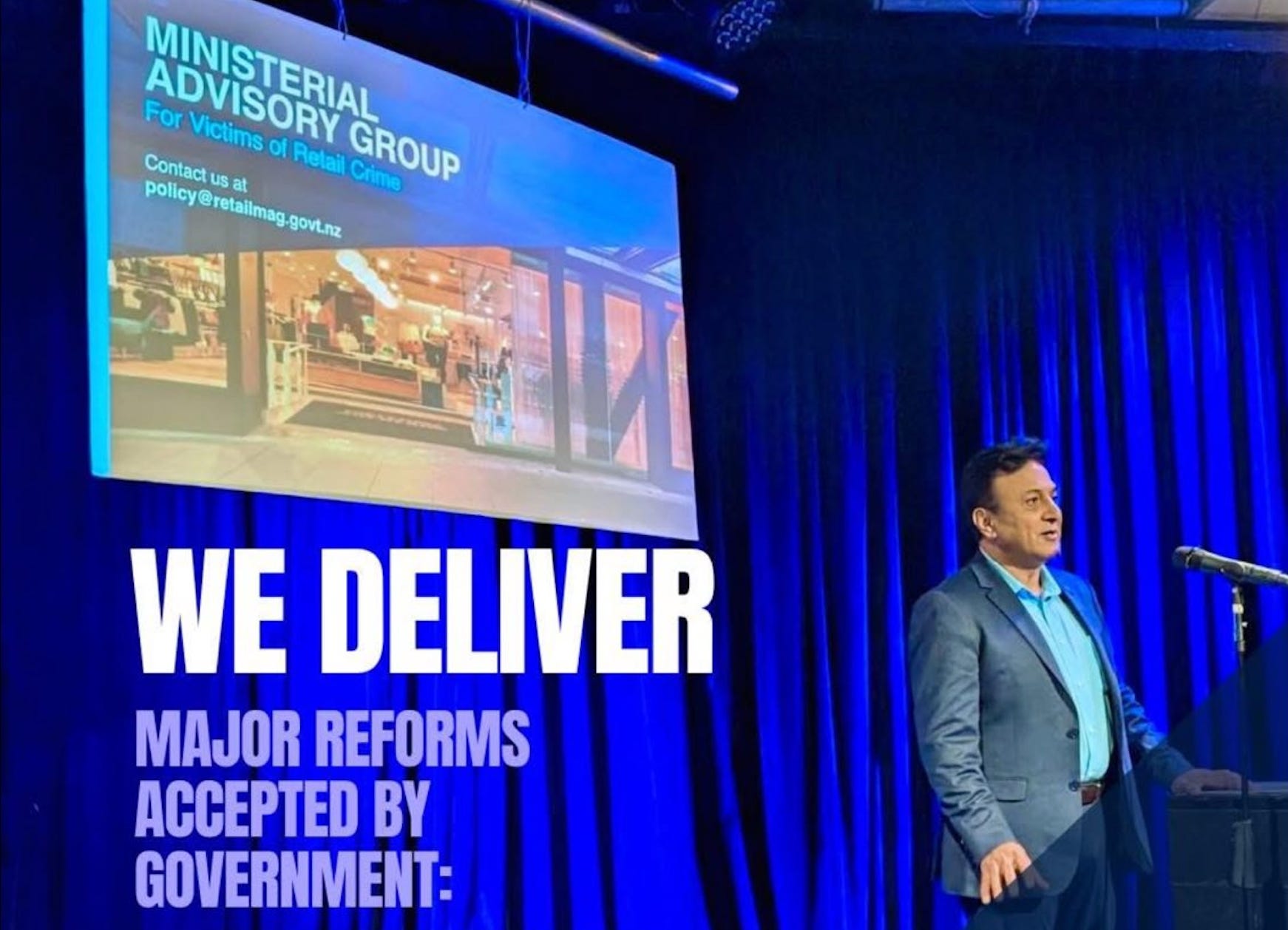
The Government’s Ministerial Advisory Group for Victims of Retail Crime is finally being put out of its misery. After less than two years of existence, $1.8 million in spending, the resignation of three of its five members, and an ongoing trail of embarrassing headlines, Justice Minister Paul Goldsmith announced last week that the group would be wound up months ahead of schedule.
If you want a clear example of how patronage rots policy-making, this is it. The whole episode has been a farce, and an instructive one.
The story of this advisory group is really the story of one man: Sunny Kaushal. And understanding how Kaushal ended up chairing a $1.8-million-a-year government body tells you nearly everything you need to know about the state of political appointments in New Zealand.
From Labour candidate to National’s man
Madeleine Chapman’s excellent profile of Kaushal in The Spinoff traced the arc neatly. Kaushal ran as Labour’s candidate in Pakuranga in 2011, being the “first candidate of Indian origin in New Zealand” to contest an electorate for Labour, as he told the media at the time. He was placed at 43 on Labour’s list in 2014. When Deborah Russell beat him for the New Lynn nomination in 2017, he quit the party almost immediately, citing “hostilities and bullying.” Three months later he was a proud, card-carrying member of the National Party.
This isn’t an obvious “policy expert” appointment. It’s an appointment of a political operator who switched parties when the ladder in one place stopped moving. And yet Paul Goldsmith appointed this man to lead a policy group with a $3.6 million two-year budget, on a daily rate of $920, payable for up to 250 working days a year.
Goldsmith didn’t even pretend the process was merit-based in the conventional sense. He told the Herald he “went out deliberately to find somebody that was going to be ferocious in the defence of retail operators.” He later called Kaushal “absolutely fierce.” What he didn’t explain is why fierce advocacy, of a kind Kaushal had been offering for free to anyone who would listen for years, needed to cost taxpayers nearly a quarter of a million dollars a year in chair fees alone.
A Group designed to deliver predetermined answers
From the beginning, it was obvious what this group was going to recommend. Kaushal had been pushing the same agenda since at least 2017: expanded citizens’ arrest powers, tougher penalties for shoplifting, arming shopkeepers. He outlined these ideas in his Crime Prevention Group “manifesto,” repeated them in op-ed after op-ed, and shouted them at community meetings and on breakfast television.
Then in July 2024 the Government handed him a budget and a title and told him to come up with ideas. What a surprise that the very first recommendation, sent to Goldsmith in October 2024, was an expansion of citizens’ arrest powers, straight out of the Kaushal playbook.
Carolyn Young, the Retail NZ chief executive and one of the group’s five members, told The Spinoff she expected the first task would be establishing a strategic plan and a foundational document outlining the group’s purpose. “It was asked by all other members of the group for it to be done, was asked several times at several of the early meetings, and it just wasn’t done.” Instead, as Young put it bluntly: “The ideas put forward are Sunny’s ideas. They’re not new, and I don’t think they’re widely supported.”
If you’re spending $1.8 million a year of public money on an advisory group, the minimum expectation is that it actually advises — that it gathers evidence, weighs competing views, and produces recommendations reflecting the breadth of the people it claims to represent. What happened instead was that a political appointee used the group to launder his long-standing personal advocacy into the appearance of formal government advice.
The Members who walked
By January 2026, three of the group’s five members had resigned. Carolyn Young (Retail NZ), Lindsay Rowles (Foodstuffs North Island), and Michael Bell (Michael Hill) all departed within a month of each other.
Young was the only one willing to talk publicly, and she didn’t hold back. She described the group’s internal culture as “a very unpleasant environment.” It “wasn’t a nice place to go and spend an afternoon in a meeting room, that’s for sure.” She said she felt the final advice sent to the minister “did not consistently reflect all members’ positions,” and that there were occasions where “one or two voices” overruled the rest. She told The Spinoff that the three resignations were “linked.”
As Chapman noted, the three departing members collectively represented approximately 80% of the victims of retail crime. The two remaining members (Kaushal and Hamilton liquor retailer Ash Parmar) were respectively the president and vice-chair of the Dairy and Business Owners Group. Parmar was a former Act Party candidate. The group that was supposed to represent the breadth of retail crime victims ended its life as a vehicle for dairy and small-retail voices representing about 20% of the target population.
Goldsmith’s response to the resignations was telling. He initially attributed them to “external commitments and job changes.” When pressed, he acknowledged Kaushal could “rub up some people the wrong way” but said this hadn’t changed his confidence in the chair. This is the same minister who had received official advice from Ministry of Justice officials about “concerning behaviour” by Kaushal — advice he refused to release to the public or even describe, claiming legal privilege.
The Money trail
It’s worth looking at the money involved, because the funding was remarkable for a body of this kind.
Kaushal personally invoiced $238,625 in his first 12 months as chair, billing for the maximum 250 days allowed under his contract. Nearly $971,000 was spent on contractors, including policy advisers, administrative support, and a social media contractor. Three principal policy advisers were hired at daily rates of $1,261, $1,126, and $1,036 respectively.
The group rented a 389-square-metre office on Symonds Street in central Auckland for $119,000 a year (or $131,000 including power and other costs). RNZ reported that Ministry of Justice officials had originally recommended a cheaper shared space with Kāinga Ora in Ellerslie, but Kaushal rejected it on privacy grounds. As Taxpayers’ Union investigations coordinator Rhys Hurley put it: “This isn’t the SIS.”
Catering also drew scrutiny. Nearly $24,000 was spent on 22 stakeholder engagement meetings, with some Auckland meetings running over $4,000 each. Rock melon, goat’s cheese and prosciutto crostini featured on the menus, alongside $9 bottles of Coke. After this emerged at select committee, Goldsmith conceded the events were “clearly over-catered” and “probably had too many scones.”
All of this was funded from the Proceeds of Crime Fund. This is money meant to reduce harm for victims, not bankroll a luxury mini‑bureaucracy for political allies.
Overall expenditure reached $1,822,170 by December 2025, effectively burning through its entire annual budget in half a year. And what did the taxpayer get for all this? A Crimes Amendment Bill containing citizens’ arrest provisions that are opposed by the Police Association, the Employers and Manufacturers Association, Retail NZ, unions, Hospitality NZ, and the MTA. Even members of the advisory group itself publicly opposed the centrepiece policy.
Citizens’ arrest — the toxic legacy
The group’s signature policy achievement is a proposal to let ordinary citizens detain anyone they believe is committing a Crimes Act offence, at any time of day, using “reasonable force.” The Government has folded this into the Crimes Amendment Bill, which had its first reading in December.
What’s striking is just how wide the opposition has been. Police Association president Chris Cahill said police had already advised against expanded citizen arrest powers under the previous government, adding: “there are lots of things that I don’t think have been thought through in this legislation.” Retail NZ’s Carolyn Young called the proposal “extremely dangerous — people will get hurt or even killed.” The MTA, representing 900 petrol store operators, said it “could be a backward step.” Hospitality NZ flagged it as “a significant health and safety risk.”
One of the most enthusiastic supporters was Destiny Church leader Brian Tamaki, who said he was “excited” about “increased powers to police... where law and order has failed.” That probably tells you something.
Kaushal, naturally, was ecstatic. He’d been asking for this since 2017. “We’re building a legacy of reform not a wall of excuses,” he posted on Facebook, alongside branded graphics and hashtags like #SunnyKaushalNZ. Scroll his page and you’d be forgiven for thinking he was an MP rather than an advisory group chair.
The Deeper integrity questions
This story is not just about one advisory group. It’s about what happens when governments treat policy-making bodies as rewards for political loyalty.
The chain of events tells its own story. Kaushal campaigns enthusiastically for National in 2020 and 2023. He organises community meetings attended by Mark Mitchell, Paul Goldsmith, and Nicole McKee. National wins the 2023 election. Within months, Goldsmith announces a $3.6 million advisory group and installs Kaushal as its chair. The most vocal advocate for specific policy changes is now on the government payroll, being paid to recommend exactly those changes.
This is precisely how political appointments corrupt the policy process. You don’t need an envelope full of cash to have corruption of the process. You just need to build a system where the person providing the “independent” advice is a political ally who has been advocating the same position for years, who owes his role to a minister, and who has no accountability beyond that minister’s willingness to defend him.
Goldsmith never answered whether anyone besides Kaushal was considered for the chair role. His office didn’t respond when The Spinoff asked.
And it wasn’t just Kaushal. The other remaining member, Ash Parmar, was a former Act electoral candidate. These are not independent experts bringing fresh perspectives to a complex policy problem. They are coalition allies being given the keys to policy development.
The Lessons
The Retail Crime Advisory Group farce illustrates several problems I’ve been writing about in this column for years.
First, political appointments to advisory bodies corrupt the policy process. When you appoint someone to “advise” on policies they’ve already been demanding, the advice is predetermined. The group didn’t discover that citizens’ arrest was the answer. It was set up to produce that answer. The $1.8 million was the cost of manufacturing the appearance of a legitimate process.
Advisory panels are attractive to governments precisely because they look like action, bringing in some “experts”, announcing a group, generating some headlines. But when those experts turn out to be mates, the exercise loses credibility.
Second, the lack of transparency was appalling throughout. The Ministry of Justice refused to release the group’s advice and recommendations. It refused to release advice about “concerning behaviour” by the chair. Final reports were sent to the minister without all group members seeing them. The public was effectively asked to trust that everything was above board, with no way to verify it.
Third, Goldsmith’s unwavering defence of Kaushal, even as the group disintegrated around him, shows how political appointments create perverse incentives for ministers. Admitting the appointment was a mistake would be admitting the process was flawed. So the Minister doubles down, calling the chair “absolutely fierce” while the bodies pile up.
And fourth, this was poor value for money by any reasonable standard. Nearly $2 million was spent to produce policy recommendations that were opposed by the majority of the retail sector, the police, business lobby groups, and health and safety experts. As Labour’s Ginny Andersen put it: “the person who had benefited most from the ministerial advisory group was Kaushal himself — and sadly not small business owners who continue to face the direct impact of retail crime.”
One final thought. When the NZ Herald asked Kaushal whether he would be contesting this year’s election, he said he was not “engaging with this distraction”, but wouldn’t give a direct answer. Of course he wouldn’t. For a politician at heart (as Chapman so precisely described him) this was never really about advisory work. It was about building a profile, collecting a salary, and keeping the seat warm.
The Retail Crime Advisory Group is dead. But the problems that created it — the cronyism, the lack of transparency, the absence of independent appointments processes — are very much alive. Until New Zealand gets serious about an integrity framework for political appointments, we’ll keep paying for more of the same.
Dr Bryce Edwards
Director of the Democracy Project
Further Reading: