

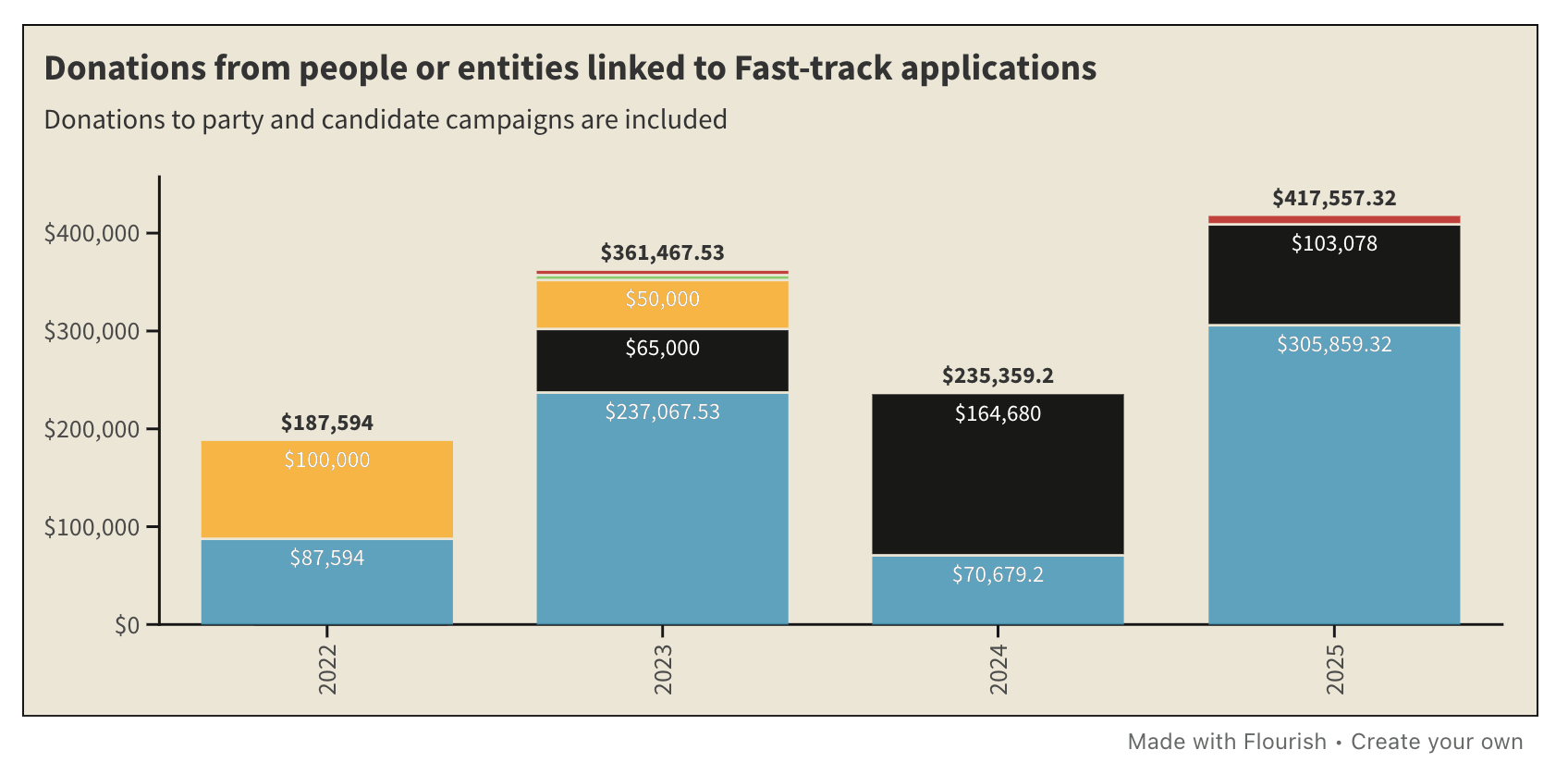
RNZ’s Farah Hancock has published an important piece of public-interest journalism today. She has mapped the newly released 2025 political donation returns against applicants and entities linked to the Government’s fast-track approvals process.
It is exactly the sort of painstaking work that is needed if New Zealanders are to understand how political money actually moves around power.
Hancock’s central finding is stark: over the four years since 2022, donations from people or entities linked to fast-track projects have crossed the $1 million mark, with nearly 90% flowing to the two coalition parties most directly responsible for the regime. The 2025 returns alone account for $400,000 to National and NZ First, against $8620 to Labour. You can read Hancock’s piece here: $1m in political donations from entities linked to fast track applications revealed
My research on money in politics
I’ve also been doing some research on this area – donations and the Government’s Fast Track process. And so, this is the fourth column in my current series on the 2025 political donation returns.
The first looked at the overall surge in money flowing into New Zealand politics – see: Following the money in 2026. The second looked at property and construction donations – see: The developers’ government. The third looked at the extraction sector – see: Digging for influence.
This fourth column concerns what happens when big donors are not just backing general political ideas, but are connected to specific projects needing the state’s permission.
There is no need to claim that every donor has bought an approval. What Hancock has uncovered is more troubling than that crude reading would suggest. The fast-track regime has created a special lane through the state, and many of those hoping to use that lane have also been funding the parties that control it.
Why the Fast-track is different
Political donations always create integrity questions. A farmer donates to a party promising weaker environmental regulation. A union backs a party promising stronger labour law. A property developer funds a party promising to loosen planning rules. That is politics. It can still be problematic, but it is usually a dispute over general policy.
The Fast-track is different, because it’s not just a broad ideological programme. It is about specific projects, specific companies, specific parcels of land, and specific commercial gains. It is where regulatory policy becomes permission. Under fast-track, a single ministerial or panel decision can make or break a particular business development.
That is why the donations matter so much. The more discretionary the state becomes, the more dangerous political donations become. And the Fast-track Approvals Act is a machine for discretionary power. It exists to speed selected business projects through a process that bypasses parts of the normal consenting architecture. Its defenders call that pragmatism. Its critics call it a short-circuiting of environmental and democratic protections.
The projects and the cheques
Hancock’s article should be read in full, because the detail is what makes the pattern so uncomfortable. The case-by-case detail below is drawn from Hancock’s reporting; I have grouped the examples to draw out some important patterns.
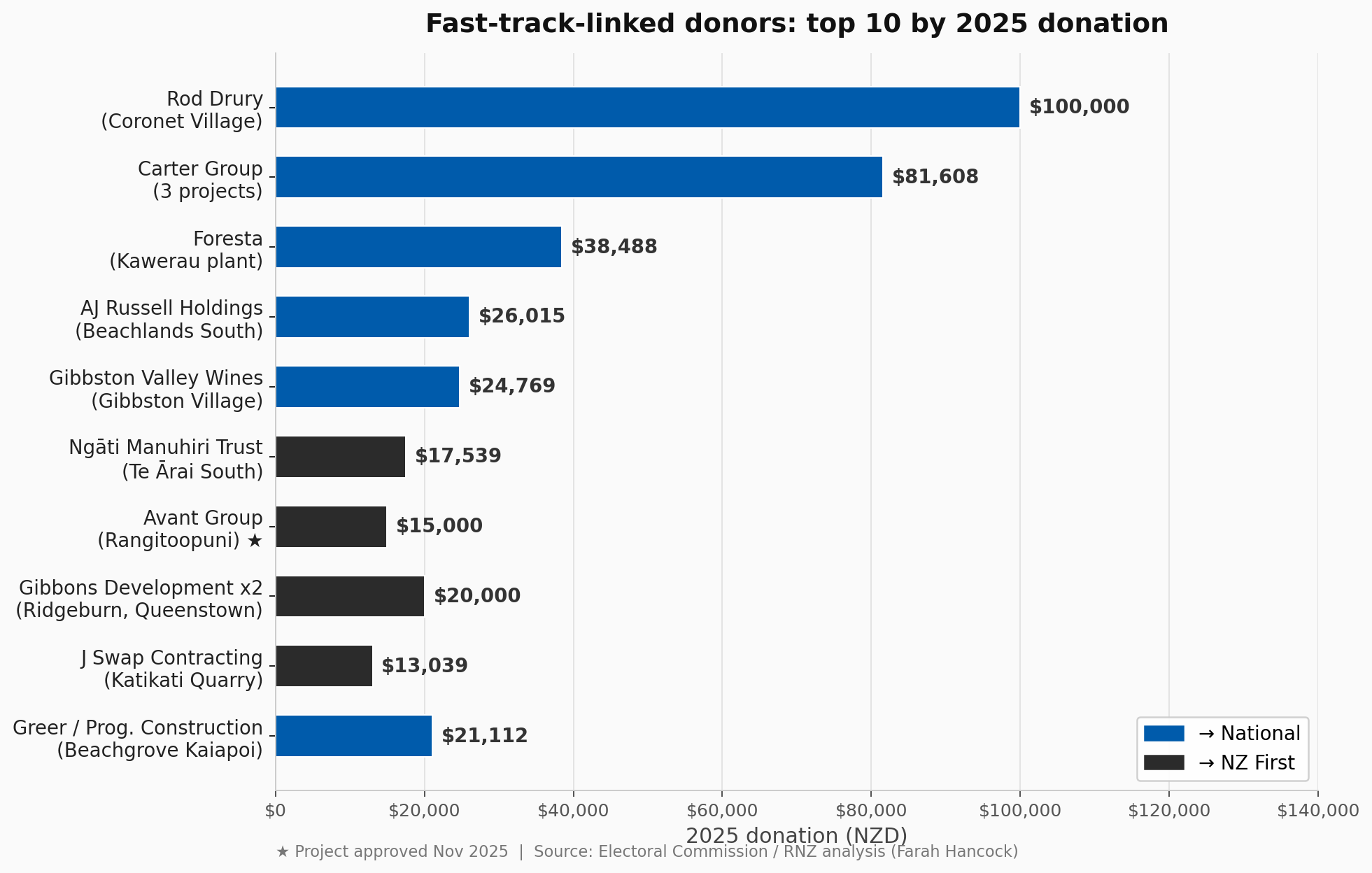
The largest linked donation in 2025 was $100,000 from Sir Rod Drury to the National Party. Drury is linked to the Coronet Village development, a proposal for 780 dwellings, a ski area, gondola and schools at the foot of Coronet Peak. Drury has previously said donating is an “expectation” of successful people, and that they are made “not looking to buy influence, but looking to be heard”.
Drury’s statement is obviously meant to reassure us, but it actually explains the problem perfectly. Most New Zealanders would also like to be heard. They just cannot afford the ticket.
The Carter Group’s $81,608.56 to National in 2025 sat alongside three of its developments on the fast-track schedule. The Christchurch industrial project at Ryans Road has been approved; the two residential schemes (at Rolleston and Ōhoka in Canterbury) remain pre-application. The company’s director Philip Carter had also given $59,500 directly to National in 2023, and is the brother of former Speaker Sir David Carter.
Hancock also identifies a $7500 contribution to NZ First from Christopher Meehan, who is linked to both Winton Land’s Sunfield housing scheme and Ayrburn Screen Hub (a television production facility) both of which have now passed fast-track approval. Meehan’s cumulative giving across Act, National and NZ First now exceeds $213,000.
Foresta — which donated $38,487.69 to National across three tranches between July and October 2025 — is proposing a pine chemicals and wood pellet plant on a 9.5-hectare Kawerau site. The Beehive itself hosted the signing of its 30-year land lease with the Putauaki Trust, with Regional Development Minister Shane Jones presiding. Foresta says its wood pellets are intended as a coal alternative. That might well be true. But it is still another example of a company seeking state-facilitated development while contributing to the parties of government.
The Te Ārai South precinct, an Auckland regional development bundling sand quarrying, aquaculture, residential housing and a park village, is one fast-track scheme with iwi involvement. One of its applicants, the Ngāti Manuhiri Settlement Trust, donated $17,539 to NZ First in 2025, up from $13,000 the previous year.
This case should be handled carefully. Not every fast-track-linked donor is a private developer or extractive company. Some are iwi entities pursuing economic development, Treaty settlement value, housing, aquaculture or regional infrastructure. That matters. But the integrity question does not disappear.
Trust chief executive Nicola Rata-MacDonald told RNZ the donation was for tickets to events, saying: “Where we are invited to an event by any party and representatives from our senior leadership team are available, we accept to ensure that all parties are well informed of our priorities.” She also said: “We believe this project stands on its merits.”
Again, the language is revealing. Of course applicants want parties to be “well informed” of their priorities. That is what access is. And of course applicants say their projects stand on their merits. The problem is that the public has no way of knowing where merit ends and political proximity begins.
The J Swap Contracting $13,039 donation to NZ First in 2025 sits in the same territory. J Swap shares directors with Katikati Quarries, which has a fast-track application to expand into Kaimai conservation land. Spokesperson Stu Husband told RNZ the money paid for tickets to three NZ First dinners, “just to keep in the loop of political aspirations of the party”, and that he did not believe the donation would influence the application.
Hancock’s Kings Quarry case is the bluntest. The expansion proposal would extend quarry activities across an additional 60 hectares of the operation's existing 152-hectare site. Kings Quarry Limited itself has made no donation, but AJR Group — whose sole director, Andrew Ritchie, was previously a Kings Quarry director and remains a shareholder — gave $10,000 to NZ First. Asked by RNZ why he donated, Ritchie said: “It’s called democracy and I can do whatever I like.” He added that he supports other parties too: “I like some of them, it’s just a flavour of the month.”
In its own way, that might be the most honest explanation in the whole story. It is called democracy. He can do what he likes. And that is the problem. The rules allow those with money and projects before the state to treat party finance as just another relationship-management tool.
The paywall now starts at halfway through all Democracy Project newsletters. Please take out a paid sub if you want to support this service and access the full content, including the following sections: “Party money is exempt from Cabinet conflict of interest rules”, “Access capitalism”, “Structural corruption”, “The 2026 warning light”, “A stand-down period”, “Disclosure is not enough”, and “The toll booth”.
