

If you want to understand what will happen on 7 November, forget the polls for a moment. Forget the horse-race coverage, the personality contests, and the pundit predictions. Instead, read Danyl McLauchlan’s cover story in this week’s Listener magazine. It’s the sharpest piece of political analysis I’ve read this cycle – and probably the most important you’ll read before voting day.
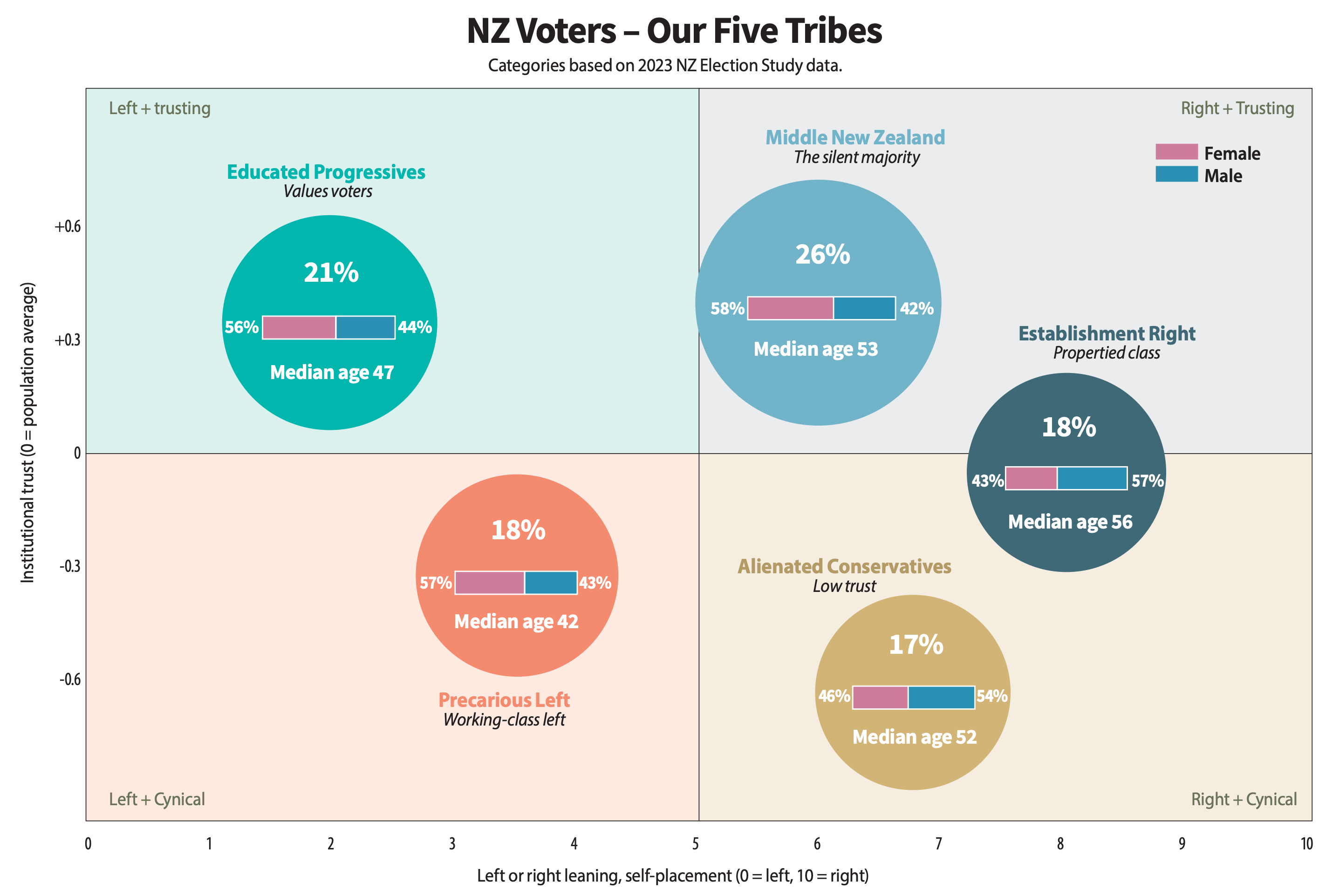
McLauchlan’s article draws on the 2023 New Zealand Election Study (NZES), a 36-year-old body of research run by Victoria University’s Jack Vowles and the University of Auckland’s Peter Aimer. Since 1987, they have surveyed voters after every general election about their values, their party allegiances, their trust in institutions, and their views on everything from the Treaty of Waitangi to wealth redistribution. McLauchlan took the responses to 40 questions about values, trust and political interest from the 2023 survey, identified groups that gave similar answers and shared similar levels of wealth, age and education, and mapped them onto a two-dimensional chart. One axis runs from left to right. The other runs from trusting to cynical.
Out of this, he pulls five distinct voter “tribes”. If we want to make sense of this year’s election, we have to reckon with all five.
The Five tribes
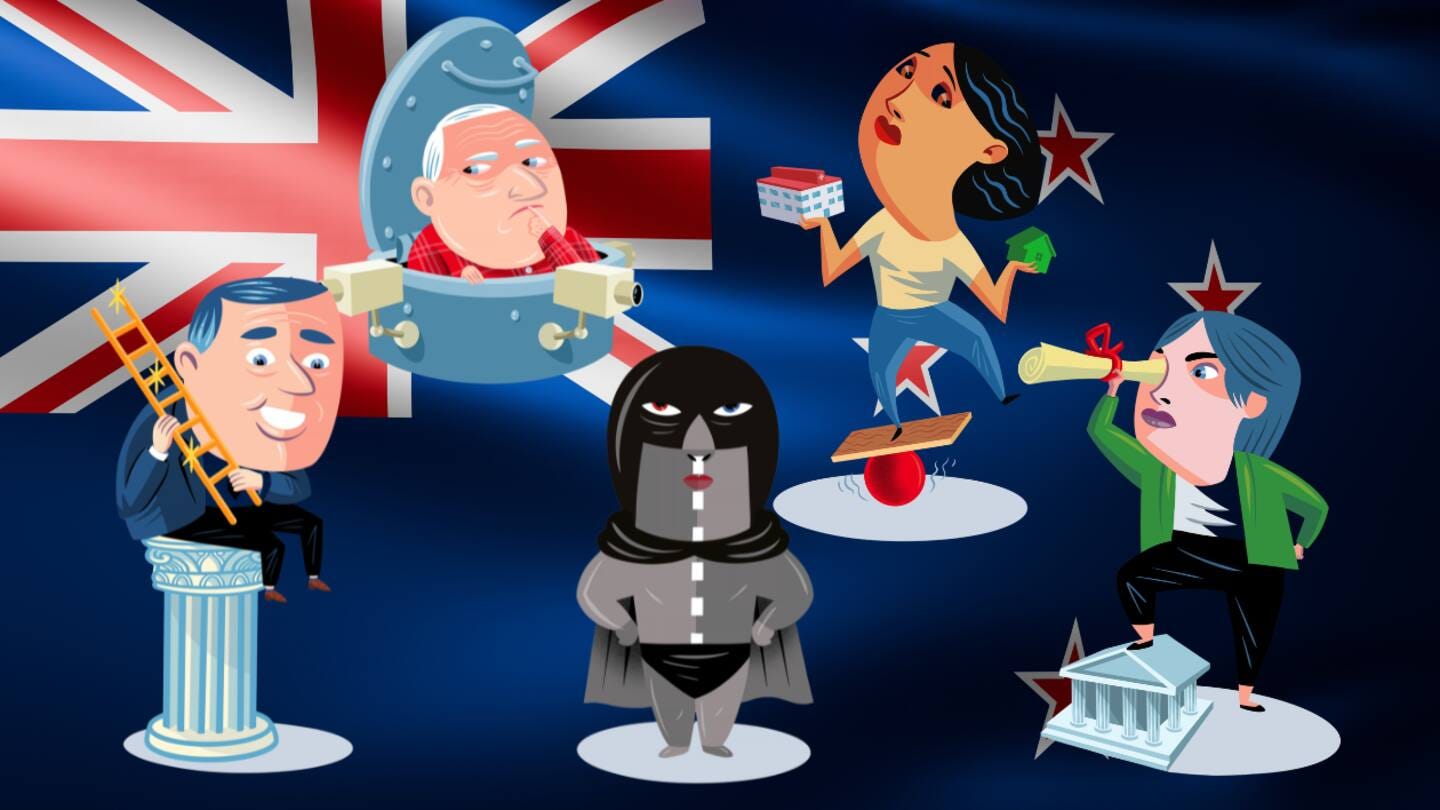
McLauchlan’s five tribes are: Educated Progressives, the Precarious Left, Middle New Zealand, the Establishment Right, and Alienated Conservatives.
The Educated Progressives make up about 21% of the electorate. The archetypal member of this tribe is a woman who votes Labour or Green, works in health policy, law, or the NGO sector, and owns her home. She is three times more likely than average to hold a postgraduate degree and is the most politically engaged tribe in the entire dataset. She trusts institutions. She votes. She supports co-governance, wealth redistribution, stronger climate policy, and union rights.
But here is the sting in McLauchlan’s analysis: she works in the sectors that grow when government grows — healthcare administration, tertiary education, the public service, consultancies — and her vision of a larger state inevitably means more high-income jobs for people with advanced degrees. As McLauchlan puts it, “her interests and her ideals are conveniently aligned,” because she works in sectors that grow when government grows.
The Establishment Right accounts for about 18%. This tribe is the mirror image of the Educated Progressives at the top of the income ladder, but on the right. He is male, the highest-income earner, mostly Pākehā, and the most opposed to redistribution and co-governance. Over a quarter of his tribe earn in the top income bracket. More than half own their home outright. He is the most stable tribe in the dataset: two-thirds voted National in 1990, and two-thirds vote National now. He decides his vote early and sticks with it.
Middle New Zealand is the largest tribe at 26%, and the hardest to pin down, precisely because its defining feature is the absence of strong positions. Average age, average income, average education. On most of the values that define the five tribes, these voters sit close to the centre on almost everything. They are the most trusting group in the country. They trust Parliament, the government, the courts and police. In 2020, 42% voted Labour. In 2023, they swung to National at 39%. They don’t hate either major party. As McLauchlan writes, they “just vote for whoever seems competent.”
Both Labour and National understand this is where elections are won and lost. It explains why leaders compete on managerial competence rather than ideology. As McLauchlan puts it: “Middle New Zealand doesn’t want a revolution. They want things to be slightly better than last year.” Victory depends on winning what McLauchlan calls “a ruthlessly pragmatic third group, largely indifferent to values, who just want competent government.”
These are the two tribes I think matter most. Not just here, but across a lot of Western democracies.
The Precarious Left: locked out and losing faith
The Precarious Left makes up about 18% of the electorate, and they are the youngest tribe, with an average age of 42. This tribe is disproportionately female, Māori and Pasifika, earning below average incomes, and more likely to be raising kids alone. As McLauchlan puts it, she works in early childhood education or aged care or as a community health worker – “essential jobs that don’t pay enough for a deposit on a house in a city where she could find work”. Only 11% of her tribe own their home outright. Another 11% are in social housing.
She is not uneducated, but her qualifications have not translated into security. She needs public healthcare, public transport, welfare benefits and childcare subsidies. She deals with the state both as a client and as a poorly paid worker, and mostly finds it slow, unhelpful, and failing her..
And she is the most cynical tribe in the entire dataset. She strongly agrees that government is run by big interests, that MPs are out of touch, that a person like her has no say. She depends on the very institutions the Educated Progressive trusts, but she doesn’t trust them at all. Of all five tribes, she scores lowest in her confidence that she can effect political change.
This is a tribe that is economically leftwing but deeply hostile to the political establishment. Where the Educated Progressive sees a system that basically works and could be improved with the right policies, the Precarious Left sees a system rigged against people like her.
The Alienated Conservative: rightwing, locked out, and suspicious
The Alienated Conservatives make up about 17% and are, according to McLauchlan, “the mirror image of the Precarious Left. Where she turns left, he turns right.” But the underlying condition is the same: modest income, low trust, and a strong feeling that the system doesn’t work for people like him.
McLauchlan traces the evolution of this tribe from the “Social Conservative” of 1990: male, religious, middle-income, middle-class, with a home ownership rate of 78%. That voter trusted politicians and participated enthusiastically in democratic processes. Thirty-three years later, his successor is the Alienated Conservative, and almost everything about him has changed except the way he votes. He is older, predominantly male, but far less likely to own property or earn in the top bracket. Home ownership has fallen to 30%, and his non-voting rate has quadrupled.
He is the most likely tribe to have been born overseas: only 65% are New Zealand-born. As McLauchlan writes, he “might run a small contracting firm in the outer suburbs, or drive trucks or work a trade he brought with him from South Africa or the UK” – and he “distrusts everything: Parliament, government, the courts.” He strongly agrees that big interests run the government, that politicians don’t care, that MPs are out of touch.
In 2023, he was twice as supportive of New Zealand First as any other tribe. Winston Peters speaks to his combination of social conservatism, economic modesty and disaffection in a way Christopher Luxon and David Seymour cannot.
The Tribes the political class forgot
Here is where McLauchlan’s analysis becomes genuinely important for the 2026 election. And for understanding what is happening in democracies around the world.
The Precarious Left and Alienated Conservatives between them account for roughly 35% of the New Zealand electorate. They share two defining characteristics: they are economically insecure, and they profoundly distrust institutions. They disagree on almost everything ideological (Treaty, redistribution, etc) but they agree on something that matters more than any of that. They believe the system is not designed for them.
And here is the problem. Neither tribe is properly represented in the current party system.
Look at what has happened on the left. Labour and the Greens have increasingly aligned themselves with the Educated Progressives (the university-educated, home-owning professionals who work in the knowledge economy and the public sector). The party’s policy language, its cultural preoccupations, its personnel, its entire worldview has shifted to reflect the values and interests of that tribe.
This is not a uniquely New Zealand phenomenon. It is happening to left parties across the Western world. Thomas Piketty has documented the transformation of social democratic parties from workers’ parties into what he calls “the Brahmin Left”: parties of the educated elite. The working class voters those parties were built to represent have been gradually orphaned.
McLauchlan’s five tribes map almost perfectly onto Piketty’s framework. The Educated Progressive is Piketty’s “Brahmin Left”. The Establishment Right is the “Merchant Right”. And the Precarious Left and Alienated Conservative are the people who fell through the cracks — the “subjective losers of globalisation”, as European political scientists have termed them.
Joan C. Williams, in her recent book Outclassed, argues that the left has a fundamental misunderstanding of working-class voters, and that the “diploma divide” between college-educated progressives and non-college workers is the central political fault line of our time. She notes that the far right manipulates class anger to undercut progressive goals, and liberals often inadvertently play into their hands. This description resonates with New Zealand, where our political class is drawn overwhelmingly from the university-educated professional stratum and finds it difficult to speak authentically to voters who haven’t had the same trajectory.
The consequences of this neglect are on full display around the world. Brexit. Trump. The rise of Le Pen, the AfD, Meloni, Milei. These revolts don’t come out of nowhere. They are what happens when tens of millions of people conclude, rationally, that nobody in the political establishment gives a damn about their lives.
And on the right, National and Act have aligned themselves with the Establishment Right (the high-income earners, property owners, and business class). Their tax policy, their deregulatory instincts, their opposition to redistribution, it all speaks directly to the interests of that tribe.
And of course, every party also chases Middle New Zealand, which is the pragmatic centre that decides elections on the basis of who looks most competent. Many millions of dollars in political advertising and communications strategy are directed at that 26%.
But what about the 35% at the bottom of the economic ladder who don’t trust any of them? The Precarious Left sits there wondering why the parties that claim to speak for working people are staffed by professionals who own houses in leafy suburbs. The Alienated Conservative sits there wondering why the parties that wave the flag of aspiration have done nothing about the fact that he will probably never own a home.
That’s the opening populists look for.
The Populist opening
I have written extensively about what I call “Broken New Zealand”: the growing sense that the country’s institutions are failing, that the economy is rigged in favour of insiders, that politicians care more about their own interests than those of ordinary citizens. Survey data from the NZES, the Edelman Trust Barometer, and numerous other sources all point in the same direction: a democratic deficit is growing, and it is not caused by any one party or politician. It is structural.
McLauchlan’s tribal analysis puts flesh on those bones. It shows precisely who is being left behind and how they differ from the comfortable tribes that dominate political life. The Precarious Left and the Alienated Conservatives are not fringe groups. Together, they are larger than Middle New Zealand. But they are largely invisible to the political class of politicians, journalists, pollsters and academics who set the terms of public debate.
This is the pattern we have watched play out overseas. In the United States, Donald Trump’s political “genius” was not in inventing new voters but in speaking to the alienated tribes: the economically insecure, institutionally distrustful voters who felt the system had left them behind.
Brexit followed the same logic. So did the rise of Marine Le Pen, Giorgia Meloni, and a string of populist movements across Europe. In each case, the political establishment was blindsided because it was paying attention to the tribes it understood (the educated, the professional, the centrist) and ignoring the ones it didn’t.
New Zealand is not immune to these forces. In fact, McLauchlan’s data suggests we are ripe for them. The lifecycle mechanism that once reliably created conservative voters — get a mortgage, get kids, get conservative — requires people to actually get mortgages. If home ownership among the young keeps falling, the constituency for conventional rightwing politics contracts with it. And on the left, if Labour continues to function as the party of the professional-managerial class, it will keep bleeding the voters it was originally created to serve.
The one politician who seems to understand this instinctively is Winston Peters. McLauchlan’s data shows NZ First draws disproportionately from the Alienated Conservatives. Peters speaks their language: sceptical of elites, suspicious of institutions, economically modest but culturally conservative. It is no coincidence that he keeps coming back from the political dead.
But beyond Peters, who is speaking to these tribes? Who is telling the Alienated Conservative that his distrust of institutions is not irrational but the rational response of someone the system has genuinely failed? National is nominally the party for the typical Alienated Conservative, but National is run by the Establishment Right: independently wealthy professionals and property owners whose interests diverge sharply from his. Christopher Luxon, with his many houses and corporate background, does not speak his language. David Seymour, with his libertarian abstractions, does not address his concrete frustrations.
Who is offering the Precarious Left something more than the cultural politics of the Educated Progressives? Labour is nominally the party for the typical Precarious Left — but Labour is run by Educated Progressives whose daily lives look nothing like hers. When Labour talks about co-governance and climate targets and gender equity, these are not irrelevant issues to the Precarious Left. But they are not the issues keeping her awake at night. What keeps her awake is the rent, the groceries, the power bill she can’t afford, the ECE centre that’s about to close.
This is where this year’s election could still get messy. Whoever figures out how to speak to that roughly one‑third of voters who think the system is rigged will change New Zealand politics.
Reading the election through tribal lines
McLauchlan’s tribal map is a useful way to read the 2026 campaign as it unfolds.
Watch which party can hold its base while reaching into the other tribes’ territory. Labour needs the Precarious Left to turn out and vote, but its Educated Progressive base pulls it toward cultural positions that alienate working-class voters. National needs to keep the Establishment Right while not losing Alienated Conservatives to NZ First (or just to the couch).
The other thing to keep an eye on is the non-voters. As McLauchlan and the NZES data show, the Alienated Conservatives have the highest non-voting rate of any tribe. Their largest “party” in 2023 was non-vote, at 32%. The Precarious Left has its own participation problem. If either tribe gets mobilised by a compelling leader, a galvanising issue, or a sense that someone finally gets it, then the electoral map could shift dramatically.
The gender-age divide has also tripled since 2011. Older males are trending right; women under 40 are trending left. That gap is baked into the tribal structure and it is getting wider. They are moving further apart culturally, even though materially they often look more alike than the political class likes to admit. This creates both danger and opportunity: danger that populism on each side takes increasingly hostile forms, and opportunity for any political movement that can bridge the gap with a message about shared economic interests.
As pollster David Talbot relays to the Listener: “If the election is an exam, it’s the voters who set the question. Parties who choose to answer a different question will be marked accordingly.” The point is that many politicians are not connecting with what the big issues are for the voters.
The question from the Precarious Left and the Alienated Conservatives is simple enough: when does the system start working for us? No party has yet given them a convincing answer.
Dr Bryce Edwards
Director of the Democracy Project
Further Reading:
