

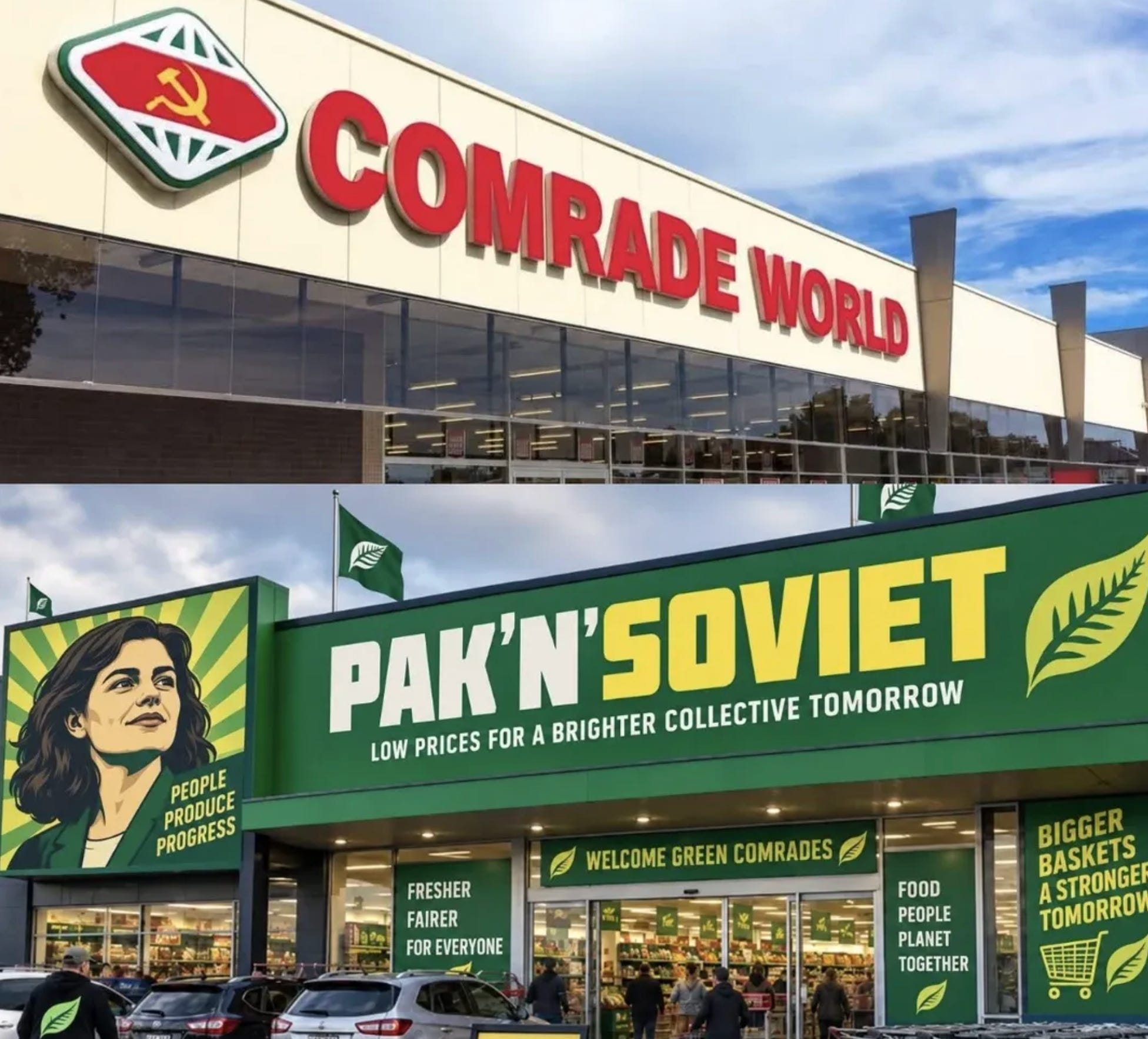
The easiest way to dismiss the Green Party’s KiwiMart supermarket reform proposal is to turn it into a joke. So, within hours of the Greens announcing their plan for a publicly owned supermarket chain, opponents had rechristened it “CommieMart”. Winston Peters called it “textbook communism by stealth”. National called it a “Soviet-style” government-owned supermarket chain, while former Act leader Rodney Hide imagined the scheme progressing from cheaper milk to shortages, rationing and, eventually, what he called a “Lettuce Board”.
Some of this ridicule lands because governments can make dreadful retailers. Public companies can become expensive and vulnerable to political meddling. But a state-owned chain competing for customers alongside private supermarkets is not Soviet central planning. The jokes also let opponents avoid answering the Greens. After years of inquiries, regulation and promises, why has New Zealand still failed to produce a serious third supermarket competitor?
KiwiMart might ultimately prove too expensive. Its business case is incomplete and its governance arrangements remain vague. But after the failure of more modest reforms, simply opposing KiwiMart is not an adequate supermarket policy. Its critics need to say what they would do instead.
A supermarket policy born of failure
New Zealand’s supermarket problem has been studied almost as intensively as it has been complained about. The Commerce Commission completed its market study. Parliament passed new regulation. A Grocery Commissioner was appointed. A regulated wholesale-supply regime was established in an attempt to help smaller competitors. Restrictive land covenants were targeted, planning processes altered and overseas chains encouraged to consider the New Zealand market. Yet Foodstuffs and Woolworths still account for about 82% of the national grocery retail market, and the Commerce Commission’s latest annual report found that retail prices increased while most national measures of competition showed little change.
The commission says the reforms need more time. That might be true, but it is a difficult message to sell to households watching their grocery bills continue to rise. For years, political leaders have held out the prospect that better competition will eventually arrive if the Government removes enough barriers and makes New Zealand sufficiently attractive to an overseas chain. But no large entrant came.
Nicola Willis eventually acknowledged the limit of that strategy in as many words: “I can’t force a third entrant in... All I can do is open my arms as wide as possible.” KiwiMart begins where that admission leaves off. If the private market will not produce a third chain, the state could create one. The radicalism of the policy is partly a measure of the failure that preceded it.
KiwiMart’s answer to the entry problem
Under the Greens’ policy, Foodstuffs and Woolworths would be required to divest at least 120 stores and distribution-centre capacity into public ownership. The party’s costing assumes the acquisition of two distribution centres. The Parliamentary Library modelling used by the Greens estimates that acquiring the assets would cost about $1.3 billion. The Crown would provide another $1.5 billion to capitalise the business, taking the initial commitment to roughly $2.8 billion. The Greens say KiwiMart would begin with about 15% of the grocery market and operate at arm’s length from ministers, with a mandate to prioritise affordability while remaining commercially viable.
A serious supermarket entrant needs much more than a collection of shopfronts. It requires enough purchasing power to negotiate with suppliers, warehouses and trucks to move the goods, compatible computer systems, customer data and stores in locations where people already shop. KiwiMart would acquire an operating network rather than spend a decade assembling one store by store. As Chlöe Swarbrick puts it, “We’re not short of supermarkets, we’re short of competition.”
Grocery Action Group chair and former Consumer NZ chief executive Sue Chetwin describes the proposal as “a plausible answer to bringing those prices down”. Tex Edwards of Monopoly Watch says its focus on distribution is crucial. New Zealand already has plenty of supermarket floor space, but the established chains’ control of distribution and wholesale supply makes it extraordinarily difficult for a challenger to reach competitive scale.
Easing planning rules might allow another shop to be built. It does not give the new owner a national supply chain. Liberalising foreign investment does not make a small and geographically isolated market commercially irresistible to Aldi or Lidl. The Greens are aiming at the real bottleneck. Their proposed solution may prove to be the wrong one, but it is a serious response to the entry problem.
The paywall now starts partway through all Democracy Project newsletters. Please take out a paid sub if you want to support this service and access the full content, including the following sections: “The state changes the argument”, “The numbers are the weak point”, “What the Soviet jokes avoid”, and “If not KiwiMart, then what?”.
