

New Zealand’s tax system is broken, and by now, almost everyone knows it. Not just the leftwing economists and welfare advocates who have said so for decades, but Treasury, Inland Revenue, the OECD, the IMF, the CEO of ANZ, the accounting profession, and even rightwing commentators like Matthew Hooton.
In April 2026, Hooton wrote in the Herald that the IRD’s economists had nonetheless concluded that taxes must rise. He concurred with IRD, and he warned that politicians were avoiding any real acknowledgement of fixing the fiscal settings: “Don’t listen to anyone this election year who promises more spending on anything, or that they will reduce the tax you pay… The best case is that they are lying to you. The worst is if they believe it.”
The old consensus — that New Zealand’s tax settings were broadly fine, that capital gains didn’t need taxing, that fiscal drag wasn’t a serious problem — has dissolved. What has replaced it is not yet a new settlement, but a widening conversation, the first one worth having in a generation.
Economist Shamubeel Eaqub captured it precisely when he reflected on the Greens’ new tax proposals released this week. He told BusinessDesk that the Overton window around wealth and capital taxes has shifted: “It’s gone from it will never happen to I think more of a question of when might it happen.”
All of this is what makes the Greens’ new tax policy so puzzling. The consensus is breaking down, the window is opening, the chance has arrived for the first serious tax debate in a generation — and the Greens have chosen this moment to water down their own tax agenda. What they have put up this year is barely radical at all by international standards. They are retreating on major reform at exactly the point the ground is shifting in their favour.
What the Greens announced
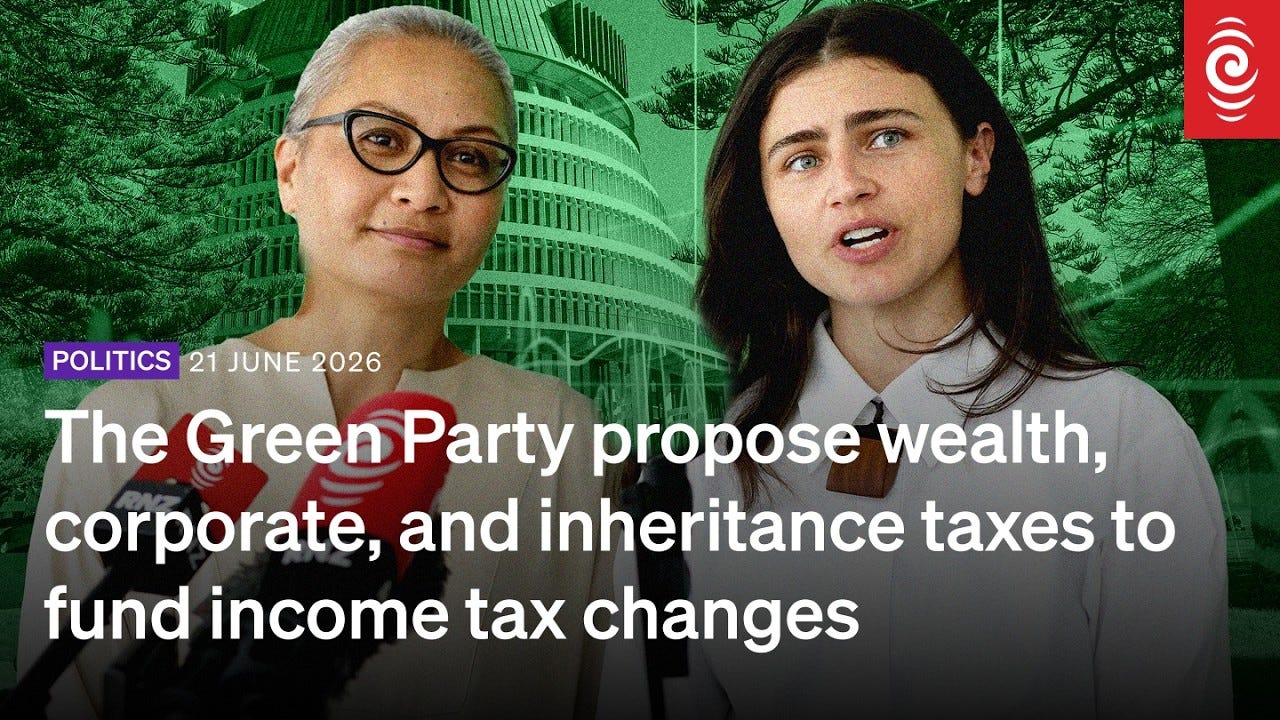
Last Sunday Chlöe Swarbrick and Marama Davidson unveiled “A Tax System for All of Us” — seven tax changes built around a 2.5% levy on net wealth above $10 million, dressed up as the boldest economic offer of the campaign. In response, Christopher Luxon called it “economic lunacy.” David Seymour reached for “Hunger Games policy.” And Chris Hipkins, the one man whose support the Greens actually need, killed it before lunch.
The wealth tax is the centrepiece: 2.5% a year on net assets above $10 million, family home exempt, the threshold lifting to $20 million for couples. Bolted on beside it is a Capital Acquisitions Tax, which is an inheritance and gift tax wearing a more clinical name, charging 33% on anything passed on above a $1 million lifetime threshold. Homes and farms are exempt there too. The company rate climbs back to 33%, but only for the largest 0.7% of firms, those turning over more than $30 million; everyone smaller is left alone. There is a 0.06% levy on the liabilities of the four big Australian-owned banks, and a 5% withholding tax aimed at the profits big tech books offshore. On the income side, the first $10,000 anyone earns becomes tax-free, set against a new top rate of 45% above $160,000. The landlord interest deduction is gone again, and the bright-line test is stretched back out to ten years.
And the outrage missed the real story. Before any of those men got near it, the Greens had already shrunk the thing themselves. The wealth tax they once aimed at fortunes over $2 million now starts at $10 million. The revenue is a fraction of what they promised last time.
Henry Cooke, in his Post analysis, described the Greens wealth tax as “remarkably stripped back,” delivering less than half the revenue of the version the Greens ran at the 2025 Budget.
The Post’s Tom Pullar-Strecker also did the useful work of checking the Greens’ tax announcement against the rest of the world, and the parallels are everywhere. The bank levy copies one Australia brought in back in 2017, a levy Nicola Willis herself asked officials to look at. The inheritance tax is lifted more or less wholesale from Ireland, a model senior Labour figures reportedly wanted to adopt here. Wealth taxes of this kind exist in Spain, Norway, Switzerland. The $10,000 tax-free threshold is meaner than Britain’s or Australia’s. The two-tier company rate mirrors Australia. Even the 45% top rate sits roughly at the OECD average and bang in line with Australia. His verdict was that the package is “radical” in a New Zealand context rather than “wild” in an international one.
The wealth tax component is central, and is what has been watered-down the most. For three campaigns, the party drew its wealth line at $2 million – above which a tax would be paid. In 2020 it was 1% over a million and 2% over two. By 2023 it was a flat 2.5% above $2 million, plus a trust tax. Then the Greens’ 2025 Alternative Budget held that same $2 million line.
But this year the rate stayed put and the threshold leapt to $10 million, which would suddenly let off a lot of wealthy people from paying the tax. The changes in the Greens’ wealth tax component meant that what was once promised to bring in around $13 billion would now only raise about $3.7 billion. The whole tax package nets roughly $5 billion a year, against a remarkable $23.4 billion in last year’s Alternative Budget. The Greens are now campaigning on a “tax revolution” worth, in real terms, about a fifth of what they were demanding twelve months ago.
It’s been assumed that the Greens have heavily moderated their tax policy to suit the Labour Party. Elliot Crossan, writing from the socialist left, asked the question the Greens have not answered: if Chris Hipkins was always going to rule it out anyway, why water it down first? Crossan says: “watering down your demands before even getting to the table is a losing strategy.” He also points out that the major reduction in revenue from the revised policy means billions less to pay for everything else the Greens claim to want. What, he asks, gets quietly dropped to fund this caution?
The paywall now starts at halfway through all Democracy Project newsletters. Please take out a paid sub if you want to support this service and access the full content, including the following sections: “Who got spared”, “Killed by the only party that could pass it”, “Will the Greens actually fight for this?”, and “Why it matters”.