

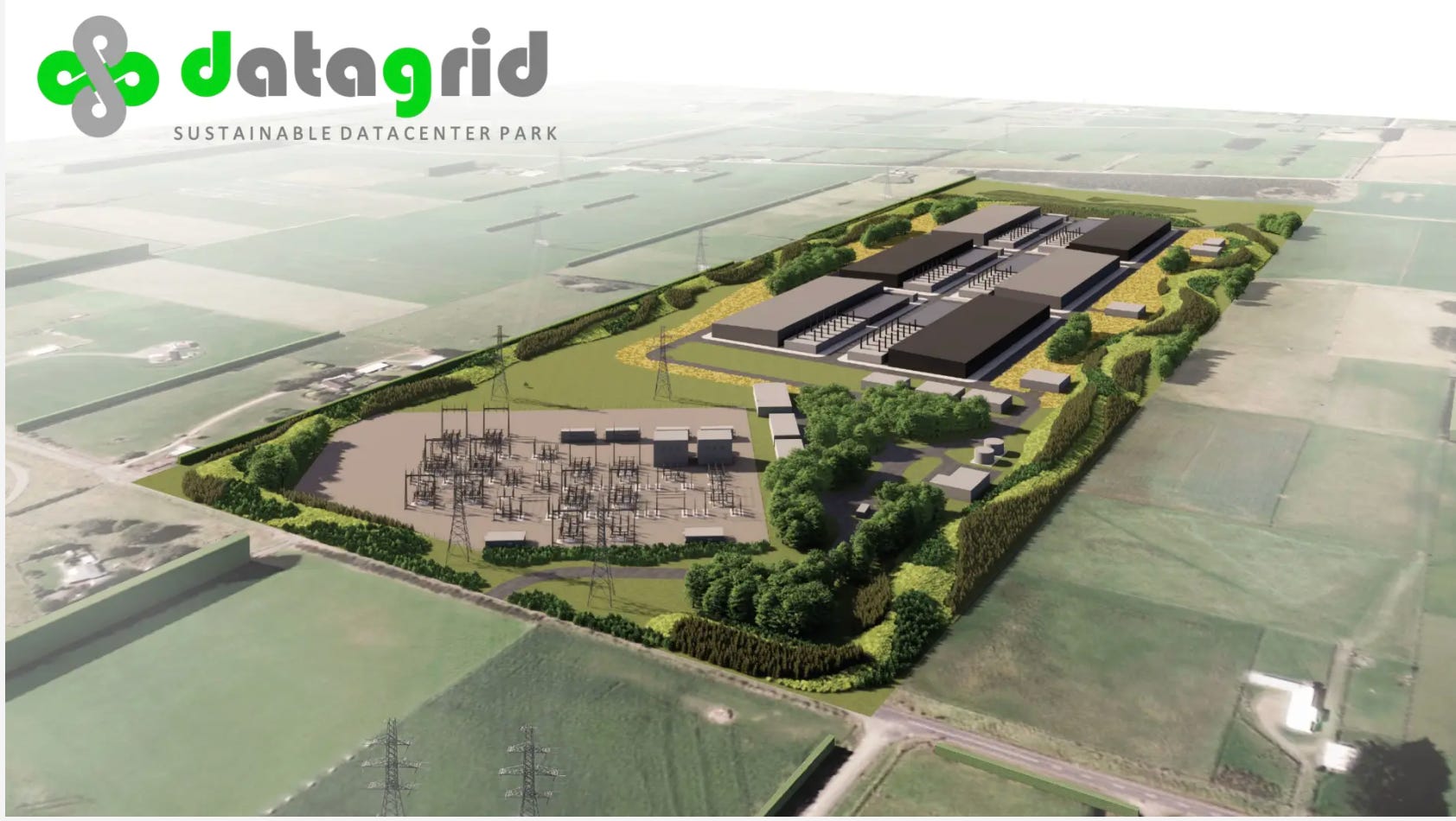
A huge new data centre has just been approved for Southland, and the tone of much of the coverage so far has been one of celebration. The headlines talk about a “$3.5 billion bet” on the south, an “AI factory”, a futuristic leap into the knowledge economy. Local leaders are upbeat. Business groups are upbeat. The company itself is, unsurprisingly, very upbeat.
And perhaps some of that enthusiasm is justified. New Zealand does need more serious digital infrastructure. Southland does need more economic diversification. And if a giant new industry is going to arrive anywhere in the country, there is a reasonable case that the deep south is one of the more logical places for it.
But that’s only half the story. Because behind the futuristic language and the civic cheerleading sits a much tougher set of questions. What exactly is being built? Who really benefits? Where will the electricity come from? What pressures will this place put on the national grid? What does New Zealand get in return for handing over land, water, political attention, and a very large slice of renewable power to a data venture geared heavily to offshore markets? And why has so much of the public discussion felt strangely muted, given the sheer scale of what is being proposed?
None of this is anti-technology, and it is not anti-Southland either. It is what basic democratic due diligence looks like.
What is actually being built
Datagrid New Zealand has now received resource consent for a hyperscale data centre at Makarewa, north of Invercargill, along with approval for an international subsea cable landing at Ōreti Beach. The project has been talked about for years, but the latest announcement makes it far more real. The sheer size of it hits you when you see the numbers.
The site is planned to include six data halls spread across a large campus. It is being sold as New Zealand’s first “AI factory”, language borrowed from the global tech industry to describe facilities built not just for ordinary cloud computing, but for the training and operation of artificial intelligence systems. That already tells us something important: this is not just another warehouse with servers in it. This is a proposed industrial-scale node in a global AI economy.
And that matters because a project like this is not simply local. It might be physically located in Southland, but it is designed to plug into international networks, international finance, international tech demand, and international profit streams.
That doesn’t automatically make it bad. But it does mean we should be wary of the way it is sometimes framed as a straightforward regional development story. It isn’t straightforward at all.
The sales pitch is easy, but the electricity question is not
The case being made for Datagrid is familiar enough. Southland has a cool climate, which helps with data-centre cooling. It has renewable electricity nearby. It has land. It has distance from some of the congestion and constraints of the upper North Island. It has civic leaders eager for investment. Put all that together, and the region can supposedly become a major player in the digital economy.
Fine. But the hard question starts where the sales pitch ends: power.
The reported electricity demand is around 280 megawatts. That’s a huge amount of power. It would make Datagrid the country’s second-largest electricity user after Tiwai Point. Once you get to that scale, this stops being just a private commercial project. It becomes an issue of national infrastructure and political economy.
As University of Auckland computer scientist Dr Ulrich Speidel told Mike Hosking, 280 megawatts is “about 70 percent of what Christchurch consumes” and “not a trivial amount.”
And yet the public still doesn’t have a clear enough explanation of where all that power comes from, on what terms, with what back-up, and with what effect on the rest of the country.
That’s the nub of it. If New Zealand had abundant surplus generation, fat hydro lakes, robust dry-year security, and falling power prices, this would still be a major issue, but a more manageable one. Instead, we’ve spent years being told that electricity is tight, that dry-year risk is real, that new generation needs to be built urgently, and that households and businesses should brace for higher costs.
So where does a 280MW AI datacentre fit into that picture?
Some supporters argue that Datagrid could help unlock new wind and solar investment by providing the sort of large, stable demand that developers need in order to finance new generation.
There is some logic to that. Big industrial demand can indeed help underwrite new supply. But that is only reassuring if the timing, scale, and system effects actually line up. If they don’t, what you have is not a virtuous circle but a squeeze: a giant new load arriving before the promised new generation fully materialises.
That is exactly the sort of thing the public should not be expected to accept on trust.
Not all large power users are the same
The Tiwai comparison is useful, but only up to a point. For years, New Zealand politics obsessed over the aluminium smelter and what would happen if it closed. That debate at least had one virtue: everyone understood that a plant using that much electricity had national consequences. The same should apply here.
But there is another issue. Some industrial users can reduce consumption at times of system stress. Demand response matters in an electricity system. It gives the grid breathing room. A giant AI datacentre may be far less flexible. If so, the implications are obvious. A very large, relatively constant load is not the same thing as a very large but potentially interruptible one.
None of that sinks the project. But it changes the burden of proof. If Datagrid’s demand is hard to reduce, then what obligations should come with that? Should there be stronger disclosure? Specific curtailment arrangements? A much clearer account of how the project fits within national energy planning? At the moment, that discussion feels underdeveloped to the point of absurdity.
Forty-five jobs?
Then there is the issue of jobs, where the rhetoric quickly outruns the reality. Promoters point to the big construction phase. Fair enough. Building something of this scale will employ a lot of people for a period of time. In a region like Southland, that matters.
But construction jobs are not the same thing as long-term transformation. Once the place is up and running, the reported workforce is tiny relative to the scale of the investment and the resource demand. Around 45 permanent staff has been the figure repeatedly cited.
Forty-five jobs? For a project of this scale, that is not an economic transformation.
A datacentre is not a factory in the old sense. It doesn’t absorb large numbers of local workers year after year. It doesn’t create a broad labour market in the way some traditional industries do. It is capital-intensive, electricity-intensive, infrastructure-intensive, and highly automated. That is not some scandalous revelation. It is simply the business model.
Which is why the standard regional-development script sounds a bit flimsy here. Southland may get a temporary building boom and some useful spillover benefits. But if New Zealand is effectively allocating huge volumes of renewable electricity and grid capacity to a project that directly employs only a few dozen people once operational, then we should stop pretending this is mainly a jobs story.
It is really a power-allocation story.
What does New Zealand actually get?
This is where the wider economic nationalism question creeps in, whether people like it or not.
Datagrid’s defenders would say the benefits are broader than the payroll. Better digital infrastructure. New international connectivity. More resilience. A signal that New Zealand is open for advanced-tech investment. Maybe all true.
But even then, the obvious question remains: how much of the actual value stays here? If the power is here, the land is here, the water is here, the public infrastructure is here, and much of the decision-making and profit sit offshore, then New Zealanders are entitled to ask whether this is a high-value future industry for us, or whether we are mainly providing a convenient platform for someone else’s.
That might sound harsh. But it is a perfectly normal question to ask of any export-oriented, foreign-owned, resource-hungry venture.
The phrase “AI factory” has a glamorous ring to it. Yet there is a risk that New Zealanders hear that and imagine some flourishing local ecosystem of researchers, startups, software firms, and spin-off innovation. Perhaps some of that will happen. But it may not. A lot of the real value in artificial intelligence lies not in the physical shed full of servers, but in the software, intellectual property, data, models, and platform control built on top of the hardware.
And that is precisely the sort of value that can flow elsewhere.
Water, environment, and the local costs
Electricity is the biggest national question, but it is not the only one. The project is also consented to draw a very substantial volume of groundwater for cooling and potable supply. There are reported effects on wetlands, questions around the cable landing, and cultural and ecological concerns associated with Ōreti Beach and marine life, including toheroa. The consent process has put mitigation measures and monitoring around some of these issues. That is good. But it doesn’t make the issues trivial.
Too often in New Zealand, environmental concerns are treated as if they are merely irritants once a project has been deemed economically exciting enough. They shouldn’t be. They are part of the real balance sheet.
And there is a democratic point here too. If a project of this magnitude proceeds largely through technical reports, non-notified processes, and a limited public arena, then the country misses out on the kind of serious, open debate such a development deserves.
That is not a procedural nitpick. It is a political problem.
Who has had access?
Then there is the influence question. As with many big projects in New Zealand, Datagrid has not emerged from nowhere. It has spent years cultivating relationships, meeting ministers, working with officials, building regional alliances, and making its case. Again, none of that is inherently improper. That is how major developments often proceed. But it does matter.
It matters because New Zealand has a very casual culture around lobbying and access. We still tend to act as if influence is only worth discussing when there is a smoking gun. In reality, influence is usually quieter than that. It is about who gets meetings, who gets heard early, who is treated as a strategic partner, who is inside the room when frameworks are being shaped, and who is left reading about it later.
Datagrid appears to have been very effective on that front. Good for them. But that is exactly why the rest of us should be more questioning, not less.
When a foreign-owned company seeking major access to land, water, electricity, and regulatory pathways has been moving through the political system for years, the burden should not fall on the public to prove something sinister. The burden should be on the system to be more transparent.
The international warning signs
Supporters of the project sometimes talk as if New Zealand would be foolish to hesitate. The future is digital. AI is booming. Countries are competing for this investment. If Southland can host a major facility, why overthink it?
Because other countries have already gone through this. Overseas, datacentres have become politically contentious for good reason. They chew through vast amounts of electricity and water. They can strain local infrastructure. They often deliver far fewer jobs than the hype suggests. And they raise a deeper strategic question about who bears the physical costs of the digital economy.
Ireland is the closest analogue. Data centres grew from consuming 5% of Ireland’s national electricity in 2015 to 22% by 2024. In Dublin, they now consume approximately 50% of all metered electricity. Irish households pay among the highest electricity rates in the EU. In 2021, Ireland imposed a de facto moratorium on new data centre grid connections in the Greater Dublin Area after the grid operator warned of rolling blackout risk.
That doesn’t mean New Zealand should slam the door. It does mean we should stop behaving as if every warning amounts to backwardness.
A mature country would look at the international experience and say: right, what are the conditions under which this works for us? What safeguards are needed? What disclosures should be mandatory? What public benefits should be locked in? How do we protect households and smaller businesses from being the residual shock absorbers of somebody else’s energy demand?
Instead, much of the response here still feels cringy. More like excitement at being invited to the party than a serious assessment of the bill.
This may still be a good project, but Datagrid needs to prove it
To be clear, I’m not arguing that Datagrid should automatically be stopped. The project may well go ahead and become an important part of New Zealand’s digital infrastructure. It may help bring forward new generation. It may improve connectivity. It may help Southland diversify. It may even become one of those rare big bets that genuinely pays off.
But if that is the case, then the proponents and political champions should have no problem answering some very basic questions in public.
Where is the electricity coming from? What happens in tight years? How flexible is the load? What are the long-term public benefits beyond the construction phase? How much value remains in New Zealand? What are the full trade-offs for households, other businesses, and the wider grid? And why, given the sheer scale of the project, has there been so little sustained national debate?
Those are not the questions of luddites or nimbys. They are the questions of citizens.
Right now, the cheerleaders are out in Southland, and perhaps that is understandable. But the rest of the country should be a bit more hard-headed. New Zealand has a long history of waving through big developments on the basis of glowing promises, only to discover later that the gains were narrower, the dependencies deeper, and the public leverage weaker than first advertised.
Maybe Datagrid will be different. But if so, now is the time to show it.
Dr Bryce Edwards
Director of the Democracy Project
Further Reading: