

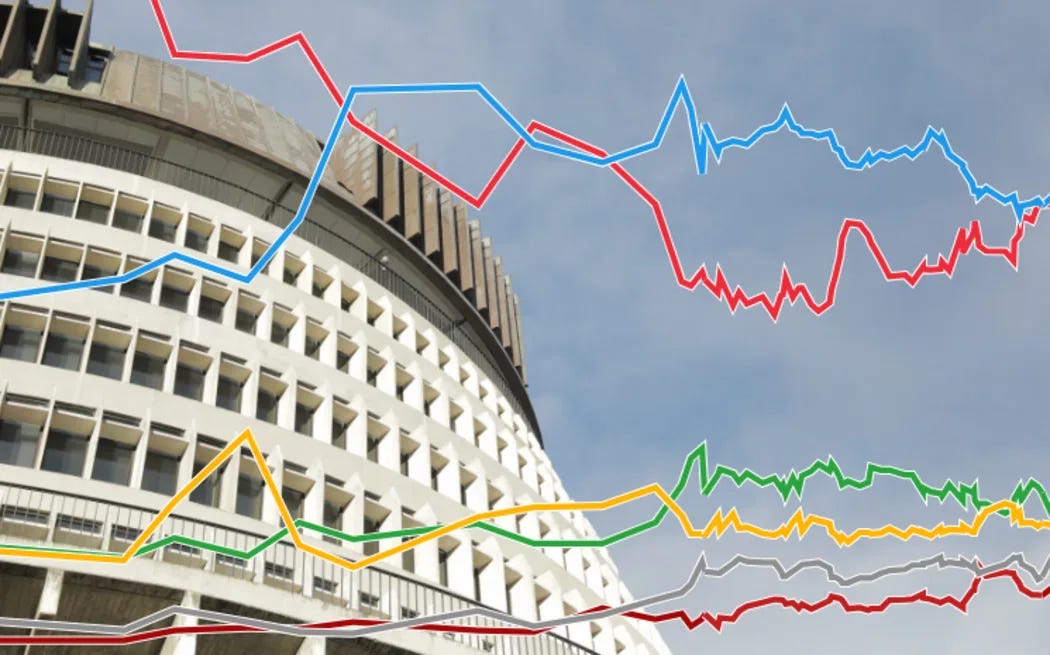
Friday’s Taxpayers’ Union-Curia poll was a political earthquake. National at 28.4%. Christopher Luxon’s net favourability in freefall. The centre-left, for the first time in this polling series, able to form a government on the numbers. Senior figures in the National Party reportedly told the Prime Minister to go home for the weekend and seriously consider whether he was the right person to lead them into November.
Luxon said he was “absolutely not” considering resignation. But the damage is real. And the poll that triggered this crisis – the one that may yet end his prime ministership – was commissioned by a rightwing lobby group, conducted by a company run by a National Party insider, and is not even a member of the industry body that is supposed to regulate polling standards in this country.
Welcome to the new political polling landscape in New Zealand. It’s messy, it’s compromised, and the public barely understands how it works. That matters because polls do not just measure politics now. They increasingly help shape it.
The Old world of polling
Not so long ago, New Zealand political polling was a fairly simple affair. A major media outlet commissioned a reputable survey firm to conduct regular polls on voting intentions. The results were broadcast or published, analysed by journalists and pundits, and that was more or less the end of it.
The archetypal arrangement was the TVNZ-Colmar Brunton poll, which ran for decades and became one of the reference points for political debate in this country. TV3 (and later Newshub) ran the Reid Research poll. The public understood the deal: a news organisation paid a survey company, the survey company did its work, and the results were presented to voters as something close to an objective snapshot of political opinion.
That world has largely disappeared. Colmar Brunton rebranded as Kantar, then became Verian. Newshub shut down entirely. And the simple relationship between big media and established survey companies has been replaced by something much more tangled and, frankly, much harder for voters to evaluate.
The Curia-Taxpayers’ Union arrangement
The biggest and most consequential political poll of 2026 is the Taxpayers’ Union-Curia poll. It’s the one that triggered the current leadership crisis around Luxon, and it drops monthly with the regularity of a political weapon.
Curia Research is owned and run by David Farrar, one of the most prominent and connected figures in National Party circles. John Key once called him “the best in the country.” Farrar co-founded the Taxpayers’ Union itself, only stepping down as a director in July 2023. He also runs the influential Kiwiblog, which is firmly aligned with the centre-right. None of this is hidden. But not many voters know it either.
Curia is also the National Party’s internal pollster – the firm that does private polling for the party. So the public Taxpayers’ Union poll is conducted by the same company that privately services the very party it is publicly measuring. Is that a conflict of interest? Possibly not, but at the very least it’s an arrangement that the public should be more aware of.
Then there’s the industry oversight question. Until August 2024, Curia was a member of the Research Association of New Zealand (RANZ), the industry’s self-regulatory body that operates the Political Polling Code of Practice. But Farrar resigned his membership after RANZ upheld a complaint against him about biased poll questions (notably a Family First-commissioned survey about puberty blockers that RANZ found “does NOT meet acceptable research principles” and “could bring discredit to the profession”). Farrar characterised the complaints process as “weaponised.” Curia now operates outside the industry body entirely.
Here’s where it gets inconsistent. New Zealand media largely refuses to report Roy Morgan polling on the stated grounds that Roy Morgan is not a RANZ member. Yet the same media treats Curia’s numbers as gospel despite Curia also not being a RANZ member. Roy Morgan, whatever its methodological quirks, is a longstanding Australian research firm with no skin in New Zealand’s partisan game. That inconsistency is hard to defend.
The exclusion of Roy Morgan is particularly curious because they were arguably the most accurate pollster ahead of the 2020 election. They were the first to identify that National had dropped below 30%, from which the party never recovered. By blacklisting a firm that has a history of calling uncomfortable results early, the media is depriving the public of a valuable, independent perspective. It suggests that the decision on which polls to report is driven more by the interests of the established media-political complex than by a commitment to data accuracy.
Stuff, Freshwater Strategy, and the Infrastructure Lobby
The other major poll reshaping political coverage is the Freshwater Strategy poll, which is commissioned by Infrastructure New Zealand and published by Stuff and its masthead newspapers, including The Post and the Sunday Star-Times.
Infrastructure New Zealand is a lobby group. It represents the private companies that build roads, bridges, and other major public projects. These are big companies that compete for government contracts worth billions of dollars. It is not a neutral civic body. It has a direct financial interest in government spending decisions, particularly around transport and construction. INZ’s board and membership reads like a directory of government contractors: Fulton Hogan, Downer, McConnell Dowell, Fletcher Building, Aurecon, ANZ Bank, PwC, and Tonkin + Taylor all hold governance or membership positions. These companies compete for a government infrastructure pipeline worth an estimated $275 billion, including the current government’s Roads of National Significance programme.
Freshwater Strategy is not a traditional survey company. Founded in July 2022 by Dr Michael Turner, Jonathon Flegg, and Nicholas Nogarotto (all formerly of Crosby Textor) it describes itself as operating “at the nexus of capital, business, and government,” offering services in public affairs, lobbying, policy and regulation, and “markets and investment advisory.” It is a corporate strategy and lobbying firm that also does polling — not the other way around. The firm has deep connections to the corporate world in Australia and the UK. One of Freshwater Strategy’s main political clients in New Zealand has been Wayne Brown, who used their polling and strategic advice to good effect in his last two Auckland mayoralty triumphs.
The underlying problem is straightforward: a lobbying organisation whose members compete for major government contracts is commissioning political polling that gets published as independent journalism in a mainstream newspaper.
Freshwater’s “New Zealand collaborator” is Tim Hurdle, who is regularly quoted in The Post’s coverage analysing the poll results. What readers may not know is that Hurdle is a former senior National Party adviser who served as the National Party’s Campaign Director in 2020. He’s also a director of Museum Street Strategies, a lobbying and public affairs firm. He appears on RNZ’s political commentary panels, where he is generally described only as a “former National senior adviser.”
Infrastructure NZ is unusually candid about the project. In its own publication, it states that the point of the polling is to help it “urge politicians to make decisions” during the election year, and that it will keep asking questions “that relate to infrastructure issues” throughout 2026. There’s also a commercial edge that should make any reader sit up: the magazine explicitly suggests that companies might be interested in “commissioning your own polling”, and it recommends you contact a specific person at “Freshwater Strategies” to discuss.
So the picture here is not “independent polling reported by the media”. It is polling commissioned and funded by an industry lobby group, published in a newspaper, then used to shape an election-year agenda around funding models, megaprojects, and the politics of infrastructure spending. The commissioner is not neutral, the poll is part of advocacy, and the newspaper publishing it is inevitably pulled into that ecosystem.
And what about the arrangement with Stuff? The Post’s poll stories typically carry a disclosure line stating that the poll is “funded by Infrastructure NZ to encourage debate about issues important to the future of New Zealand.” That’s quite a euphemism for a lobby group paying for polling that is then presented as news. The journalists who write up the results regularly interview the very lobbyists who funded the research to explain what the results mean for the government’s performance. It is an integrated communications strategy presented as journalism. This blurs the line between reporting and lobbying. When Freshwater polls the public on issues like the “cost of living” or “economic management,” the framing is often designed to lead toward spending money on an “infrastructure solution.”
This is how a lobby group plants itself at the centre of political coverage. They fund the data, they frame the questions, and they get their spokespeople quoted as experts in the resulting news coverage.
Jordan Meyers, Freshwater’s head of research, even writes opinion columns for The Post based on Freshwater’s own data. His columns carry a byline but not always a clear declaration that Freshwater is a corporate lobbying firm, not an independent research outfit.
In Australia, Freshwater’s record is equally telling. The firm’s reputation took a significant hit after the 2025 Australian federal election, where it served as the Liberal Party’s internal pollster (a $1.5 million spend) and predicted a tight race; but Labor won a decisive victory. The ABC reported in April 2025 that Freshwater was simultaneously working as the Coalition’s internal pollster and running a campaign for a group called “Australians for Natural Gas”, which a political communications expert described as “a textbook example of astroturfing.”
Is this problematic? I think so. When a lobby group pays for a poll, a lobbying firm conducts it, a former party operative analyses it, and a newspaper publishes the results with quotes from the lobbyists, then that is not independent journalism. It’s a supply chain of influence, and the public deserves to understand that. In addition, it’s worth pointing out that Stuff also carries out joint public operations with the Infrastructure NZ lobbyists, such as public forums on politics topics and conferences on the economy.
Talbot Mills, Labour, and the question of selective leaking
On the other side of the political fence sits Talbot Mills Research, which is the successor firm to UMR Research, the company that was for decades Labour’s in-house public research firm. This is not a simple survey company; it is an arm of Anacta Consulting, a trans-Tasman lobbying and government relations firm run by former high-level political staffers. Talbot Mills also markets the political insider credentials of its principals. It says David Talbot has been “pollster and strategist” for Labour prime ministers Jacinda Ardern and Chris Hipkins. It describes Stephen Mills as a former senior adviser to Prime Minister David Lange.
But Talbot Mills is not just a polling company. It is a lobbying and market research firm that provides services to businesses and politicians. Its most famous client remains the Labour Party. It is run by former Labour staffers. And through its parent company, Anacta Holdings NZ Ltd, it is connected to a wider commercial lobbying network. Anacta Holdings NZ is split equally between Talbot’s family trust and two Australian entities linked to Evan Moorhead (former Queensland Labor MP and state secretary) and David Nelson (Labor campaign strategist who worked on Keir Starmer’s 2024 UK victory).
Polling and lobbying are completely intertwined. Anacta provides “fearless advice” to corporate and political clients, using their proprietary Talbot Mills data as a foundational tool. This creates a situation where a single company is polling for the Labour Party, lobbying the government on behalf of corporate clients, and then selectively leaking their results to the media.
What’s changed in recent years is that Talbot Mills polls are increasingly surfacing in media coverage, but not through any transparent, regular publishing arrangement. Instead, the results appear when the company or its clients choose to leak them. In January, The Post reported on a Talbot Mills poll “obtained by The Post” that showed Labour ahead but the right bloc retaining a governing edge. The story presented the numbers alongside the usual analysis, but the question of who chose to release these numbers, and why, and at that particular moment, was left unexplored.
The media’s use of Talbot Mills’ “corporate” polls is particularly opaque. These polls are technically private and intended for corporate clients, but they are frequently passed on to journalists when the numbers are favourable to Labour or damaging to the coalition.
This is the integrity problem that doesn’t get enough attention: leaked internal polls are selectively political by definition. We usually don’t know the full methodology, the full questionnaire, the weighting choices, or what else the poll found but didn’t release. We see only the bits someone wanted in the public domain. They may not be false, but they are highly selective, and therefore easy to weaponise. A pollster can design issue questions that tilt results towards a predetermined agenda.
Some on the right of politics believe that Talbot Mills polls which damage the National Party and the political right are the ones that get released to the media at sensitive times. That’s hard to prove, but it’s also hard to disprove, because there is no transparency about how or when these results are shared. We see the numbers that someone wants us to see. The rest stays behind the curtain.
The most damaging controversy involved Andrew Kirton, who resigned as Anacta NZ’s Executive Director one day before being announced as PM Hipkins’ Chief of Staff in February 2023. Kirton had been working for Anacta as a lobbyist for a year before moving back into the heart of government. The appointment was a stark illustration of the “revolving door” between corporate power and the Beehive.
Luxon’s secret UK pollsters
One of the most revealing stories of recent days is the one about who Christopher Luxon actually listens to on polling. Because it’s not actually Curia.
In his NewstalkZB interview following Friday’s disastrous poll, Luxon distanced himself from Curia’s numbers entirely, saying he only looks at “the one that we do internally for ourselves... stuff that we actually get processed overseas, actually, to be honest, because there’s skills that we need, to process the data.”
Matthew Hooton, in his Patreon email newsletter today, has revealed the identity of this mysterious offshore pollster. It is Sancrox Political Advisory Ltd, a company incorporated in the UK in September 2023, closely associated with another firm called Fleetwood Strategy Ltd.
The key players behind both are Michael Brooks and Isaac Levido OBE, an Australian protégé of Lynton Crosby – meaning that both Freshwater Strategy and the Sancrox/Fleetwood operation trace their origins to the same Crosby Textor consultancy stable. The NZ Herald has confirmed that National has “recently brought back Sancrox (formerly Fleetwood) Political Advisory” for the 2026 campaign, with Levido “personally involved in the latest round of advice.”
Fleetwood was hired by National for its successful 2023 election campaign. As Hooton explains, Sancrox and Fleetwood don’t conduct their own fieldwork. They take the raw Curia data and apply their own re-weightings and statistical adjustments. This is why they provide Luxon with different numbers to the ones the public sees. Luxon no longer relies on Curia’s raw numbers. Instead, National sends them to Sancrox Political Advisory Ltd in London.
According to Hooton, the account is now handled mainly by Zach Ward-Elms, Izzy Walker (a former National staffer), and Andrew Laidlaw, who works out of Fleetwood’s Melbourne office and performs the statistical adjustments. Laidlaw has previous New Zealand experience as a polling assistant at Crosby Textor during the John Key era and as a private consultant to National during the Simon Bridges leadership in 2020.
What are these adjustments? Hooton reports that media sources suggest the re-weightings produce more encouraging numbers for Luxon: around 32% where Curia had 28%, better but still historically dire.
New Zealand politics is now professionalised to a point where internal party opinion research is being outsourced offshore (or at least “processed” offshore). And that creates a new transparency problem: the public can’t evaluate the influence of political consultants it can’t see.
Hooton’s basic point, and one that Luxon inadvertently validated on radio, is absolutely central to this new polling landscape: political polling is now deeply embedded in professional campaign and influence operations, sometimes spanning multiple countries, and the public has very little visibility of who is advising whom. Pollsters are no longer disinterested survey companies. They are political players with their own interests to serve. Freshwater’s funder wants more government contracts. Talbot Mills works for the party it polls.
The Media’s other polling relationships
For the sake of completeness, the other major media polls are:
1News now uses Verian (the company formerly known as Colmar Brunton, then Kantar). This is the closest thing to the old-style arrangement in which a media outlet commissions a recognised survey firm.
RNZ launched a partnership with Reid Research in April 2025, building on the old Newshub-Reid Research poll that ran from 2009 to 2023. Reid Research maintains a database of about 40,000 panellists and conducts online surveys of 1,000 eligible voters. Its founder, Ngaire Reid, has been in the business since 1996 and the firm remains a member of RANZ.
Ipsos NZ publishes its quarterly Issues Monitor, which tracks voter concerns and party trust on policy areas, and has recently been picked up by several media outlets.
Roy Morgan continues to conduct monthly New Zealand polls, typically by phone (both landline and mobile), and has done so for years. Its results occasionally differ from other polls, but its track record over time is comparable. Interest.co.nz has been one of the few outlets willing to publish Roy Morgan’s numbers.
Time for new ground rules
Political scientist Grant Duncan recently wrote that polls “are snapshots, not predictions” and urged voters to always check “who’s done the survey, who’s sponsored it and what the methodology was.” That’s good advice. But it puts the burden entirely on the public, and most voters simply don’t have the time or the information to do that homework.
The burden should fall more heavily on the media. And the truth is that New Zealand’s media has not kept up with the changes in the polling landscape. The old model in which “media commissions poll, poll gets reported” no longer applies. What we have now is a patchwork of arrangements involving lobbying firms, partisan insiders, corporate interests, and offshore consultants, and media organisations that often do not make these connections transparent to their audiences.
Here are some questions the media should be asking itself:
If a poll is funded by a lobby group, shouldn’t the reporting include scrutiny of that group’s interests, not just a boilerplate disclosure line? If a polling firm is also a lobbying company, shouldn’t that be stated prominently in every story that uses its numbers? If poll results are selectively leaked by a firm with partisan ties, shouldn’t the reporting interrogate the timing and motivation of the leak, not just publish the numbers?
And if the media is going to exclude Roy Morgan on the grounds that it’s not a RANZ member, then shouldn’t the same standard apply to Curia, which is also no longer a RANZ member? Or perhaps they should just remove Roy Morgan from their blacklist.
One useful reform would be to split polls into two categories in reporting:
Public-interest polling: commissioned by media or public broadcasters with consistent transparency, regular schedules, and clear methodology. Polls such as Verian and Reid Research appear to fall into this category.
Advocacy polling: commissioned by lobby groups, industry associations, parties, or political consultancies, where the numbers may be methodologically sound but are also part of a political project. Polls from Freshwater-Infrastructure NZ and Curia-Taxpayers’ Union appear to fall into this category.
That second category can still be reported. But it should be reported with much more scepticism and context than it usually gets.
Looking further ahead, New Zealand should seriously consider a public “polling register” for election-year political polling, where any poll reported by major outlets must file basic documents (questionnaires, method notes, dates, sample frames, weighting variables) so that citizens, academics, and rival media can interrogate it properly.
Polls shape political reality. They drive leadership speculation, influence voter behaviour, and set the media agenda for weeks at a time. The March 6 Curia poll may yet precipitate the end of Christopher Luxon’s leadership of his party and the country. That’s an enormous amount of power to be wielded by institutions that most voters know almost nothing about.
The polling firms of 2026 are not the simple survey companies of the past. They are political players in their own right, connected to parties, to lobby groups, to offshore strategy firms, to corporate clients with interests in government spending. The questions they ask, the way they weight their results, the clients they serve, and the timing of their releases all have political consequences.
The public has a right to understand all of this. And the media has an obligation to explain it. Right now, too much of the political polling landscape is operating in a fog of assumed neutrality. It’s time to clear the air.
Dr Bryce Edwards
Director of the Democracy Project
Further Reading:
