

Yesterday, as the Infrastructure Commission released New Zealand’s first-ever National Infrastructure Plan, the North Island was cleaning up from yet another extreme weather event. Roads blocked by slips and flooding. Power cut to homes. Stormwater and sewage systems overwhelmed. Commission chief executive Geoff Cooper acknowledged the grim backdrop, noting that the challenges of maintaining infrastructure in the face of natural hazards “sit at the heart of what the national infrastructure plan is about.” It was a polite way of saying the system is failing.
The 226-page plan is the most honest document about the state of New Zealand’s infrastructure that any government body has produced. It is a stinging critique. Not just of pipes and roads and hospitals, but of the political system that got us here. Read through the lens of my recent “Broken NZ” columns, this plan is an object lesson in how vested interests, short-term political calculations, and captured institutions have left New Zealand spending more than almost anyone else in the OECD on infrastructure — while getting some of the worst results.
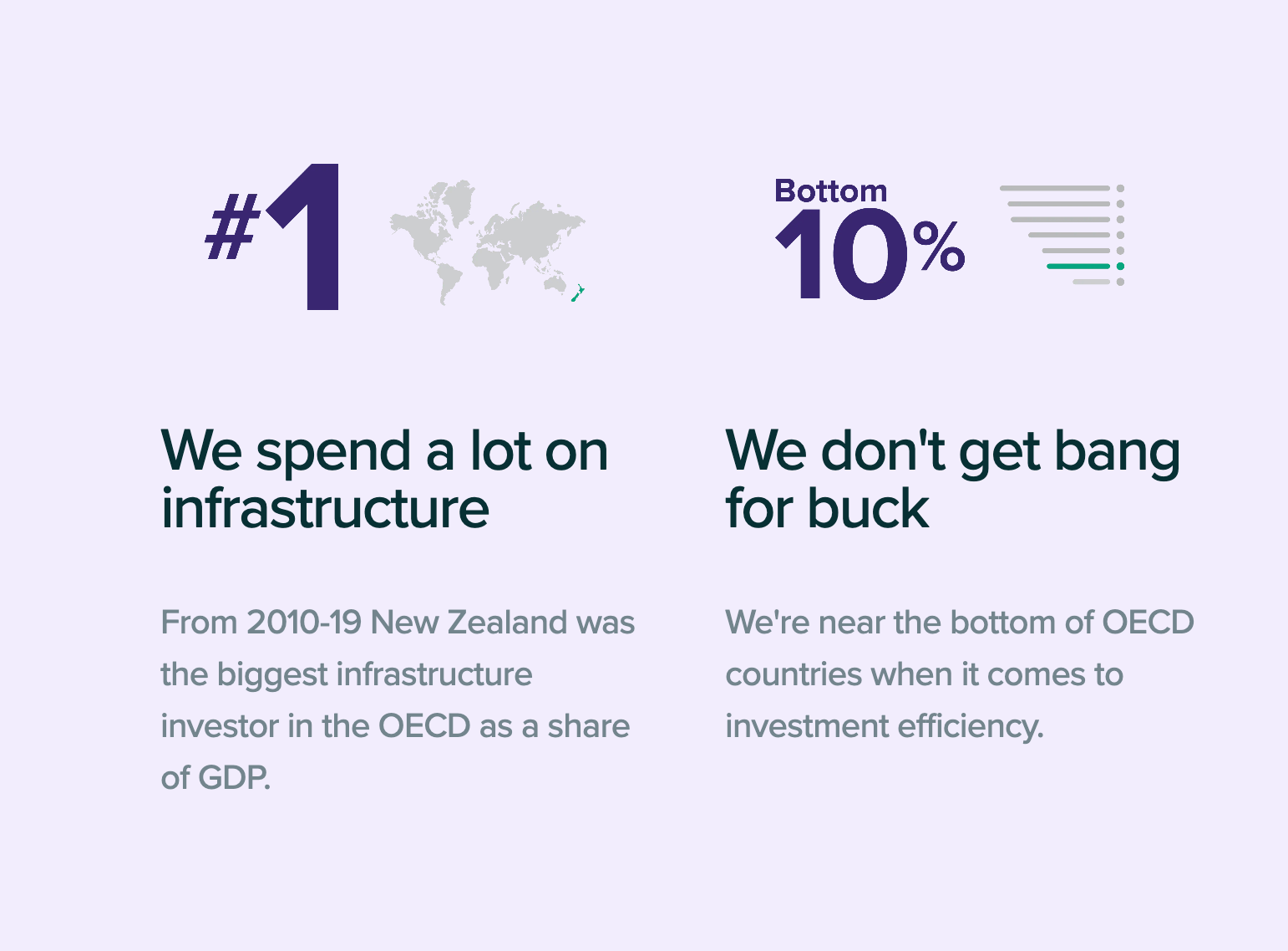
The core finding is blunt. New Zealand spends around 5.8% of GDP on infrastructure each year, over $20 billion, one of the highest rates in the developed world. Yet the country ranks near the bottom for efficiency. “On a dollar-for-dollar basis, we achieve less than many of our more-efficient international peers,” says the Commission. We rank fourth-to-last in the OECD for asset management. There are nearly 12,000 projects in the pipeline valued at $275 billion, and two-thirds of that — $193 billion — is unfunded. We don’t have a spending problem. We have a value-for-money crisis, and a political system that is incapable of making honest choices.
A Savage critique of politics as usual
Threaded through the plan and its 16 recommendations is an implicit rebuke of how successive governments have handled infrastructure. Too much emphasis on unfunded transport mega-projects. Not enough spent on maintenance. A lack of stable commitment to anything. As Thomas Manch puts it in BusinessDesk, there is “an implicit criticism of the political and public handling of infrastructure.”
Infrastructure Minister Chris Bishop was almost defensive in response. He acknowledged that many central government agencies do not properly understand what they own, lack asset registers, and have no long-term investment plans. “I would go so far as to say it is broken,” he told reporters. That is a striking admission from the minister responsible for fixing it.
Yet Bishop’s own record is part of the problem. He championed the expansion of the Roads of National Significance programme to 17 projects costing an estimated $56 billion, which the Commission now says is unaffordable. Last year, Henry Cooke reported that Bishop redirected $27 million from a Kāinga Ora housing fund to build a bridge in his own electorate, overriding official warnings. It is hard to lecture the country on depoliticised, merit-based decision-making when you have just raided a housing fund for a pet project in Hutt South.
Thomas Coughlan in the Herald traces the tortured history of road-building politics. In 2018, the Labour Government proposed spending more on maintenance and less on new roads. The backlash was fierce. Labour retreated, resurrecting cancelled roads with $6.8 billion in borrowed money. Costs nearly doubled. Several projects were cut. National then campaigned ruthlessly on potholes and promised its own extravagant road programme. The cycle repeats, and the Commission is essentially saying: enough.
Coughlan’s conclusion is sobering. Both parties need to find a way to make “boring maintenance” more attractive to voters and to “tactically retreat from promising expensive mega projects.” He argues that governments prefer ribbon-cuttings to maintenance, and none of them minds handing the mess to the next lot.
What the plan gets right
The most significant shift the plan proposes is philosophical. It says 60 cents in every dollar of capital spending over the next 30 years should go on maintenance and renewals — fixing what already exists — rather than building new mega-projects. Much of the infrastructure built in the post-war decades is now wearing out. Hospitals need seismic upgrades. Water networks are crumbling. Roads need strengthening against heavier vehicles and more extreme weather.
This is welcome, and long overdue. The plan’s ten priorities for the coming decade include lifting hospital investment for an ageing population, completing the catch-up on water renewals, and taking a predictable approach to electrifying the economy. Health is identified as the sector requiring the biggest lift, with investment needing to double as a share of GDP. Auckland alone will need about 1,100 additional beds and other health facilities by 2050.
On land transport, the plan raises serious questions about the affordability of the Roads of National Significance programme and recommends that major projects be prioritised and sequenced — a polite way of saying some will be delayed or dropped. It also notes the absurdity of building vast road capacity for peak use rather than managing demand through congestion pricing. As the plan puts it: “It’s time to do new projects right, rather than dreaming big and seeing them constantly delayed, rescoped, or cancelled because they’re too big for us to afford.”
Richard Harman, in his Politik newsletter, takes the broadest and most sobering view. His piece argues the plan, combined with demographic data showing the lowest growth rate for under-15s since 1992, tells us plainly that “we cannot afford the future” without radical changes. He predicts the necessary debates about taxes, privatisation, user-pays and superannuation will be “met with resistance, denial and obfuscation.” He is probably right.
Where the real dangers lie
For all that the plan gets right about maintenance, it also raises hard questions about inequality and the concentration of economic power. The Commission proposes that roads, water and telecommunications should be funded “predominantly” by users, with Crown loans and grants no longer propping up land transport.
That may make economic sense in the abstract. In practice, it means higher fuel taxes or road user charges, tolls, congestion fees, and water charges landing on households, while large corporates pass those costs on. The plan forecasts electricity charges rising by 1% of the average household budget by the mid-2030s. For higher-income households that is irritating. For those already squeezed by rents, food costs and stagnant wages, it is significant.
The push towards public-private partnerships is also concerning. PPPs have failed badly in New Zealand. Transmission Gully — where an under-priced PPP contract, poor risk assessment and consenting confusion led to massive delays and overruns — should be a cautionary tale. Yet the plan and the Government continue to flirt with greater private sector involvement. Industry voices, including at INZ’s own conference, have pushed for KiwiSaver funds to be channelled into infrastructure investments, which would create a major new capital pool for the industry’s members while shifting financial risk onto ordinary workers’ retirement savings. There is remarkably little discussion of the downsides.
More fundamentally, the plan floats economic regulation of land transport, giving NZTA more autonomy but shifting power away from elected politicians and towards technocrats and regulators. In a small country where the same people rotate between agencies, consultancies, and major suppliers, that concentrated gatekeeping function becomes a prime lobbying target.
Bishop describes this as “a very large structural change.” It would be. And without strong transparency and accountability mechanisms, it could easily mean less democratic control rather than better decisions. The question, as always, is who gets to sit at the table, and who profits.
The Infrastructure lobby’s quiet power
What is notable about the response to yesterday’s plan is how quickly the infrastructure industry moved to shape the narrative. Infrastructure New Zealand — the sector’s peak lobby group — responded within hours. CEO Nick Leggett cautioned against “allowing fiscal constraints alone to define national ambition,” insisting that infrastructure is “not simply a cost” but “an investment in prosperity, productivity and resilience.”
The Civil Contractors echoed the call for “pipeline certainty.” The Building Industry Federation wrote in the Post that the plan’s maintenance emphasis could deliver “more predictable, steady demand” for the supply chain.
These are not disinterested voices. Infrastructure New Zealand operates at the intersection of public and private sectors. Its membership includes engineering firms, construction companies, banks and public agencies. Its current CEO, Nick Leggett, is a former mayor with National Party connections. He also resigned this week as Chair of Wellington Water over his role in the capital’s sewage crisis.
Its former CEO, Stephen Selwood, was appointed to the Infrastructure Commission’s own board — a classic revolving door from industry advocacy to government oversight. Its current chair, Tracey Ryan, simultaneously serves as CEO of Aurecon, a global engineering firm. The organisation’s position — more spending, more private capital, more PPPs — is backed by deep pockets and sharp organisation.
There is no lobbying register in New Zealand. INZ has no formal requirement to disclose its interactions with government. Its annual “Building Nations” conference has become a platform for infrastructure policy announcements, with ministers routinely appearing as keynote speakers. The organisation regularly places opinion pieces and sponsored content in major outlets, creating the appearance of expert consensus when it is often industry advocacy dressed in policy language. This is not unique to infrastructure — it is how New Zealand’s crony capitalism operates across sectors from banking to supermarkets to electricity. But the scale of the infrastructure pipeline, at $275 billion, makes the stakes here particularly high.
The Broken NZ pattern repeats
Readers of my recent columns on “Broken New Zealand” will recognise the pattern. Whether we are talking about monopolistic supermarkets, profiteering banks, or dysfunctional electricity markets, the dynamics are familiar: concentrated power, feeble competition, the same people rotating between industry and government, and politicians who talk reform while shielding the incumbents.
Infrastructure fits this pattern perfectly. New Zealand spends the most in the OECD on infrastructure and gets among the worst results. The industry benefits from cost blowouts and perpetual project churn. The consultants and contractors feast on the boom-bust cycle. The lobby groups write the policy papers, sit on the advisory boards, and then profit from the decisions. Meanwhile, the public gets sewage in the harbour, crumbling hospitals, and potholed roads.
The National Infrastructure Plan is a welcome intervention. It is the most clear-eyed assessment of where New Zealand stands that any official body has produced. Its emphasis on maintenance over mega-projects, on affordability over ambition, and on honest choices over empty promises is exactly what the public debate needs. Henry Cooke captures the core message: New Zealand’s crisis is political, not just plumbing.
But the plan will only matter if it shifts the balance of power. If the Government cherry-picks the bits it likes — congestion charging, RMA reform — while ignoring the implicit critique of its own road-building programme, it will change nothing. If the response to the plan is shaped behind closed doors by the infrastructure industry rather than in transparent public debate, the $275 billion pipeline will remain what it is today: an opportunity for quiet enrichment as much as national renewal.
The test is obvious. Will the politicians level with voters about what the country can and cannot afford? Will they confront the power of the construction and transport lobbies, or continue to let them set the agenda? And will they design the inevitable user-pays reforms with protections for those least able to bear the cost, or just pass the bill to ordinary households while corporates cash in?
This plan needs to be read and argued over. It should be a turning point. Whether it actually becomes one depends on whether New Zealand’s political class has the backbone to match the Commission’s honesty. Going by the record, I wouldn’t bet on it.
Dr Bryce Edwards
Director of the Democracy Project
Further Reading: