

Each year Parliament publishes one of the most useful documents in New Zealand politics — and one of the most underused.
“The Register of Pecuniary and Other Specified Interests”, tabled yesterday, tells us what MPs own, who’s bought them dinner, and where their household money sits. It isn’t a full map of political power. But it’s about as close as the public ever gets.
This year’s register doesn’t deliver any spectacular scandals — and that’s the story. The bigger story is less dramatic but probably more important: Parliament is overwhelmingly made up of property owners governing a country where ownership is becoming harder and harder.
That matters because these MPs are voting on housing, rents, social housing, tax, planning, landlord regulation, and the future of state housing. These aren’t detached observers. They are participants in the very economy they regulate.
Therefore the register doesn’t prove corruption or any rule breaking. But it does show the social and economic world our MPs inhabit. And that world is overwhelmingly propertied, asset-rich and heavily insulated from the housing insecurity experienced by hundreds of thousands of New Zealanders.
Parliament’s property class
The headline numbers are stark. Across 121 MPs, there are 271 declared properties. That works out at about 2.24 properties per MP. Almost all MPs declare some form of property interest. Only a handful appear to have no property at all.
This is not representative of New Zealand. It is certainly not representative of renters, younger people, beneficiaries, low-wage workers, or those trying to get into a first home.
The partisan differences are also revealing. National MPs are again the most property-heavy caucus, averaging about 2.82 properties each. More than half of National MPs own three or more properties. Act and NZ First MPs are also well above the one-home norm. Labour MPs are hardly propertyless, but they sit lower than the governing parties. The Greens are the outlier, with less than one property per MP on average and several MPs declaring none.
This doesn’t mean every National MP is a landlord, or that every Green MP is a renter. But the aggregate picture matters. Parliament isn’t just a debating chamber. It is a class composition. And on housing, that composition leans heavily toward ownership.
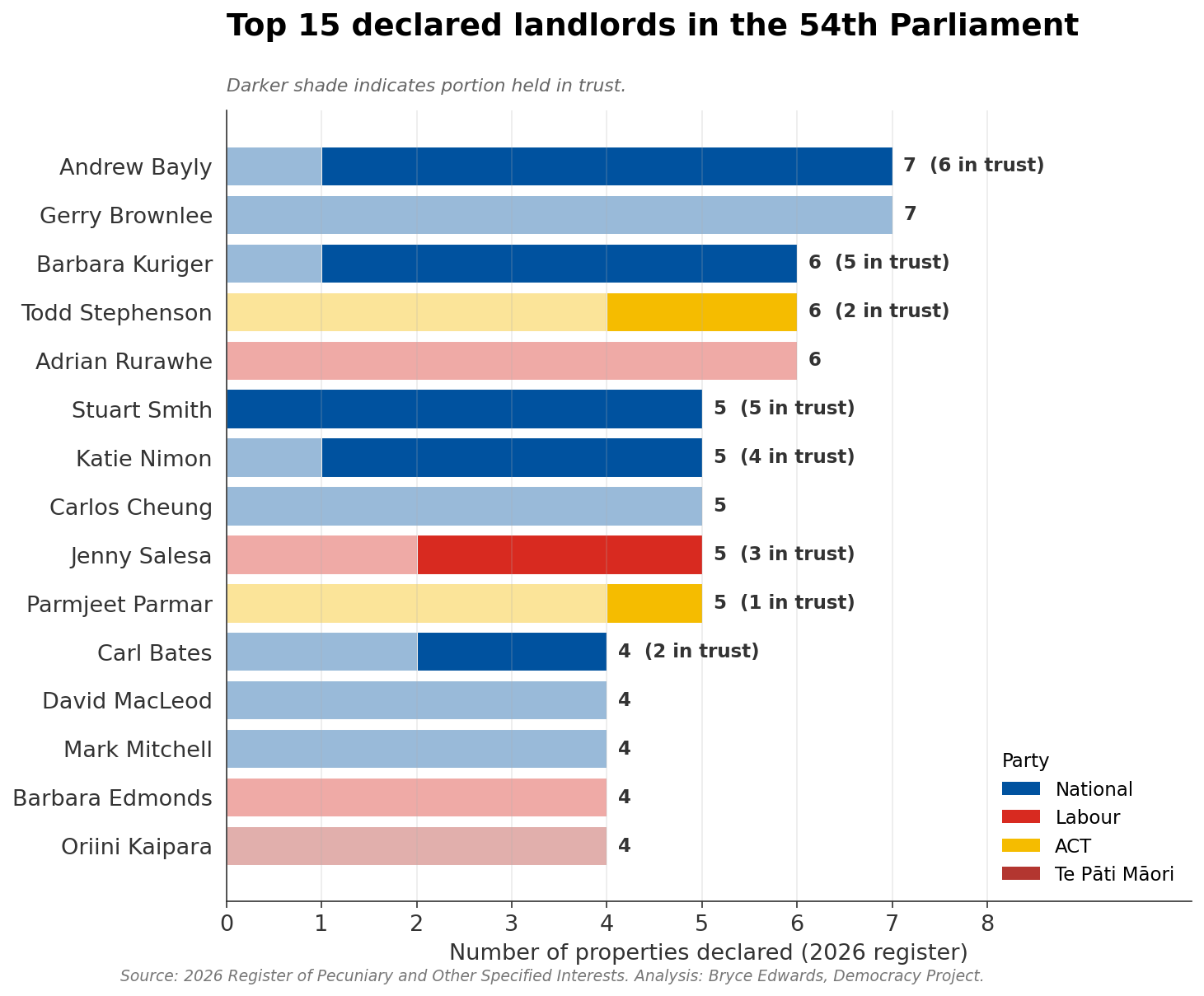
The biggest property declarations this year include National’s Andrew Bayly and Gerry Brownlee, each with seven properties. Barbara Kuriger has six. Labour’s Adrian Rurawhe also has six. Todd Stephenson, the Act MP and Parliamentary Under-Secretary, declares a six properties in Queenstown, Wellington, Sydney, Geelong and Te Ānau. Louise Upston declares a family home in Cambridge and an apartment in Wellington.
None of this is automatically improper. MPs are allowed to own property. They are allowed to have mortgages, trusts, farms, apartments, holiday houses and investments. No one expects MPs to live like monks. The real question is whether a property-heavy Parliament can judge housing policy fairly when the status quo works so well for them personally.
The awkward timing
The register was published on the same day the Government announced major reforms to social housing and the Accommodation Supplement. That coincidence is almost too perfect.
On one side of the political ledger, the public was shown a Parliament full of property assets. On the other side, the Government announced that social housing tenants will be required to pay more of their income in rent, and that the state will more aggressively push some tenants toward the private rental market.
Housing Minister Chris Bishop argues the changes are about fairness. His case is that people in social housing can end up better off than comparable low-income households renting privately. The Government says social housing should be more tightly targeted to those with severe and persistent needs, while other households should receive support through private-market subsidies.
There is a real argument here. The housing support system is messy, expensive and often irrational. Arguably it’s a system that’s quite broken. Certainly private renters can be treated badly by the current settings. Social housing is scarce, and people in desperate need do sit on waiting lists for too long.
But the Government’s fairness argument has a revealing limitation – it only looks at unfairness between two groups at the bottom of the scale. It asks whether a state-house tenant is getting too much compared with a poor private renter. It is much less interested in whether the entire housing system is tilted toward landlords, property investors, homeowners, and asset holders.
The Government is focused on the bottom end of the system. It is far less curious about the top.
That is where the register becomes politically revealing. It reminds us that the people making these decisions are not, as a group, housing outsiders. They are overwhelmingly on the owning side of the divide.
The Louise Upston problem
The most politically damaging example is Louise Upston. Stuff journalists Emma Ricketts and Jenna Lynch reported today that Upston, the Social Development Minister, claims $1000 a week in parliamentary accommodation allowance while also seeking tougher criteria for ordinary people receiving the Accommodation Supplement.
MPs and ministers who live outside Wellington are entitled to accommodation support when they are in the capital. Upston’s claims reportedly amounted to $52,000 last year, on top of her ministerial salary. As Ricketts and Lynch report, the register shows she jointly owns a Wellington apartment, although no associated mortgage debt appears to be declared.
Again, this doesn’t mean Upston has broken any rule. That is exactly the point. Her case is revealing not because it appears to be illegal, but because it appears to be allowed. There is one housing-support system for MPs, based on entitlement. There is another for low-income New Zealanders, based increasingly on suspicion, conditions and tighter tests.
Upston’s policy change would raise the threshold for some homeowners receiving Accommodation Supplement support. Ordinary households will be expected to contribute more before help is available. But MPs receiving parliamentary accommodation support are not subject to the same sort of test. No one asks whether a politician on a $320,600/year ministerial salary is contributing enough of their own income before receiving taxpayer support for Wellington accommodation.
When Stuff asked whether she would meet the 40% threshold she is imposing on other New Zealanders, she declined to answer. Stuff reports she “suggested we direct our questions to her office”, and that her office “said the minister had nothing to add.”
What matters here is less the individual politician than the institutional culture. It shows how political institutions normalise generosity for insiders and discipline for everyone else.
The paywall now starts at halfway through all Democracy Project newsletters. Please take out a paid sub if you want to support this service and access the full content, including the following sections: “The private rental market is not neutral”, “Trusts and the half-visible Parliament”, “Gifts, hospitality and access”, “Business interests and investment politics”, “A register designed for another era”, “The conflict that hides in plain sight”, “What should change” and “The real story of the register”.