

The story of New Zealand’s climate law change is strange and damning enough on its own. Two weeks ago the Government announced it would retroactively strip citizens of the right to sue major polluters, while ignoring official advice to let the courts proceed. But it is no longer just that story. Yesterday the episode got considerably worse: it turns out the legislation may have been written, in essential form, by the very corporations standing to benefit from it.
When you strip the story down, the bones of it are these. Two of the country’s biggest greenhouse gas emitters drafted, in actual statutory language, the law they wanted Parliament to pass. They printed it out. They walked it into the Prime Minister’s office. Two years later, the Justice Minister announced that exact change as government policy. And the Prime Minister’s office now says it has no record of any of it.
Some are suggesting that this is normal stakeholder engagement. It is not.
What the Government’s climate law change has exposed is a corridor of influence between the country’s largest corporate emitters and the Prime Minister’s office. The corridor was hidden from public view, missed by every official information request that went looking for it. It only came to light because a High Court judge refused to entertain the corporates’ confidentiality claims and ordered the documents released.
The interesting story here isn’t really climate policy. It’s how laws get made in this country.
A two-sentence wish list
By now, this much is beyond dispute. In June 2024, a Fonterra government affairs representative hand-delivered a printed briefing note to a staffer inside the Prime Minister’s office. About a month later, Z Energy did the same thing, with a substantially identical document, to the same adviser. Both companies have confirmed this. Both stand by the document. It has the appearance of being prepared in substantial part by Chapman Tripp, the elite law firm acting for the defendants in Smith v Fonterra, and was prepared on behalf of all of them.
The briefing did two things. It argued that legislative intervention was “necessary and appropriate” to wipe out tort-based climate litigation. And it proposed, in actual statutory language, a “two-sentence legislative amendment” to the Climate Change Response Act that would, in its own words, “resolve the uncertainty and risks posed by private law claims like Mr Smith’s”.
The drafting wasn’t generic. It was aimed. It would retroactively strip New Zealanders of any common-law right to bring climate damage claims. It would kill, mid-flight, the Supreme Court-sanctioned case that Ngāpuhi and Ngāti Kahu kaumātua Mike Smith has been trying to take to trial since 2019.
On 12 May 2026, Paul Goldsmith stood up and announced the Government would do precisely that. The Minister framed it as a matter of “business certainty” and avoiding “uncertainty in business confidence and investments”.
The disappearing trail
Here is where the story gets uglier.
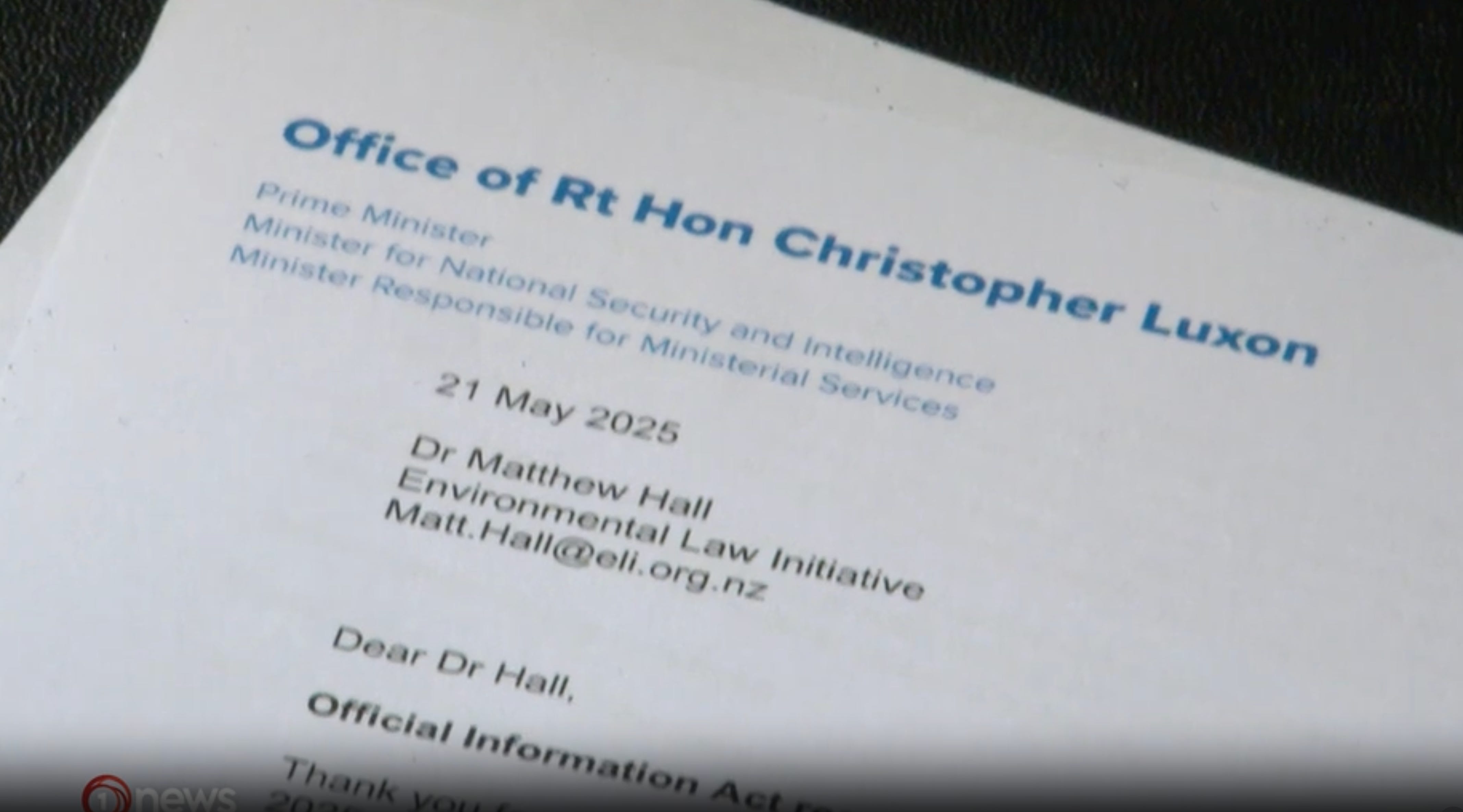
In March 2025, Dr Matt Hall of the Environmental Law Initiative filed an Official Information Act request to the Prime Minister’s office. He was not fishing. He was specific. He wanted all documents relating to Smith v Fonterra, all documents about any proposed legislative or regulatory response to it, records of meetings with industry stakeholders about the case, and internal policy discussions on it.
A request more clearly aimed at what would eventually be revealed is difficult to imagine. So is a properly functioning government office that could fail to find a hand-delivered briefing note from two of the largest companies in the country proposing the very legislative response the request concerned.
That, however, is what happened. The PMO took a 19 working-day extension to “consult”. It then released a limited set of heavily redacted emails and text messages. There was no mention of the June or July 2024 meetings. No copy of the briefing note. Not even a hint that the document existed.
A similar OIA request from Lawyers for Climate Action NZ returned the same kind of nothing.
The document only surfaced because the High Court forced it out. In December 2025, the court ordered the corporate defendants to disclose lobbying-related documents by 27 March 2026. They missed the deadline. It took Goldsmith’s 12 May announcement and an urgent intervention by Smith’s legal team before Fonterra and Z Energy finally disclosed the briefing in mid-May. Both then claimed confidentiality. On 21 May, Justice Peter Andrew ruled those claims could not be sustained and ordered the document released to the public.
Therefore, the information existed. The corporates had it. The PMO either had it or should have had it. Two OIA requests aimed straight at it produced nothing. The corporates missed a court deadline to hand it over. Only after the Government had announced its law change did the document fall into public view.
The PMO’s official response to all this can be summarised in two words: nothing happened. “We have been made aware of these meetings and briefing notes via the media and have no record of either on file,” Christopher Luxon’s spokesperson told the press. Cabinet, he added, “makes its own decisions”.
Cabinet always makes its own decisions. Cabinet decisions are not normally meant to mirror the precise wording of a privately printed corporate text that no one in the building can apparently remember receiving.
Either the PMO’s record-keeping has collapsed to the point where hand-delivered documents from billion-dollar emitters evaporate on arrival, or those documents were not disclosed when the law required them to be. There is no flattering reading.
A familiar script
This isn’t a one-off. The Post’s Andrea Vance pointed to the precedent last night. She explained how in July 2024, the High Court set aside a pollution discharge consent for the Ashburton Lyndhurst Irrigation scheme. Within weeks, three primary industry lobby groups, Beef + Lamb, DairyNZ and Federated Farmers, fired off a joint letter to Associate Environment Minister Andrew Hoggard. The letter included their preferred statutory amendments to sections 70 and 107 of the Resource Management Act, designed to bypass the court’s enforcement of environmental bottom lines. Within weeks, the Government amended the RMA under urgency. The catchments stayed degraded. The councils got the power to issue the consents the industry wanted.
Same year. Same model. Lose in court, draft the law you would prefer, slip it under the right ministerial door, and watch Parliament hand it back to you in legislative form.
Mike Smith’s reading of what has been done to him is therefore not paranoid. It is observational. He calls it “a co-ordinated campaign of secret lobbying, political interference and corporate influence at the highest levels of power”. He has called it a “cover-up”. He has noted that “ordinary New Zealanders do not get private access to the prime minister’s office to discuss shutting down active court proceedings against them.”
The paywall now starts at halfway through all Democracy Project newsletters. Please take out a paid sub if you want to support this service and access the full content, including the following sections: “What was actually bought”, “What courts do that governments cannot”, “A transparency deficit, again”, and “A reminder, in case it’s needed”.