

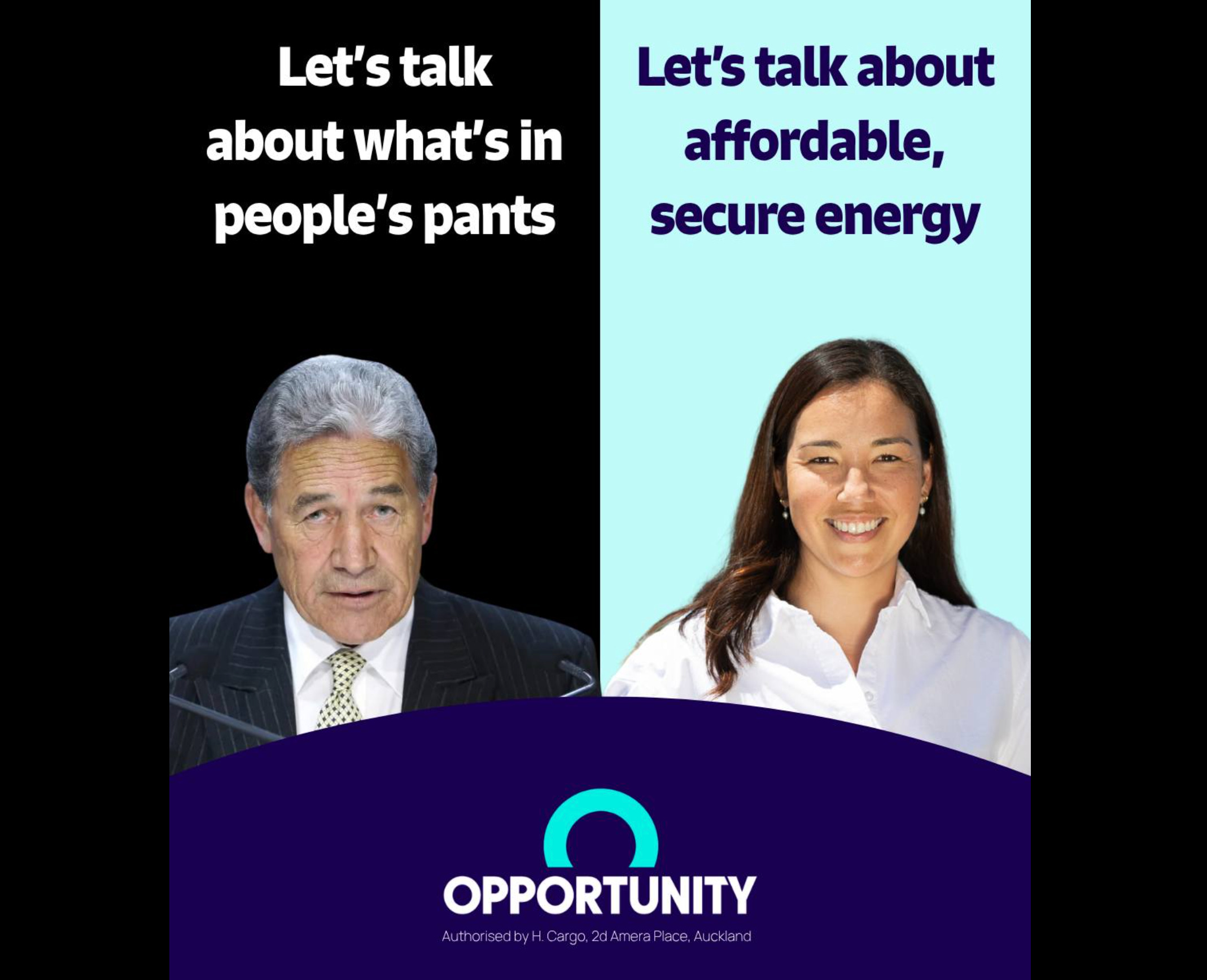
Every few days now, a senior commentator floats the idea of a grand coalition. National and Labour, the two old majors, governing together in a centrist marriage of convenience designed to keep the extremists at bay. The fantasy keeps recurring because the current arrangement has produced something resembling a hostage situation. National is bound to NZ First. Labour, on current numbers, will need the Greens and Te Pāti Māori. Both major parties spend much of their time managing partners they would rather not be in business with. The grand coalition idea is a way of imagining out from under that pressure.
There is, however, a quieter and more realistic version of the same instinct. It is called the Opportunity Party.
I talked about Opportunity yesterday on RNZ’s Jesse Mulligan show (What does The Opportunity Party stand for in 2026?), and the more I worked through the material, the more it struck me that this is the underlying story of the party in 2026. The grand coalition daydream and the Opportunity insurgency are two answers to the same problem: how do you break a political system in which Winston Peters has been kingmaker for thirty years?
Opportunity has the more plausible answer. It will still probably fall short. But it has a better chance this year than it has ever had, and the reasons are worth taking seriously.
Something has shifted
Under new leader Qiulae Wong, the party formerly known as The Opportunities Party (or TOP) has rebranded, dropped its old wonk-and-cats baggage, and assembled the strongest campaign apparatus it has put together in four election cycles.
The general manager is Iain Lees-Galloway, the former Labour minister who has actual experience of how parliamentary campaigns are won. The candidate list has grown to twenty-eight, with some recognisable names from the environmental sector. The party has built a war chest of around half a million dollars. Les Mills founder Phillip Mills has now donated $100,000 to Opportunity so far this year, after a second $50,000 contribution last week. Tech entrepreneur Brian Cartmell has put in another $100,000. These are big numbers by the party’s historical standards.
The leader is also the most likeable face the party has put forward. Ben Thomas, the National-aligned commentator, observes that Wong “certainly appears the most likeable of the Top leaders so far”, and notes that Act went from one seat to ten partly on the back of David Seymour learning to look more relatable.
The external conditions are unusually favourable too. National and Labour are together polling at around 64%, well below their typical combined share. And any idea of National being able to attract “blue green” voters has died. Related to this, conservation NGOs boycotted National’s recent Bluegreens forum and turned up to Wong’s state of the nation speech instead. There is a real pool of disaffected, environmentally minded voters looking for somewhere new to go.
Most importantly, the party is finally polling at levels it has rarely touched before. The Newsroom piece by Hanna McCallum today puts Opportunity’s average for the year so far at 2.3%, with the latest 1News Verian poll showing 3.3%. The new Curia-Taxpayers’ Union poll out this afternoon will be worth watching closely. A figure that holds at three per cent or above, across multiple firms, is the threshold of credibility the party needs to break out of the wasted-vote trap.
The conditions are real, and so is the improvement. The harder question is whether any of that converts into actual seats.
The five per cent moat
To win seats in Parliament, Opportunity needs to clear 5% of the party vote, or win an electorate. Wong is standing in Mt Albert but is realistic about her chances there. So the whole campaign rests on getting above 5%.
The threshold is brutal, and it is brutal in a particular way. Peter Dunne, the long-serving United Future leader, captured the dynamic on RNZ’s The Detail. People say they like the party, he explained, but they don’t believe it can win, “therefore can’t waste the vote on you.” He went on: “It becomes a self-fulfilling prophecy in a way.”
This is the wasted-vote trap. To reach 5%, the party first has to look like it might reach 5%. Looking like it might requires media coverage. Media coverage follows relevance, and relevance depends on polling close to the threshold. The whole thing is circular. Danyl McLauchlan put it bluntly in a March Listener column: “Opportunity is appealing to an educated and informed demographic, and these people hate wasting their vote. They’d rather give their support to a major party that will make it than a minor party that may not. Opportunity is stuck in a trap: to reach 5% it needs to have already reached 5%.”
There is a further structural difficulty. No new party has entered Parliament in the modern era of MMP without a leader who already had a seat. Richard Prebble had been a Labour minister. Jim Anderton was a sitting MP. Tariana Turia walked out of Cabinet. Winston Peters had been an MP for two decades when he set up NZ First. Wong, by contrast, got the job of leading the party by responding to a recruitment advertisement.
Liam Hehir captures the appropriate response to recent polling movement with characteristic dryness. The February Roy Morgan poll at 4% was the highest the party had ever recorded, and its supporters “treat it as evidence of imminent breakthrough”. But, Hehir writes, “as Colin Craig could tell you, polling at four percent in an election year is about the same as polling at one percent”. Craig’s Conservatives polled nearly four per cent in 2014. Three years later they were on 0.2.
These are the gravitational forces pulling Opportunity back to earth. None of them is new. None of them is decisive. But all of them are present.
Who is the Opportunity Party actually for?
The deeper problem is older and harder, and I have been writing about it since 2017. The party has never managed to answer the most basic question that any new political formation must answer. Who is this party for?
When I first put this argument forward, in the wake of Gareth Morgan’s decision to step down after the 2017 election, I observed that the party had been exuding two very different (and mutually exclusive) messages about its political character. For some, it was a vehicle for Wellington cosmopolitan policy wonks, an urban-elite project for people who liked to read books about public policy and had a strong allegiance to Te Tiriti. For others, it was a more provincial, down-to-earth, straight-talking party of outsiders for those sick of the establishment.
It can’t be both of those things at once. Yet nine years on, the party is still trying.
Liam Hehir has been making the same point from the right of the political spectrum, and his framing remains the most accurate single description of the problem. Hehir’s description of TOP under Gareth Morgan was that it was an anti-establishment party “that was going to rise up against the entrenched way of doing things from its base in, er, bureaucratic Wellington” — one that “railed against personality-driven politics while earning free media on the basis of celebrity”. And, in his most quoted formulation: TOP was “too woke for talkback town, too talkback for woke town”.
The contradiction sits inside Opportunity’s self-presentation in 2026 too. The branding is anti-establishment. The website talks about people who are tired of waiting for change. Verity Johnson’s Stuff piece yesterday paints the launch as “an EDM rave crossed with a powerpoint presentation” — black merino sweaters, ironic knitted tank tops, a snack platter, and a whiteboard for the policy bits. The people in the room, she writes, were “smart, restless, urban, thoroughly pissed off with the status quo.”
The paywall now starts at halfway through all Democracy Project newsletters. Please take out a paid sub if you want to support this service and access the full content, including the following sections: “Blue, green, or just red?”, “The Greens problem and the unhoused progressives”, “A millionaire-funded party?”, “The anti-Winston wager”, and “Could 2026 finally be Opportunity’s year?”.