

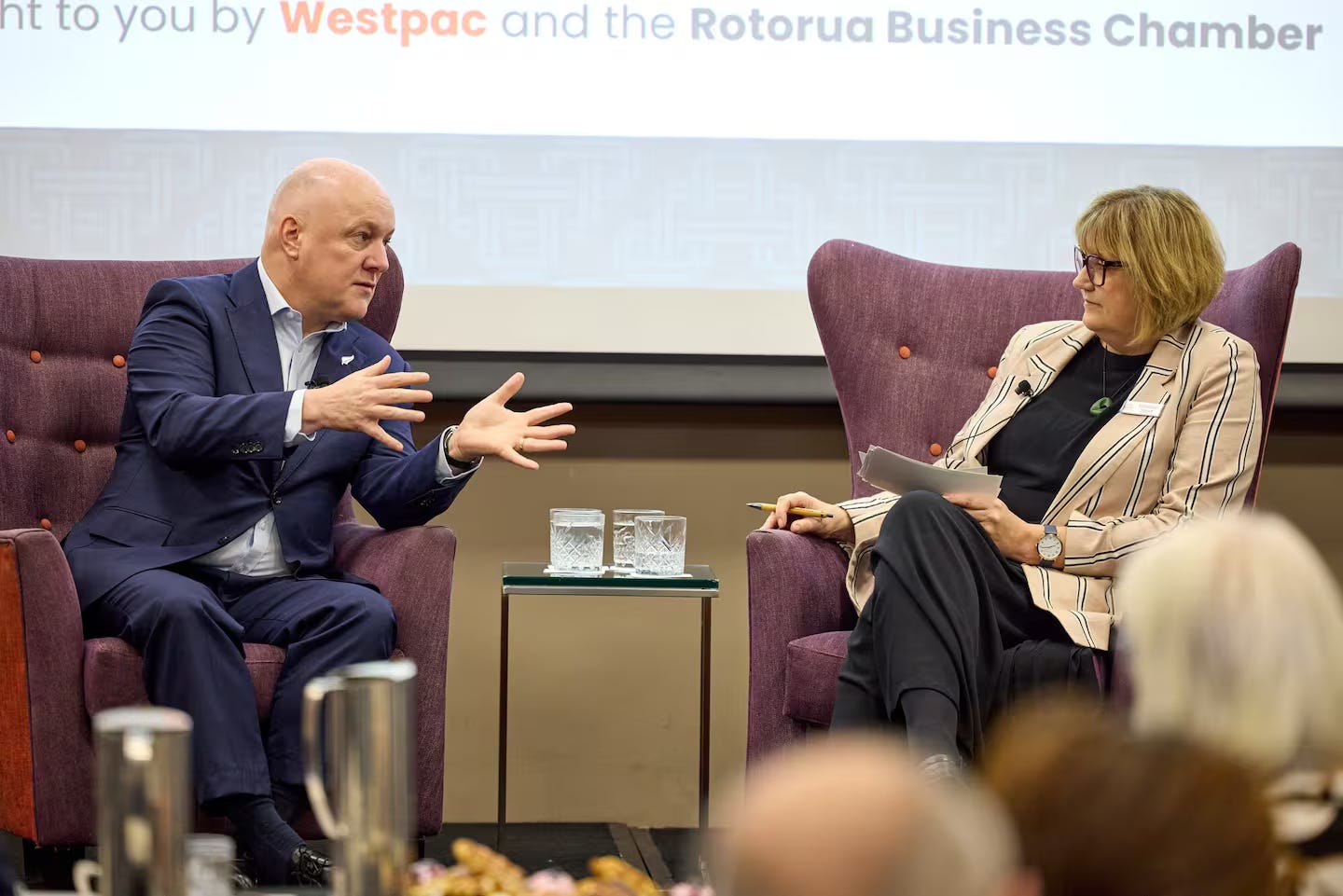
Christopher Luxon’s apology to small-business owners has largely been treated as another of the Prime Minister’s communications failures. It was certainly that. But the episode also exposed a much bigger problem for National: the party that regards itself as the natural representative of business is increasingly losing the confidence of businesspeople.
At Friday’s Rotorua Business Chamber breakfast, chief executive Melanie Short presented Luxon with the results of a survey of 85 local businesses. As the Rotorua Daily Post’s Annabel Reid reported, optimism about the economic outlook for both New Zealand and Rotorua had fallen by 62 percentage points, while confidence in respondents’ own businesses had dropped by 43 points. Costs were rising while customer numbers fell. Many businesses were absorbing those costs rather than passing them on, because they did not believe customers could afford higher prices.
“The affordability of doing business, it’s getting harder and harder,” Short told the Prime Minister. “How long can we hang on?”
Luxon responded that this was “quite a negative view”. He told the audience that businesses needed to be “retooling and radically disrupting” themselves, and that “if you’re not retooling and radically disrupting your business, you ain’t doing the job”. He then described what he regarded as an unhealthy relationship between New Zealand businesses and the state.
“Come home to New Zealand, and there’s a parent-child mentality,” Luxon said. “I have literally sat in boardrooms across New Zealand, and the conversation goes: ‘I wonder what the Government’s going to do? I wonder what the Government’s going to think?’ Who cares what the Government thinks or does? Our job is to be adult, adult, adult.”
The response was extraordinary because Short had not asked Luxon for money or a bailout for any particular business. Asked afterwards what she made of the answer, she said: “We do do it ourselves.” What businesses want from government, she said, is confidence and direction: “It’s knowing the Government has a plan.”
Rotorua Business Chamber president Paul Ingram made much the same point when he spoke to RNZ after Luxon’s eventual apology: “I don’t think we’re looking for a handout. We’re looking for understanding.” Ingram said many owners had their mortgages and homes on the line, and he hoped there was “genuine reflection” behind the Prime Minister’s apology.
Luxon initially defended his remarks. Yesterday morning he said he was “disappointed” by the reporting and argued that his comments had been taken out of context. By the afternoon he had changed course: “I am sorry if my comments do not properly acknowledge the challenges that many small business owners are facing, and that I got that wrong.”
More than a communications mistake
Releasing the transcript did not help the Prime Minister. It confirmed that the news stories were accurate and showed that Luxon had turned a reasonable question into a lengthy management lecture.
At one point, he asked for a show of hands from those using artificial intelligence: “OK, so in this chamber, how many of you are actually using Claude or Claude Code?” He then asked how many training sessions the chamber had held and whether increasing AI literacy was its “number one focus right here, right now”.
Although AI will indeed help many businesses, Luxon’s pivoting to Claude did not answer Short’s question about whether the Government had a plan for the local and national economy. It reinforced the impression that Luxon was more comfortable reciting the lessons of a corporate leadership course than engaging with what small businesses were telling him.
The Post’s editorial yesterday put the problem bluntly, arguing that Luxon “has never adjusted to leadership of a nation of small and medium-sized businesses rather than corporate monoliths”. It said his analysis of New Zealand business culture sounded more like “the gibberish of corporate bureaucrats” than the language of the entrepreneur he presented himself as.
There were also questions about Luxon’s account of his own business experience. He told the Rotorua audience that during his years in Illinois, “the last person I wanted to ever talk to as a CEO was the Government”. As The Post and other outlets noted, Luxon was not a chief executive in Illinois. He held senior Unilever management roles there before later becoming chief executive of Unilever Canada and then Air New Zealand.
More importantly, Luxon used his American experience to imply that businesses there largely got on with their work without paying much attention to government. That is difficult to reconcile with the scale of corporate lobbying in the United States. As The Post pointed out, “That would be news to the enormous US lobbying industry in Washington DC and every state capital. Unilever has in-house lobbying capability, retains lobbying law firms.”
Before entering Parliament, Luxon also chaired Jacinda Ardern’s Prime Minister’s Business Advisory Council. At the time, Luxon said the council would “build closer relationships between business of all sizes and the Government” and provide expertise to inform policy decisions. This makes his suggestion that businesses should not concern themselves with what government thinks or does even harder to understand.
National’s declining credibility with business
National’s relationship with business has been deteriorating for some time, and Luxon’s corporate background has not protected him from that.
In the Herald’s 2024 Mood of the Boardroom survey, Luxon ranked sixth among ministers, with a score of 3.73 out of five. A year later he had fallen to 15th among 28 ministers, scoring 2.96. Finance Minister Nicola Willis also dropped sharply, finishing 13th with 3.09. In the interviews with business leaders, Luxon was criticised for not being a good listener.
The Mood of the Boardroom is a narrow survey of senior chief executives and directors. It is not a representative measure of public opinion, nor does it speak for the thousands of small-business owners who rarely appear in such exercises. But that is why the result was so embarrassing for National. This is the constituency most inclined to support its tax, spending and regulatory agenda, yet many of its members had already become deeply dissatisfied with the Government’s performance.
Writing from the libertarian right, Auckland business owner Damien Grant titled his response “Corporate New Zealand has written off this administration”. Grant reported that former Mercury chief executive Fraser Whineray said Luxon had entered politics with a “massive Rolodex” but “hasn’t used it at all”. Grant himself argued that Luxon and Willis either did not understand the scale of the problem or did not care. “The disappointment isn’t in their failure,” he wrote, “but in their unwillingness to try and succeed.”
Yesterday Steel Worx Group director Chris Barrett told Ryan Bridge’s Today that he had voted National throughout his life but would not do so at this election. His company had spent $37 million building factories, retooling and automating. Referring to Luxon’s advice, Barrett said: “I did everything he said that they should become adults and do. What I didn’t do was destroy the economy.”
Barrett blamed Labour for damaging the economy and National for failing to fix it. The downturn obviously has more complicated causes than that, including international shocks. What makes Barrett worth listening to is that he is exactly the sort of businessperson National expects to have on its side: a manufacturer who has invested in and adopted new technology.
The problem is no longer that Luxon is failing to explain National’s economic programme. A growing number of businesspeople are unconvinced by the programme itself.
Small business and corporate welfare
Luxon’s argument in Rotorua was that businesses should not look to the Government for grants or assistance. There is a perfectly respectable centre-right case for that position. Governments should be cautious about using taxpayers’ money to keep unproductive firms operating, and businesses should normally bear the consequences of their commercial decisions.
The difficulty is that this is not how the Coalition Government operates in practice. Only weeks before the Rotorua remarks, the Government announced that Golden Bay Cement, owned by Fletcher Building, would receive a grant of up to $60 million to maintain manufacturing at New Zealand’s only fully integrated cement plant.
The Government therefore hands out money to business regularly, and it did so in Rotorua that same week. Part of the reason Luxon was in the city at all was to cut the ribbon at Red Stag’s new volumetric modular timber plant at Waipā Mill. The Herald’s Annabel Reid reported that the project was built in collaboration with German and Austrian firms, “with support from the Ministry for Primary Industries’ Primary Sector Growth Fund”.
Former Act Party MP Deborah Coddington began her own critique by agreeing with Luxon that taxpayers should not routinely bail out failing businesses. She then listed some of the assistance that this and the previous government had provided, including millions for the Tūroa and Whakapapa ski fields, continuing costs associated with the closed Chateau Tongariro, $8 million for Michelin Guide promotion, and the much larger screen-production rebate system.
Some of these schemes may well be justifiable. The point is that governments intervene in markets continually, often at the request of businesses, deciding that some industries or employers are important enough to receive public support.
David Seymour came close to naming the problem, suggesting Luxon had “possibly got two groups of people mixed up”. Seymour said there were “some people who call themselves businesspeople and yet always have their hand out to the Government”, while there were many others “doing it bloody tough, for reasons not of their fault”.
That’s a fair distinction, but it’s also an acknowledgment that the Prime Minister delivered his lecture to the wrong people. The small Rotorua businesses were not the companies best placed to extract subsidies or special regulatory treatment from the state.
Luxon’s reliance on his time at Air New Zealand also invited scrutiny. Duncan Greive pressed this point in the Spinoff. He noted that the government plays a central role in the operations that underpin a national airline. What’s more, the airline was rescued in 2001, remains majority Crown-owned and received a $900 million Crown loan facility during Covid.
Greive acknowledged that Luxon had been a successful Air New Zealand chief executive, but argued that the airline’s unusually close relationship with the state made the Rotorua lecture difficult to accept. He concludes: “Christopher Luxon has worked for, but never led, an organisation which had to be truly self-reliant, without an implicit or explicit government backstop.”
The paywall now starts partway through all Democracy Project newsletters. Please take out a paid sub if you want to support this service and access the full content, including the following sections: “The missing economic strategy”, “The markets the Government will not disrupt”, and “National’s business problem”.