

Yesterday I wrote my own analysis of Christopher Luxon’s Cabinet reshuffle, arguing it was fundamentally about a Prime Minister punishing his rival and rewarding his loyalists. Today I want to go through what the political editors are actually saying about it, because on several points, the verdicts line up.
How the reshuffle was rushed into existence
Thomas Coughlan’s analysis in the Herald is the most revealing account of how the reshuffle actually came about. His key finding: it wasn’t supposed to happen this week.
As of Monday, there was no plan to reshuffle Cabinet on Thursday. Luxon had been teasing it since January, but it appears something changed between Monday and Tuesday. Coughlan reports that a mysterious Sunday night meeting of Luxon loyalists – Mark Mitchell, Paul Goldsmith and Simon Watts – may have been the catalyst. This was separate from an earlier, routine “kitchen Cabinet” meeting attended by Erica Stanford and, via Zoom, Nicola Willis.
The second meeting “got tongues wagging,” Coughlan writes, and the allegation doing the rounds is that Mitchell, Goldsmith and Watts confronted Luxon with news he was losing support in caucus and needed to act fast.
The contents of that meeting remain unconfirmed. But Luxon turned up to caucus on Tuesday and announced the reshuffle was happening. National Party president Sylvia Wood was spotted back in Wellington on Wednesday (unusual for a non-Tuesday). And on Wednesday night, as the caucus ate KFC in Parliament at 9pm, many MPs were still in the dark about their fates or even when the reshuffle would be announced.
This explains the chaotic feel of the whole thing. Jenna Lynch in Stuff confirmed this picture from her end. She reported that the Prime Minister’s own staff were scrambling and did not know what time the press conference would take place until about two hours before it happened. Staff on events-based contracts were left dangling over the Easter break, not knowing if they still had jobs.
The Cricket tickets line
Then there was the cricket line. When asked about stripping Chris Bishop of the Associate Sport portfolio, Luxon replied: “Yeah, didn’t think we needed it. Chris Bishop will be able to get cricket tickets, it’ll be alright.”
Lynch’s response was blunt: “Ouch. Pretty dismissive.” She noted it drove home the souring of the relationship between the two Chrises.
Luke Malpass at the Post opened his entire piece with the cricket tickets line, letting it hang there as the defining image of the press conference. The fact that Luxon didn’t just remove the portfolio from Bishop but abolished it altogether is, as Coughlan observed, a move “seems designed to take something off Bishop rather than anything else.” Coughlan also noted the irony: Bishop’s last cricket trip was to India on a sports diplomacy mission to shore up New Zealand’s reputation as Luxon pursues a free trade agreement. Not exactly troughing.
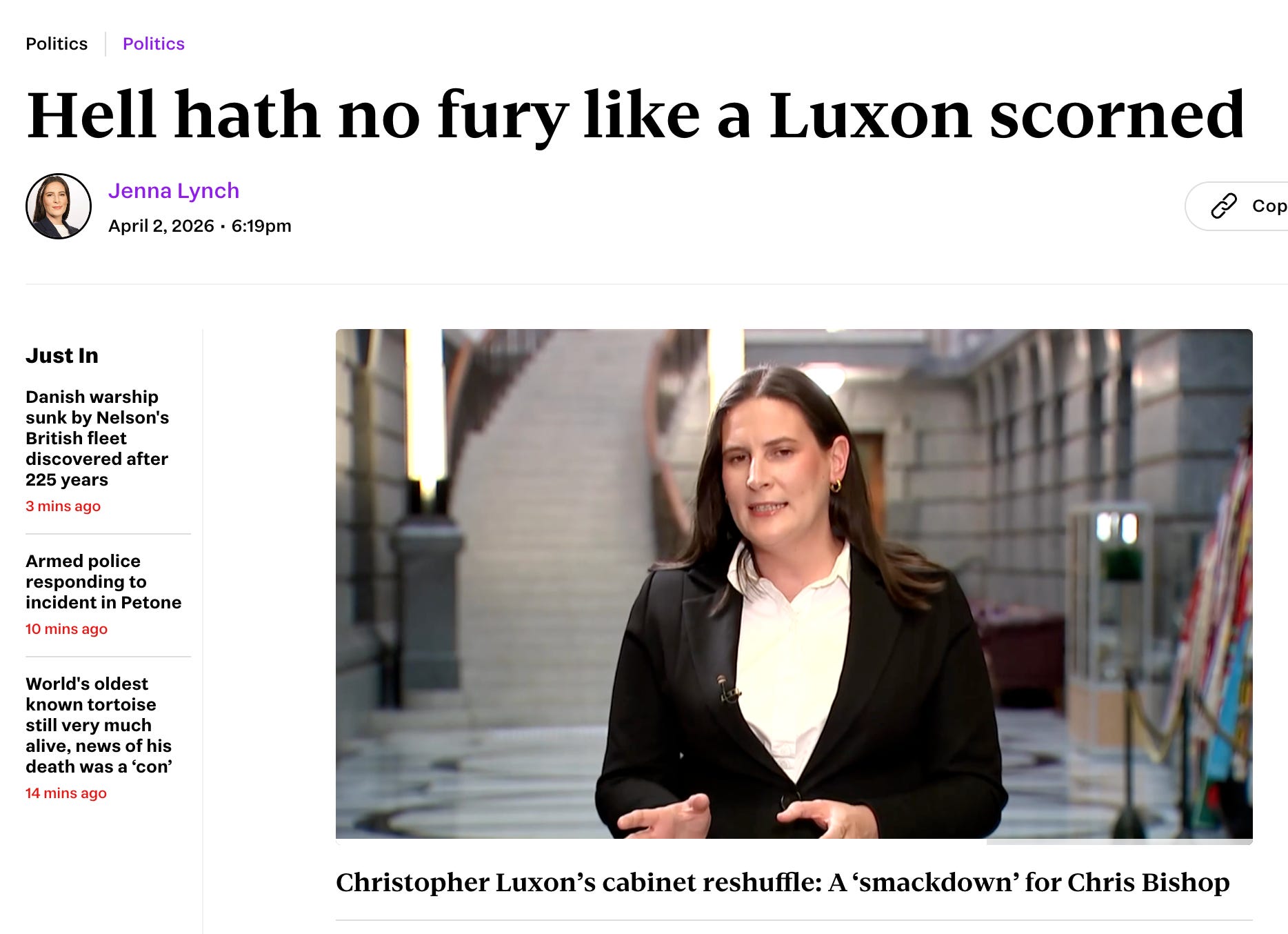
Hell hath no fury like a Luxon scorned
Lynch’s headline said it all: “It seems hell hath no fury like a Luxon scorned.” Luxon, she wrote, had chosen to “take a strike at Chris Bishop’s political heart.” Not by stripping away the big public-facing portfolios, but by removing the internal levers of influence: campaign chair and Leader of the House. Bishop still has the policy workload. What he’s lost is the power.
Nobody believes the workload excuse
Luxon’s stated rationale – that Bishop was too busy and needed to shed responsibilities – is technically true. Bishop carries housing, transport, infrastructure and RMA reform. He is genuinely one of the busiest ministers in Cabinet.
But the argument collapses the moment you look at who got the campaign chair job. Simeon Brown is already Health Minister. He has now also been handed the Energy portfolio, right in the middle of a fuel crisis. Lynch asked the obvious question: how can Brown plausibly be presented as the more available option? Sam Sachdeva at Newsroom reached the same conclusion. So did Tom Day at 1News. So did pretty much everyone in the gallery.
Coughlan captured Luxon’s stumbling defence perfectly. When pressed on why Brown was less busy than Bishop, Luxon replied: “Uh, no, they’re all busy … I get the questions guys, all I’ve done is given Attorney-General to Chris Bishop and I’ve taken away campaign chair and Leader of the House.”
That’s not a rationale. That’s a description of what he did, minus the reason.
Jo Moir at RNZ was equally direct. When RNZ asked Luxon who was busier – Bishop or Brown – the Prime Minister’s “workload rationale crumbled when he declared they were both busy.” Her verdict: “It’s a nonsense to say Brown has more time for campaign chair.”
Moir, to her credit, acknowledged the political reality Luxon can’t say out loud: “Luxon is hardly going to say he’s moving Bishop aside because he’s sceptical of how supportive the Hutt South MP is of his leadership.”
A Fidgety and grumpily exasperated Prime Minister
Malpass’s description of Luxon at the press conference is worth dwelling on. He described the Prime Minister as “fidgety and grumpily exasperated” as he repeatedly batted away questions about whether Bishop was being punished. “Guys, you’re overthinking it,” Luxon kept insisting, in what became a refrain. At one point, asked why the reshuffle was happening the day before Good Friday, he could be heard to say “Oh yeah, this is funny” before recovering.
The paywall now starts at halfway through all Democracy Project newsletters. Please take out a paid sub if you want to access the full content and support this service. The second half of the column deals with: “The Campaign chair debate”, “Bishop stripped of power but not policy”, “Butterick, rural politics and the battle for the regions”, “Diversity and representation”, and “Does any of this settle the leadership question?”