

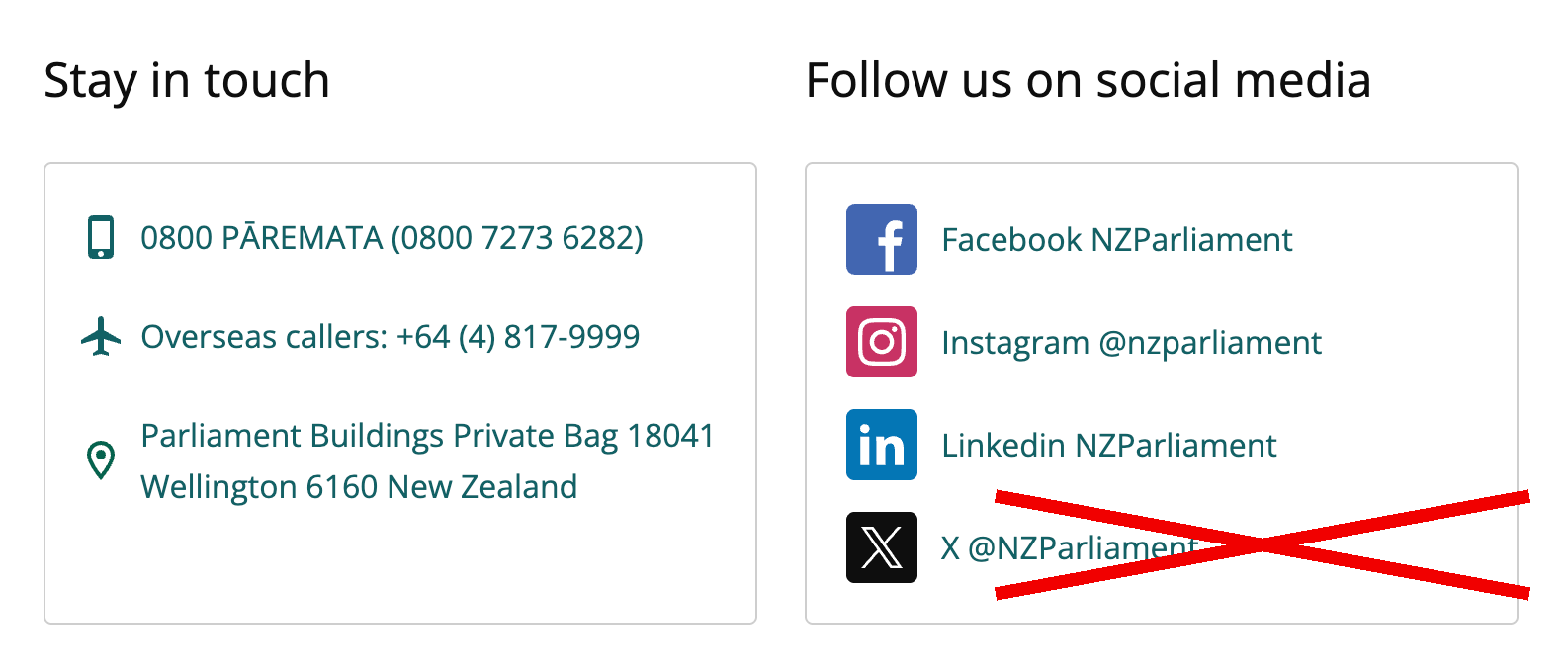
Last week, New Zealand’s Parliament ceased using X. The Clerk of the House, David Wilson, unilaterally decided the institution would no longer have a presence on the platform formerly known as Twitter. His stated reason was that he “could no longer support” X because of its AI chatbot Grok and reports about deepfake imagery. “It didn’t feel right for my organisation to use a platform that allowed that to happen,” he told Stuff.
This came shortly after Andrea Vance’s Sunday Star-Times column headlined “Every official tweet is a nod to child abuse,” which called for public organisations and politicians to leave the platform. The timing was not coincidental.
Parliament’s departure provoked immediate backlash from government ministers, the Free Speech Union, and ordinary New Zealanders who still use X. Foreign Minister Winston Peters called it out in typically blunt fashion: “This is how freedoms are lost — by unilateral decision making being made by moral virtue signalling — where someone seeks to do one thing but causes damage to other freedoms”.
He was right to be concerned. What we are witnessing is not a neutral administrative decision. It is a political gesture: an announcement of liberal principle dressed up as a child safety measure. And it is a mistake.
The Moralism of the anti-X campaign
Vance’s piece was striking in its moral absolutism. She described X as “the digital equivalent of a crime scene” and called Elon Musk a “ketamine-addled megalomaniac.” She argued that any politician who continued to use the platform was offering “tacit endorsement” of child sexual abuse material. “Every official post on X is a signal that it is credible and legitimate,” she wrote.
This is a masterclass in guilt by association, and in the kind of liberal, middle-class moralising that has come to dominate parts of our media landscape. By Vance’s logic, using X makes you complicit in the worst things that happen on the platform. The argument reduces to: if you’re still on X, you’re either ignorant or immoral.
She also threw in a curious swipe at those who disagree: “There is a weak argument (usually put forward by white men, those least likely to suffer abuse online) that staying on X somehow moderates the awful. You can’t dilute a cesspool.” So the case for staying is dismissed not on its merits but on the basis of who tends to make it. That tells you everything about the politics driving this campaign.
The moralism is the giveaway. This is not primarily about child safety. If it were, the same voices would be calling for institutions to leave Facebook and Instagram, given that Meta’s head of safety is currently admitting in open court that they have failed to protect children under 13. Facebook was directly implicated in genocide in Myanmar — the UN found its role was “significant and even determining”. Meta is planning a US$65 million political operation to influence US state elections. But, here, Parliament has happily shifted its updates to Facebook, and nobody in the commentariat seems bothered.
The Clerk goes rogue
The @NZParliament account had existed since 2008 and had more than 35,000 followers. It was used for routine procedural updates, such as alerting people when bills received Royal Assent, when oral questions were available. Now those updates will only go out on Facebook.
Liam Hehir, writing on Substack, produced what I think is the best analysis of the Clerk’s decision. He zeroed in on Wilson’s language. “The repeated use of the personal pronoun is telling,” Hehir wrote. “There is no indication in Stuff’s report that there was any direction from the Speaker or of any justification laid out as a purely neutral operational consideration. It was presented as a matter of individual conscience.”
As Hehir argued, “’support’ is not operational language. It is moral language. It implies endorsement. It implies alignment. It suggests that mere presence amounts to complicity.” He is exactly right. When the Clerk says he can no longer “support” X, he is not managing a communications channel, he is making a statement of values on behalf of an institution that is supposed to be scrupulously neutral.
The proper process would have been for the Clerk to prepare a formal neutral assessment, refer it to the Speaker, and then have it tested through a cross-party forum like the Business Committee. There is no indication any of this happened. Chris Bishop, the Leader of the House, clearly thought the same: “Wrong decision in my view. I am sure Business Committee will want to discuss it”.
It is worth noting Wilson’s professional background. Before becoming Clerk, he spent several years at the Department of Internal Affairs as a Senior Policy Analyst in censorship, then as Information and Policy Manager at the Office of Film and Literature Classification, which is popularly known as the Censor’s Office. That background in censorship and content regulation is hardly irrelevant when assessing why he might have been particularly motivated to take this step. We see the instincts of the censor resurfacing. In 2025, Wilson had already decided to stop enabling comments on Select Committee livestreams because the volume of “objectionable” comments was too high to moderate.
The move to leave X entirely is the latest step in a retreat from public engagement. It’s a mindset that sees the public not as citizens to be engaged with, but as a source of “objectionable” content to be managed or avoided.
An Elite liberal project
Make no mistake: the shift of public authorities away from X is a political gesture, however much its proponents insist otherwise. Consider the partisan optics. The parties that have recently left X are Labour, the Greens, and Te Pāti Māori (the left-of-centre bloc). National, NZ First, and Act all remain. So, when Parliament’s own institutional account departs in this context, it doesn’t look neutral. It looks like the public service is choosing a side.
Who else is pushing the departure? Stuff, which owns the Sunday Star-Times and The Post, has already left X and actively discourages its journalists from using it. TVNZ and 1News departed in December 2024. According to Stuff’s own reporting, 61 of 75 main government departments and agencies have stopped posting on X.
In short: journalists, media executives, and public servants, i.e. the professional managerial class. The same people who dominate New Zealand’s institutional culture and who tend to hold liberal-elite views on social issues. Stuff owner Sinead Boucher has been vocal in her opposition to X, echoing Vance’s stance on LinkedIn.
And who objects? Politicians from the right. Members of the public who use X. The Free Speech Union. In other words, people who tend to be suspicious of institutional liberalism and who value the fact that X, under Musk, has become a space where conservative and populist voices are no longer suppressed as they once were.
As Hehir put it: “the retreat by left-leaning media and institutions from X didn’t start with the latest AI scandal at all. It kicked off much earlier, after Elon Musk bought Twitter and made a very public point of trying to turn it into a more free-speech platform, explicitly criticising the old regime for suppressing conservative and populist views.”
The Grok deepfake controversy is real, and nobody should dismiss concerns about AI-generated child sexual abuse material. But it has been seized upon as a convenient justification for a departure that, for many institutions, was already politically motivated. Simon O’Connor put it neatly: “it is peculiar that only X has been targeted, and one cannot help speculate that all the formal excuses are just a cover for not liking X, Elon Musk, or that the platform has arguably the broadest approach to free speech.”
The Glaring double standard
If David Wilson and the public service elite were being consistent, they would have to leave almost every major social media platform. Yes, X has problems. But so does every platform. Facebook was directly implicated in the Myanmar genocide. Meta is currently on trial in the United States over claims its apps were designed to be harmful to young people. A New Mexico lawsuit found child exploitative content is over ten times more prevalent on Facebook and Instagram than on Pornhub. Instagram’s own internal research showed it made body image issues worse for one in three teen girls. TikTok faces a Supreme Court-upheld ban and fourteen state lawsuits alleging deliberately addictive design.
Yet Parliament is now directing people to Facebook for its updates. Where is the consistency?
Why not also abandon Facebook? Or Instagram? Or TikTok? These platforms have their own long histories of disinformation, exploitation, algorithmic distortion, and abuse. If the standard for leaving a platform is the presence of harmful content, then the logic demands departing from all of them. The fact that only X has been singled out confirms what many already suspect: this is about who owns the platform and what it represents politically, not about child safety.
The Democratic cost
Here is the practical argument that too many in the commentariat are ignoring. When public institutions leave X, they do not make the platform disappear. They just remove themselves from it.
As Free Speech Union chief executive Jillaine Heather put it: “When Parliament leaves X, the platform doesn’t disappear. What disappears is the authoritative information. Nearly a million New Zealanders are still there, except now they’re getting their Parliamentary news from rumour instead of the source. That’s not protecting citizens. That’s abandoning them”.
X’s monthly user base in New Zealand was still around 650,000 people as of late 2025. That is not a trivial number. When Parliament and government agencies withdraw, they are telling those 650,000 people that they do not matter enough to communicate with.
Consider, too, the state of Parliament’s existing relationship with the public. The most recent Kantar survey commissioned by Parliament itself found that only 13% of New Zealanders “feel connected to Parliament” and only 13% “feel a sense of ownership of Parliament”. Those are damning numbers.
In that context, the last thing Parliament should be doing is voluntarily removing itself from a platform where hundreds of thousands of citizens still get political news. The real question isn’t “is X good?” It’s “is it still a place where public authorities should be present, because people are there and information flows there?” The answer, for a democracy that wants to be reachable across political divides, is yes. Presence on X is not endorsement. Presence should merely be a public service.
The Own goal
Many public agencies in New Zealand are already facing a crisis of trust and legitimacy. The public service has been under sustained criticism for perceived overreach, politicisation, and disconnection from ordinary New Zealanders. The phrase “Wellington bubble” exists for a reason.
By publicly abandoning X on moralistic grounds, public agencies are advertising their political alignment. They are saying, in effect: we share the values of liberal media elites, and we disapprove of the platform where conservative and populist voices have found a home.
By painting themselves as so elitist and essentially aligned with liberal-left politics, our public agencies are making a profound strategic error. They are providing plenty of ammunition for the forces of the right to characterise the public service as “woke” or as a “blob” that only pursues an elite agenda. This is an own goal of the highest order. At a time when government departments are already facing questions about their legitimacy and social licence, they are reinforcing the narrative that they are out of touch with ordinary New Zealanders.
The better approach is the one most agencies quietly took, of reducing activity on X for practical reasons without turning it into a moralistic crusade. If engagement is declining, if you lack the staff, if it is not a good use of resources, then fine, scale back. Nobody could object to a pragmatic decision.
But when the Clerk of Parliament frames his decision for Parliament in terms of personal moral conviction, when journalists write columns accusing politicians of endorsing child abuse for using a social media platform, when media executives campaign against a single platform while happily using others with equal or worse problems, then that is not pragmatism. That is overt politics. And public institutions are supposed to be above that.
O’Connor made the uncomfortable but necessary point: “Whether mainstream media or the Clerk of the House, they once delighted in X. When it was dominated by the progressive left wing and alternative voices were canceled, it was a platform to be celebrated. They were all on there.” The political character of the shift could not be clearer.
None of this means X is beyond criticism. Elon Musk’s stewardship has been erratic. The platform has real problems. The Grok controversy was genuinely concerning. But the answer is for governments to regulate social media platforms properly — all of them, not just the one that some parts of the political spectrum find distasteful. And the answer is for institutions to stay where the public is. Withdrawing from a platform that 650,000 New Zealanders still use, because you find the owner objectionable or because your cultural peers have decided it is beneath them, is not a principled stand. It is an abdication of duty.
I’m still on X. Plenty of my colleagues across the political spectrum are too. The platform is flawed, noisy, and often maddening. But it remains one of the few digital spaces where the full range of political opinion can be found, where elites can be challenged, and where official narratives do not go unchecked.
In these polarised times, the last thing we need is for public institutions to pick a side in the platform wars. That is exactly what is happening. And it is a mistake.
Dr Bryce Edwards
Director of the Democracy Project
Further Reading:
