

Many expected fireworks at Waitangi this year. In an election year, with the Government’s record on Treaty issues still fresh and raw, the annual commemorations looked set to be a battleground. Instead, the week turned out to be remarkably calm on the surface. And deeply fractured underneath.
The real story of Waitangi 2026 wasn’t about Māori versus the Crown. It was about Māori versus Māori, and an opposition that seems incapable of getting its act together nine months out from polling day.
A Quieter Waitangi
The overwhelming consensus from journalists and commentators is that Waitangi this year was harmonious and relaxed, especially compared with the drama of 2024 and 2025. Part of the explanation is obvious: Act’s Treaty Principles Bill is gone, and with it the galvanising issue that drew tens of thousands onto the streets last year.
Shane Jones reckoned the week reminded him of “the Waitangi days of the 70s” — it had an “old-fashioned feel” and relatively little protest. Veteran broadcaster Waihoroi Shortland agreed. So did Bishop Te Kito Pikaahu, who told Glenn McConnell at Stuff that “every year, I’m seeing more tolerance, more understanding, and more fellowship and cooperation.”
Ngāi Tahu, one of the country’s largest iwi, sent a delegation to Waitangi for the first time in more than two decades. This was a show of kotahitanga prompted by the late Kīngi Tūheitia’s call for unity. The crowds, though, were smaller. John Campbell noted that attendance has fallen year on year since 2024. Documentary maker Whatanui Flavell offered a blunt explanation: “For some people, I think it’s fatigue. And sadness.”
There might even be something like “Treaty fatigue” setting in across the board. A recent RNZ poll found nearly 40% of voters think the Treaty has “too much” influence. After the hikoi, after the bill, and after last year’s Waitangi, people are spent.
The Protest that wasn’t
Protest activity against the Government was strikingly insignificant. Activist Wikatana Popata and the Aotearoa Liberation League had planned a human chain to block coalition MPs from entering the Treaty Grounds. But Ngāpuhi hau kāinga shut it down, deeming it a breach of tikanga. The organisers backed off.
As Lyric Waiwiri-Smith reported for the Spinoff, what was supposed to be a dramatic stand ended up as “a standoff with mana whenua.” She said, haukainga “had to remind demonstrators who actually has the mandate to decide who does or doesn’t belong on the marae.”
A handful of protesters still showed up, only to be blocked by Ngāpuhi security — one of whom was carrying an axe. Some were removed entirely.
The failure of the protest tells its own story. It’s not just that the Government got off lightly. It’s that the Māori protest movement, which was so formidable during the hikoi, is now fractured. There is no united front. The energy has dissipated — partly through exhaustion, partly through internal division. RNZ’s Craig McCulloch summed it up neatly: “Perennial agitators Winston Peters and David Seymour seemed almost disappointed at the muted response, with the former clearly trying to provoke a reaction from the crowd.”
War within te ao Māori
If New Zealand as a whole looked relatively united at Waitangi, the picture inside te ao Māori was the opposite. Kotahitanga (unity) within Māoridom is more absent than ever.
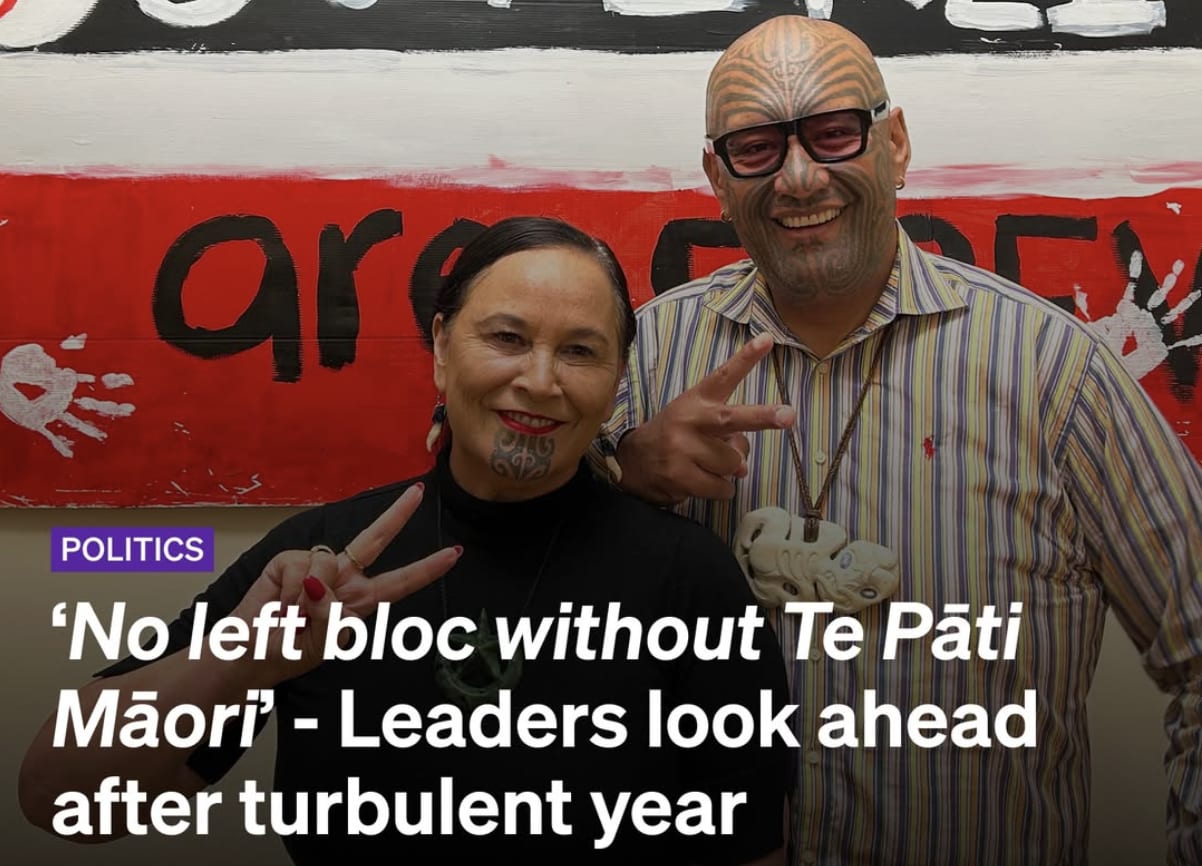
The centrepiece of the drama was Te Pāti Māori, which is tearing itself apart in public. Only one of the party’s four MPs actually turned up: Rawiri Waititi. The Spinoff’s Waiwiri-Smith noted that Debbie Ngarewa-Packer, Oriini Kaipara, and Hana-Rawhiti Maipi-Clarke were all “missing in action.” The party wasn’t even present at the dawn service.
What happened during the pōwhiri for politicians was extraordinary. Eru Kapa-Kingi — the Ngāpuhi leader and Te Pāti Māori dissident who led the Toitū Te Tiriti hikoi — delivered a scorching whaikōrero. He accused Te Pāti Māori of “milking mana Māori” and told the party to “sort itself out.” He also turned his fire on Labour: “This Government has stabbed us in the front, but others have stabbed us in the back. Labour — I’m looking at you.”
Waititi, to his credit, responded with something approaching an olive branch. He acknowledged Kapa-Kingi’s anger, apologised for declining an invitation to meet with Ngāpuhi last year, and asked for a new meeting. Adam Pearse in the Herald described the gesture as prompting a “stir among Ngāpuhi that months of mudslinging was about to end.”
And then Kiri Tamihere-Waititi blew it all up.
Waititi’s wife (who also serves as the party’s general parliamentary manager and is the daughter of party president John Tamihere) crossed the ātea during a haka tautoko and confronted Eru Kapa-Kingi directly. As she eyeballed him, Mariameno Kapa-Kingi stood and shouted “hoki atu” (go back).
Shane Jones called it “marae culture at an incandescent level.” But for Ngāpuhi leaders, it was something far worse. Ngāpuhi chairman Mane Tahere said it was “the nail in the coffin” and “the last straw.” His offer of a hui with Te Pāti Māori? Off the table. The relationship is now “hōhā.” Pita Tipene, head of Ngāti Hine, agreed: “Conflicting messages are coming out of Te Pāti Māori and the people of Te Tai Tokerau have really had enough.”
There are now open calls for a leadership clean-out. Tipene told the Post’s Amelia Wade there was “a clear need for a leadership change.” Former co-leader Te Ururoa Flavell wrote about how “sad and disappointing” the week had been for Māori politics, saying his “hope was fading everyday.”
Tahere was blunt: “Unless something drastic happens between now and November, unfortunately, they have lost the Te Tai Tokerau seat.” As Tipene put it: “The tide is really going out for Te Pāti Māori at the moment.”
An Opposition that can’t get it together
The broader opposition didn’t fare much better. Labour and the Greens tried to project unity by doing a joint media stand-up. But the elephant in the room was that Te Pāti Māori wasn’t invited. It was a very public statement about who Labour wants as a coalition partner, and who it doesn’t.
Te Pāti Māori noticed. Ngarewa-Packer fired back on social media: “any govt that claims to work for Māori, should want to work with the only truly indigenous, truly Tiriti-centric party ... not against it.” According to the Spinoff, Waititi reminded his “frenemies in red and green” that polling suggests they can’t form a government without Te Pāti Māori. He declared: “A vote for Labour is a vote for New Zealand First.” He complained that “Labour don’t do MMP very well.”
RNZ’s Craig McCulloch delivered the killer verdict: “Labour and the Greens came to Waitangi, hoping to present a united front and to draw a contrast with the warring factions within the coalition. They leave further away from that goal than closer.”
Labour’s Māori problem
Labour’s troubles were compounded by Peeni Henare’s surprise announcement that he was stepping away from politics. The 12-year MP, widely respected in the north and once touted as a potential leader, delivered the news while Hipkins was in the middle of a press conference. As the Spinoff reported, “tensions between Henare and the party’s senior leadership may have led to the former’s decision to move on from parliament.”
Hipkins tried to play it down: “This was Peeni’s decision. Unless your heart’s in it, there’s no point in talking someone into running.” But as the Herald’s Adam Pearse observed, “Labour has done its best to starve the kumara vine of gossip but it hasn’t been able to shake the impression Henare’s differences with the leadership at least partly informs his decision.”
The bigger picture is damning. John Campbell pointed out that Labour keeps losing senior Māori MPs: “Henare, Adrian Rurawhe, Nanaia Mahuta, Kelvin Davis, Kiritapu Allan — all gone (or about to go) in the past three years.” Other media, like the Spinoff, suggested that the real question is about whether Labour’s focus on “jobs, health and homes” is pitched in a way that speaks to Māori voters, or whether it comes across as colourblind politics that ignores the specific grievances of tangata whenua.
The Greens make their move
The Greens used Waitangi to position themselves as the party most willing to fight for Te Tiriti. Marama Davidson spoke of putting in place “a Te Tiriti-led Government” with Labour. Swarbrick made her own statement by wearing a protest blanket of red to symbolise Māori land taken by Pākehā.
More significantly, the Greens announced they would stand four Māori women in Māori seats, including two poached directly from Te Pāti Māori’s orbit: Heather Te Au-Skipworth and Tania Waikato. Former Te Pāti Māori co-leader Te Ururoa Flavell was openly dismayed, admonishing the Greens for raiding his old party. Waititi told the Greens to “leave the Māori seats alone.” Davidson’s retort was sharp: “Nobody owns any seats. Nobody owns any votes.”
The Greens came out of Waitangi looking more like Te Pāti Māori than ever, which is perhaps exactly the point. If Te Pāti Māori continues to implode, the Greens are positioning themselves to hoover up the votes. Whether Māori voters see the Greens as a credible kaupapa Māori party is another matter entirely.
The Government walks away smiling
And then there’s the Government, which had one of its easiest Waitangi experiences in years. Luxon delivered a speech that was essentially a Treaty history lesson. He explained the three articles and laid out how he reckoned his Government was meeting them. It was, as the Spinoff’s Waiwiri-Smith noted, “a lesson in treaty history, but not the one the crowd was hoping for.”
The most revealing moment was when Luxon declared that Article Three “must guarantee equality of opportunity” but “cannot — and should not — guarantee equality of outcomes, because that, frankly, is socialism.” For the Government’s base, it was red meat. For many at Waitangi, it confirmed what they already suspected about the coalition’s approach.
Seymour, meanwhile, copped the worst of it at the dawn service — booed so loudly it was hard to hear him. He later dismissed his hecklers as “a few muppets shouting in the dark.” But as Daalder pointed out, the Friday crowd was far larger and more diverse than the Thursday pōwhiri crowd. The reaction was real.
Still, there’s no getting around it: the Government had a good Waitangi. As McCulloch wrote, “For once, it was the opposition feeling some heat at Waitangi.” The coalition will be relieved. The opposition should be worried.
Nine months to sort it out
The Spinoff’s Waiwiri-Smith captured the mood as well as anyone: “With a significant divide in Māori political opinion arising, it could just be another three years of the same old sh*t.”
That’s the real takeaway from Waitangi 2026. Instead of the expected clash between Māori and the Crown, what the week exposed was a vicious battle within te ao Māori and a fractured opposition. Nine months out from the election, the parties that need to work together to unseat this Government look further apart than ever.
Te Pāti Māori is at war with Ngāpuhi and with itself. Labour is losing its Māori talent and can’t commit to its coalition partners. The Greens are raiding Te Pāti Māori’s candidate pool. And somewhere on the Waitangi bridge, as Marc Daalder reported, a man watching the great waka Ngātokimatawhaorua paddle past turned to his friend and asked: “Are the politicians gone yet?”
Dr Bryce Edwards
Director of the Democracy Project
Further Reading: