


The Commerce Commission’s “State of Competition in New Zealand” report landed on Tuesday. It is arguably the most important economic document of the political year. It names four sectors as the country’s least competitive: electricity, gas, water and waste services; financial and insurance services; information media and telecommunications; and mining.
The night before the report came out, the Minister of Commerce met with executives from five oligopolistic sectors — energy, banking, supermarkets, insurance and telecommunications — all but one of which feature in the regulator’s list. Cameron Brewer marked the moment by posting on LinkedIn a sunny photograph from a roundtable discussion about the broken markets that the executives presided over. The host of the discussion was Lillis Clark, one of Wellington’s most connected lobbying firms.
This is how Wellington works in 2026.
What the Commission actually found
“The State of Competition in New Zealand” is the Commission’s first economy-wide baseline study, drawing on 22 years of Stats NZ firm-level data. Commission Chair Dr John Small chose his words carefully at the launch. He called the picture “nuanced.” The press release used “mixed.” But you should read past the politeness.
“The report finds that while business concentration has reduced on average, competitive pressure has weakened in many parts of the economy,” Small said. “Market conditions are favouring larger incumbent businesses, and it is harder for smaller, newer businesses to displace them.”
That is, for a regulator, an extraordinary admission. The economy is being captured by its incumbents.
The least competitive industries over the full 22-year period are: electricity, gas, water and waste services; financial and insurance services; information media and telecommunications; and mining. Financial and insurance services show the strongest worsening trend across the entire period. The sectors sitting at the bottom of the competition table are the exact sectors sitting at the top of the cost-of-living debate.
Rob Stock, writing in The Post on Wednesday, put it cleanly: “Banks, insurers, power companies, and retailers demonstrate the greatest power to maintain their prices and margins.” He added the line most political coverage glided past: “competitive pressures appeared weakest in some essential industries that households could not avoid.” This is an important point, because these are sectors that the public has no choice but to do business with.
The OECD says the quiet part out loud
David Haugh, who runs the OECD’s New Zealand desk, spoke at the Commission’s “Competition Matters” conference in Auckland yesterday. The OECD is not some leftist pressure group. Its representative could not have been blunter: “In a small, remote economy, competition does not emerge organically. It must be designed.”
For thirty years successive governments have indulged the comforting story that our markets are small but functional and that the answer to high prices is patience. Haugh swept it away in one sentence.
He went further: “A key issue for making the New Zealand economy work better is to reduce the profitability of banks in the country, unfortunately for the banks.” Lending margins, he told the room, sit “at the upper end of the OECD range”. The profits being extracted from this country are not being recycled in it. They are being shipped to Sydney and Melbourne.
On electricity, Haugh was just as direct. New Zealand generates around 96% of its power from renewables, and runs wholesale prices among the highest in the OECD. “We think there’s a market failure here,” he said — drawing unfavourable comparisons to Norway, Sweden and Finland, other renewables-rich economies that have not allowed their energy sectors to capture the system this way.
Cameron Brewer stepped up to the same podium ten minutes later and told delegates to “watch this space” on capital markets reform. That was the Minister’s contribution to the most significant competition diagnostic the regulator has yet produced.
Brewer’s roundtable worth scrutinising
Cameron Brewer has been Minister of Commerce and Consumer Affairs since 2 April. Five weeks in, the most important document on the structure of New Zealand markets in living memory landed on his desk. He has said next to nothing about it in public.
What he did find time for was a LinkedIn post. His words, lightly punctuated: “A good roundtable discussion on The Terrace in Wellington this evening with leaders in the likes of energy, banking, supermarkets, insurance, and telecommunications. Thanks to host Lillis Clark. This Government is about improving competition so consumers have more choices at better cost.”
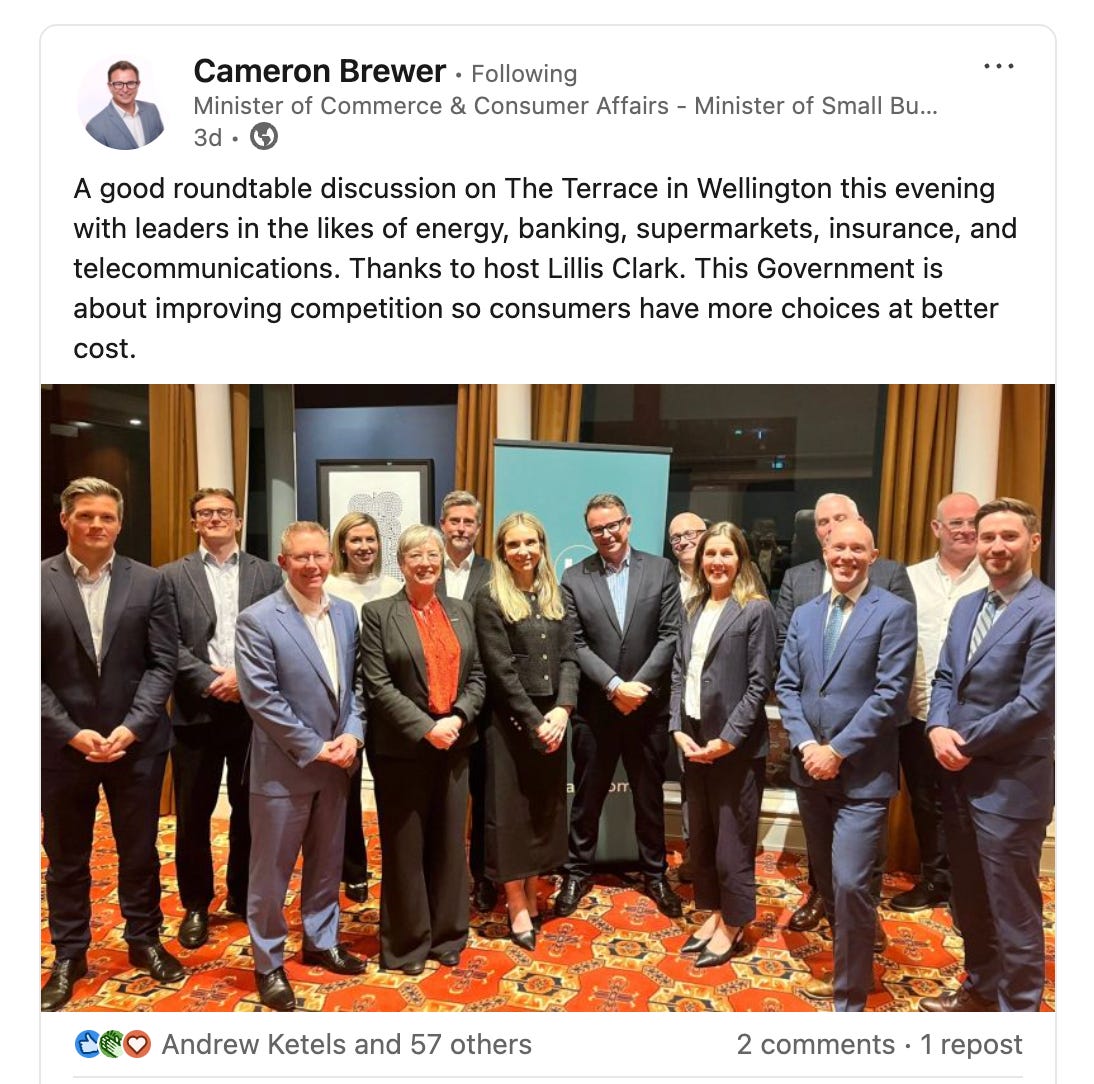
Lillis Clark is the boutique public-affairs lobbying firm of Anna Lillis and Kenny Clark, both former senior staffers to National ministers under Key and English. Mentioning them in The Post today, Henry Cooke called Lillis Clark “the go-to firm for this Government”.
Political journalist Richard Harman has reported that Lillis Clark is “said to write much of the Beehive policy” for the current government. Anna Lillis is engaged to the Trade Minister, Todd McClay. And today it was reported that Georgina Campbell, former senior NZ Herald journalist and then head of office for the Lower Hutt Mayor, has just joined the firm. The revolving door between the Beehive and the lobby is now wider than at any point in the post-MMP era.
The firm’s client list, to the limited extent it can be reconstructed in a country with no lobbying register, includes operators in exactly the sectors the new Minister of Commerce was sitting in a room with.
Maybe it’s all perfectly innocent. Wellington is a small place. But this is the point: nobody in the system thinks anything is wrong with it. Brewer isn’t hiding the meeting. He is broadcasting it with a cheerful social media post.
The paywall now starts at halfway through all Democracy Project newsletters. Please take out a paid sub if you want to support this service and access the full content, including the following sections: “Kent Duston puts a face on it”, “Upstream rot”, “What an honest response would look like”, “The politics of the rigging”, and “The democratic problem”.