

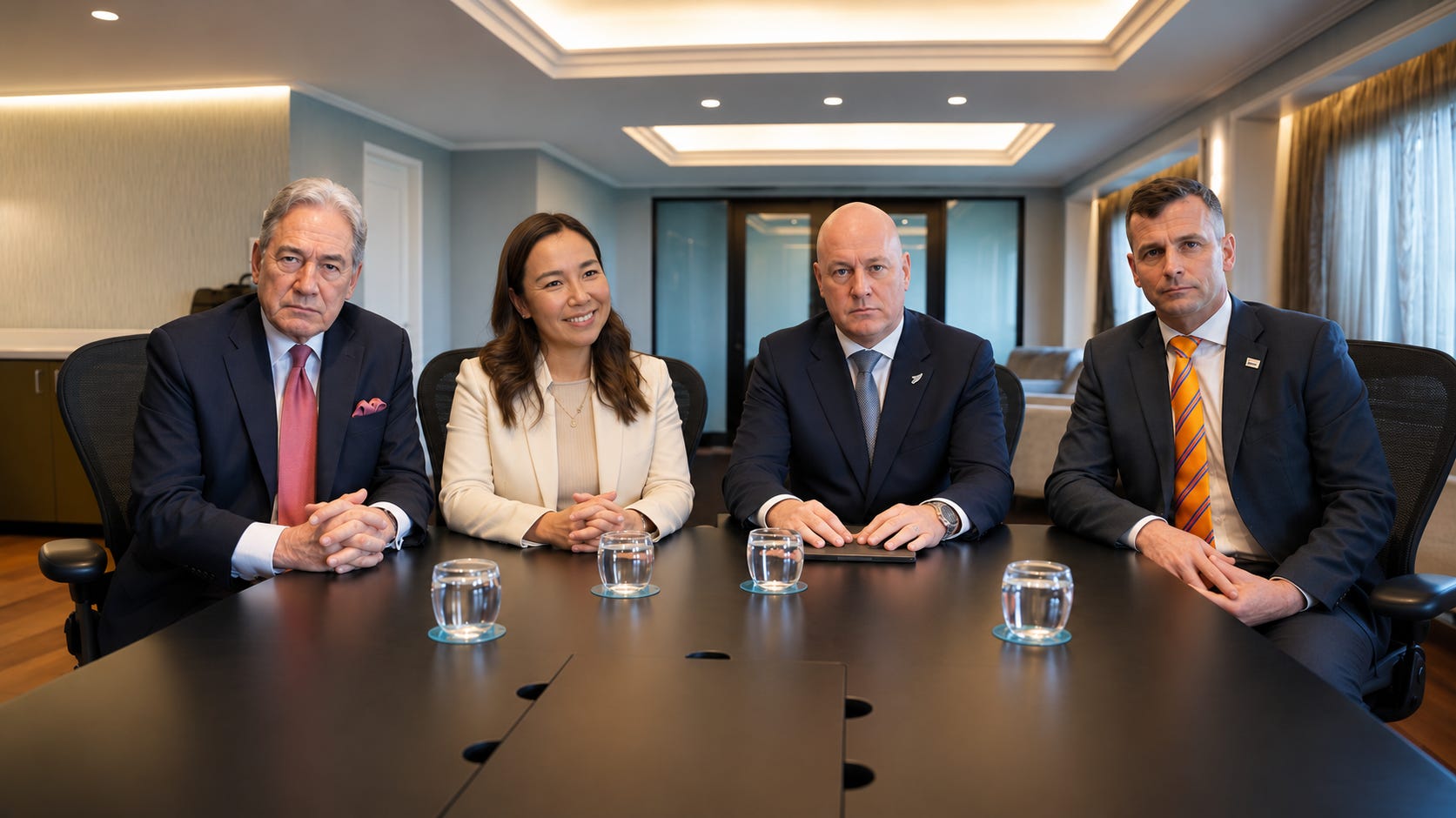
Amongst all the uncertainty of the election result, it is clear that the parties of the right are much more likely to end up governing than the parties of the left. And yet, in almost any likely scenario, it is going to be an incredibly fraught administration, vulnerable to collapse. It might therefore turn out that winning government was the easy part.
Christopher Luxon is on course to be the first prime minister under MMP to lead a government with less than 30% of the party vote, alongside two partners who have both grown at his party’s expense. Such a government could last the full three years and still be a miserable experience for National, with its policies watered down and Luxon spending his time negotiating with partners who gain from being seen to resist him.
(In the “Further Analysis” section after this column, I look at the most likely way of shoring up a fragile government, a deal with the Opportunity Party, and why it would come at a high price for the right bloc.)
A loaded gun in every pocket
The preliminary result gives the right bloc 67 seats in a Parliament of 131, a majority that rests on seven National overhang seats. With 66 needed to govern, the coalition has one seat to spare, and almost 400,000 special votes still to be counted before 27 November could reduce that margin or remove it.
Even if the majority holds, this best-case scenario for the right is a highly vulnerable one, in which stability would be constantly undermined by the danger of losing votes on legislation, or even losing the ability to continue governing. Josie Pagani told Newstalk ZB’s The Huddle that “The fragility in that coalition is going to be extreme.” She made the same prediction more bluntly in her Post column: “I expect a government that can’t get much done because everyone has a veto.”
At 67–64, two government MPs voting with the opposition would defeat the coalition on any vote, and with no seat to spare a single MP could do it. Every government backbencher will therefore be walking around with a loaded gun, even if none of them ever pulls the trigger.
Claire Robinson argued in the Guardian that “In a tight parliament, every government MP is a kingmaker.” Similarly, Phil Goff told RNZ’s Nine to Noon that it would be foolish for an MP to put the country’s stability at risk by going it alone, then added: “But you can’t rule it out, because I’ve seen it so many times.”
Luxon is more exposed than most leaders, because all 42 of his MPs hold electorates and none owes their place to a list ranking the party controls. And because National has no list MPs, any of them leaving Parliament would ordinarily mean a by-election.
Partners who hold a veto
Act and NZ First held 19 seats after the 2023 election and now hold 25 of the coalition’s 67. Because every one of the three parties is needed for a majority, NZ First’s 12 seats give it as much power to block the government as National’s 42. Political scientists call parties in this position veto players, and a government with several of them finds it hard to change much at all.
The fight over Finance began before the count was confirmed. Luxon told RNZ on Monday, as Stuff’s Jenna Lynch reported, “This is not negotiable. The finance role will go with a National person.” David Seymour’s reply to the Herald’s Adam Pearse was “Everything’s negotiable, Christopher”, and he added that National needed to recognise that “they are not a National government with two inconvenient bolt-ons; they are now a coalition.” Shane Jones delivered the same message for NZ First, telling Pearse it was “very important” that Luxon “doesn’t overplay his hand as to how powerful this position actually is”.
A weakened National
National took 29.21% of the party vote, down from 38.1% in 2023. With no list seats, it has also lost Nicola Willis, Chris Bishop and Paul Goldsmith. It will therefore go into the negotiations without the three ministers, who held 19 portfolios between them, and without its Speaker, Gerry Brownlee.
The outgoing National MP Chris Penk told Newsroom’s Fox Meyer that without those ministers the result is only “ostensibly a reelection”. His warning is that when a coalition’s agenda is seen to be driven by its minor parties, the major party looks as if it has “surrendered politically”. Richard Harman reports on Politik that National MPs are watching for more concessions like the one Luxon made on the Treaty Principles Bill, and concludes that “The overall sense is that he is now on borrowed time.”
The party is also being reshaped. Peter Dunne argues in Newsroom that the result leaves National “more than ever as a regional and rural party”.
The Opportunity option
The obvious way to make such a government less fragile is to bring in the Opportunity Party’s seven MPs as a buffer. If the special votes cost the coalition its majority, Luxon would have no alternative. He would need Qiulae Wong’s MPs, and would have to find terms that Wong, Seymour and Peters could all accept.
That would be highly fraught. Opportunity’s bottom lines include recommitting to the Paris Agreement and banning bottom trawling, which Act and NZ First oppose, and Opportunity could not replace either of them, because National, Act and Opportunity together would have 62 seats, and National, NZ First and Opportunity 61. A deal would add a fourth party with a veto to a government that already has three.
What the right has won
Earlier this year Luxon said he wanted all 20 seats around the Cabinet table filled by National ministers, and complained about the prospect of “some yahoo or numpty from some other party” sitting there. The result points the other way. National could end up with as few as 10 of the 20 seats in the next Cabinet, especially if Opportunity joins it.
If the final count holds, the right will be back in office. But Luxon will be negotiating with Seymour and Peters from a weaker position than he had in 2023, and whatever he signs, he will have to defend it to a caucus that is already watching for concessions and thinking about a change of leadership.
Dr Bryce Edwards
Director of the Democracy Project
What would a deal with Opportunity cost the right? The Further Analysis section that follows looks at what Qiulae Wong is asking for, where her demands collide with Act and NZ First, and why even her offer to abstain would leave Luxon with a fraught and unstable government.
Paid subscriptions fund this research.