

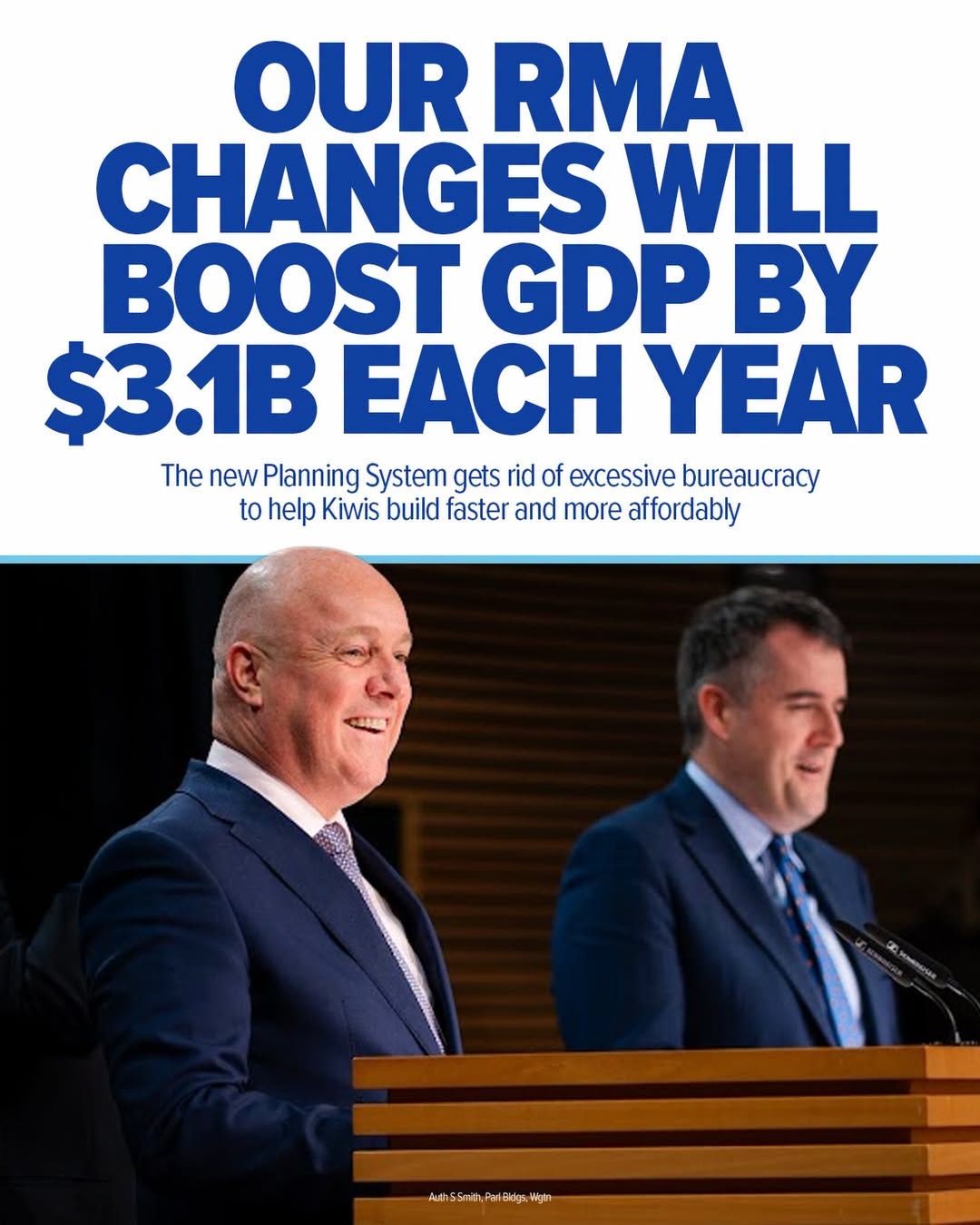
Most voters will not have followed this week’s select committee report on the two bills replacing the Resource Management Act. That is understandable. The legislation is enormous and much of the argument is buried in planning terminology. But the central issue is straightforward: how much power should Parliament hand to ministers to decide how land, water and the environment are used?
Then today, The Post published a precis of an extraordinary 7000-word note that Simon Upton, the Parliamentary Commissioner for the Environment, has sent to all MPs. Upton is not some professional protester. He is the former National Cabinet minister who took the RMA through Parliament in 1991. His verdict on its replacement is worth quoting at length.
Upton’s warning
Upton’s central charge is that Parliament is being asked to hand over its job. Where the RMA constrained regulation to managing the environmental effects of activities, he writes, the new bills “give complete discretion to Ministers to strike whatever environmental or developmental balance they prefer. In short, Parliament can have no certainty about the outcomes that are to be achieved by these Bills.”
The bills contain lists of “goals” rather than a binding purpose. Nothing ranks them, and nothing says how conflicts between them get resolved. Ministers decide. The purpose clauses, Upton says, “provide no backbone at all”, and the goals can be “rearranged by Ministers like a Rubik’s cube in almost unlimited permutations”.
He put it more plainly to The Post: “Whereas in the past, Parliament said, ‘OK, ministers, you can go off and make regulations, and councils, you can go off and make regulations, but here are the guardrails. This is what you can do’. Now there are no guardrails really in the act.”
His warning about lobbying is especially relevant: “almost unlimited ministerial discretion to fine tune the regulatory framework will inevitably incentivise vested interests to seek regulatory accommodations, increasing the likelihood that Ministers will be the target of special-interest lobbying.”
Ministerial power and lobbying
Several of the industries with the most at stake in resource management law are also significant funders of political parties. Joel MacManus made the connection in The Spinoff this week: “there are a few classes of people in New Zealand society for whom the RMA is of extreme importance: farmers, mining companies and property developers. For them, getting a resource consent can be the difference between making millions or going bust. That may be a clue as to why these three industries form the vast majority of corporate political donations in New Zealand.”
The property industry alone has donated more than $2.5 million to political parties since 2021, with roughly half going to National and about a third to Act. The fast-track regime has already generated controversy over the links between political donations, access to ministers and favourable regulatory decisions. Under the new planning system, organised interests will have even stronger incentives to seek changes to national rules, because those decisions could affect an entire industry rather than a single project.
Upton told Andrea Vance: “The more discretion you leave in the hands of the executive, the greater the opportunity for lobbying for special interests to say, ‘Look, minister, you’ve got the power to move this around. Do please do it for us’.”
A discretionary system is more easily used by organisations with the money, information and access required to influence it.
Henry VIII in the Beehive
Parliament’s own Regulations Review Committee has looked at the ministerial powers in these bills and reached for a term from Tudor England, the “Henry VIII clause”: provisions that let ministers effectively alter the operation of primary legislation without going back to Parliament.
Greg Severinsen of the Environmental Defence Society, one of the sharpest technical analysts of this reform, wrote in Newsroom this week that “a breathtaking amount of power and discretion has been vested in the minister, with minimal guardrails”. The select committee, he says, took bills that already favoured development and “doubled down on that ideology”.
The “environmental limits framework”, supposedly the great safeguard of the new system, has in Severinsen’s words been “completely gutted”. “Any activity whatsoever” is now allowed to breach a limit, so long as the minister thinks its public benefits outweigh the harm. Under the original bill this exception applied only to “significant infrastructure”; the committee widened it to “publicly beneficial activities”. Simpson Grierson’s Sarah Mitchell noted that under the broadened definition of infrastructure, “arguably, an Ikea or a very large Bunnings could be necessary to support the functioning of the economy”.
All reference to limits, says Severinsen, is “being scrubbed from the goals of the bills entirely”. His conclusion: the bills are “not only on shaky ground environmentally, but also constitutionally”. His example of what the new calculus means in practice is memorable: “dairying dollars may prove to be more important than swimmable rivers.”
Who pays for environmental protection?
Under “regulatory relief”, local councils that restrict what landowners can do with their land, by protecting a stand of native bush or a heritage building for instance, can be required to compensate the owner.
This “regulatory relief” element is one of the most consequential and least understood parts of the package. It draws on the American idea of “regulatory takings”, under which restrictions on the use of land can sometimes require compensation. New Zealand planning law has traditionally set a much higher threshold for relief.
Consultants MartinJenkins, in work commissioned by the Ministry for the Environment, estimated the potential liability at anywhere between $7 million and nearly $2 billion, with the cost ultimately falling on ratepayers. Severinsen points out that Auckland alone has more than 17,000 properties with significant ecological area protections covering 26,000 hectares, including the Waitakere Ranges, “the lungs of Auckland”.
Hundreds of submitters commented on these provisions. Nearly all opposed them. The committee kept them anyway, and Bishop has been open that the “tension” the regime creates for councils is the point.
Severinsen and councils fear that some protections will be weakened or abandoned because the financial and legal risks will be too great. Upton told MPs the Natural Environment Bill effectively reasserts a landowner’s right to destroy biodiversity which, if curtailed, would have to be compensated for by ratepayers.
Labour’s Rachel Brooking, who spent decades as a resource management lawyer before entering Parliament, expects her former colleagues to do nicely: “The resource management lawyers are going to be in for a whole lot of work for a long time.” She predicts a “cottage industry” of valuers arguing about compensation.
Greater Wellington chair Daran Ponter said the regime was designed so wealthy landowners could take councils to court. He expected his own council could end up “walking away from better and higher environmental standards” rather than risk having to compensate private owners.
The paywall now starts partway through all Democracy Project newsletters. Please take out a paid sub if you want to support this service and access the full content, including the following sections: “The rejection of localism”, “A law unlikely to last”, and “Where should power sit?”.
