

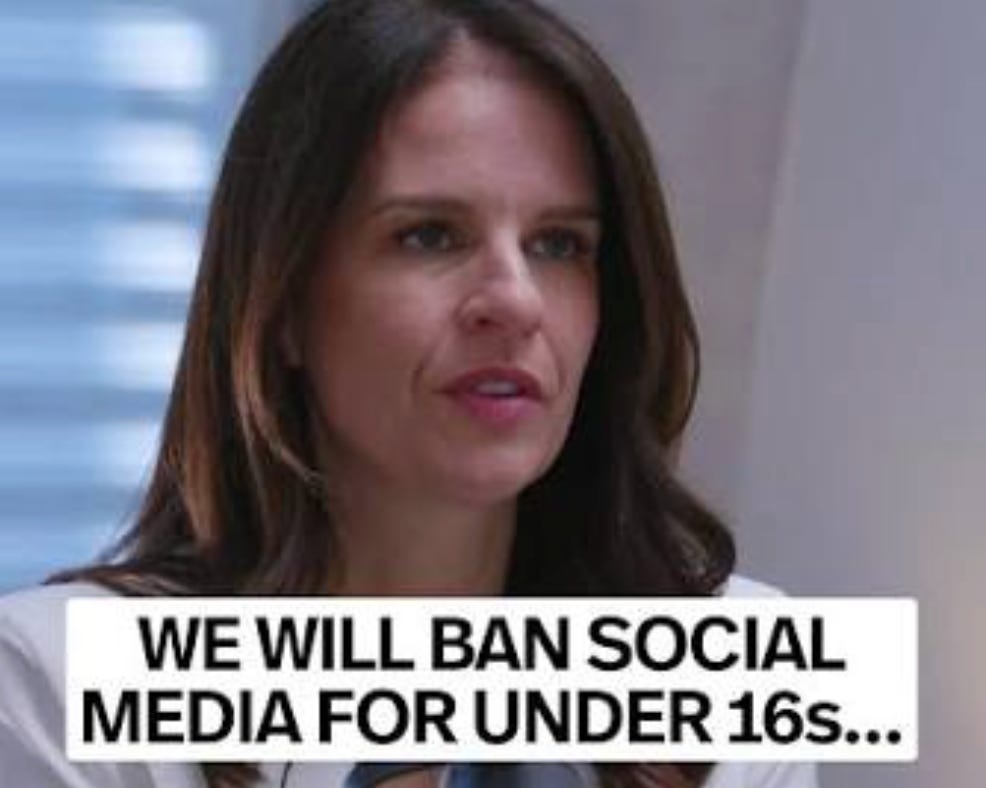
Within minutes of National unveiling its social media legislation on Monday, Act and New Zealand First announced they would vote against it. The Government’s coalition partners had abandoned the bill before Education Minister Erica Stanford had finished selling it.
Then Chris Hipkins stepped in. Labour’s offer to support the bill at its first reading produced the strangest alignment of the election campaign: National and Labour on one side, with Act, New Zealand First and the Greens on the other. The two major parties have converged on prohibition, while the smaller parties oppose it for quite different reasons.
There is little disagreement between any of them that social media can harm children. Where the two sides differ is on what should be regulated, who should bear the burden and how much privacy everyone else should surrender in the process. How did Winston Peters, David Seymour and the Greens end up on the same side of an argument against both major party leaders?
Labour comes to National’s rescue
Labour’s decision to give support to the bill was remarkably quick. Its technology spokesperson, Reuben Davidson, had complained that Labour could not properly assess the proposal, and was still waiting on answers to the 79 questions it had submitted to National. Yet within a day of the bill being introduced, Hipkins promised National the votes needed to pass its first reading.
That does not commit Labour to supporting the final legislation. A first reading normally sends a bill to a select committee, where submissions are heard and substantial changes can be recommended. Hipkins says the bill needs improvement but that he will not allow “a quest for perfection” to delay progress.
Davidson remains noticeably less enthusiastic. He has warned that the bill’s safety nets must not do more harm than good. Labour’s position is therefore difficult to pin down. It accepts the minimum age in principle while disputing how the restriction should work and where the regulatory weight should fall.
The electoral calculation is easier to understand. Labour did not need a focus group to see the danger of voting against a bill advertised as protecting children. National would have been handed one of the simplest attack lines of the campaign: why would Labour not even allow Parliament to consider measures to keep young people safe online? Why won’t Chris Hipkins protect your children from TikTok? Supporting the first reading neutralises that attack, and lets Hipkins look constructive while reserving the right to seek changes later.
But Labour’s support also gives National something important. A disputed National policy, rejected by the rest of its governing coalition, can now be presented as an emerging parliamentary consensus.
Curiously, the bill has been left to this late stage and the Government says it cannot find time for the first reading Labour has offered to support. Leader of the House Louise Upston says the remaining parliamentary programme is too crowded and the bill will have to wait until after the election.
That may be a genuine scheduling constraint, but it is a convenient one. National gets to campaign on the ban without having its practical details tested at a select committee. Labour endorses the principle without voting on the finished product.
Why National likes the ban
National’s motives deserve the same scrutiny as Labour’s, and several are operating at once.
Stanford says the issue is personal for her, and there is little reason to doubt it. She describes tech interests as “insidious and they’re everywhere”, with bottomless resources arrayed against parents who have almost nothing to fight back with. Luxon says the algorithms keep him awake at night. Stanford is not faking it.
Then there is the parent vote. The bill offers the Government as an ally to parents who feel they are losing an impossible arms race against both their own children and trillion-dollar corporations. It is a simple answer to a widespread sense of powerlessness, and it costs the government almost nothing.
The bill also gives National a culturally conservative policy stripped of the usual culture-war baggage. The message is that childhood has changed, that something valuable has been lost, and that government will help restore it. That can be said anywhere in the country without offending anyone except Meta.
And it lets a struggling government pick a fight with a target almost nobody likes. Stanford describes tech representatives offering the usual excuses, at which point, she says, she asks them what could be worse than a child learning to self-harm on their platform. It is exactly the story a government wants told about itself. And losing the vote of coalition allies is not obviously a defeat if it demonstrates that National has convictions of its own. Seymour’s complaint that there is not much point having a government of the right “if your best friends are in Labour” is the sort of criticism National can live with.
Public support and opposition
The polling is not close. Stanford’s response to Labour’s decision was to observe that Labour was now in step with the rest of the country, pointing to a Stuff readers’ poll showing 80% support. Earlier surveys have run above 60%.
Much of the commentary has moved the same way. The Otago Daily Times editorialised that the bill is a worthy first step and that National deserves credit for attempting something. The New Zealand Herald’s editorial argued that two decades into the social media experiment the harm can no longer be ignored. Mike Hosking called the announcement a “line in the sand” and predicted history would judge us to be on the right side of it. Heather du Plessis-Allan, while conceding the ban will not work as advertised, argued it will work for enough families to be worth doing. On the Spinoff, Chris Schulz wrote as a parent that the bill cannot come fast enough. Enthusiasm for this legislation is not confined to National.
The critics read the same incentives less charitably. Richard Prebble, a former Labour minister who went on to lead Act, explains why politicians reach for bans: they cost governments little, they create an impression of decisive action, and the children affected cannot vote while the anxious adults can. On the substance he is blunter still: “It is like teaching road safety by banning children from seeing a road.”
Terryann Clark and Sarah Hetrick make a related accusation. In their view the ban is “a blunt instrument, a scapegoat” that lets governments look busy about youth distress while avoiding the harder material problems that plausibly drive more of it: housing, income, insecurity, discrimination. They also argue the causal evidence linking social media to poor youth mental health is weaker than the debate assumes.
Newsroom’s Fox Meyer identifies the contradiction at the centre of the design. National says the platforms cannot be trusted with children, and then hands those same platforms the job of running the age checks and assessing their own risks. Stanford concedes the companies “don’t give a damn about our kids” and will simply absorb the fines. The Government’s answer is the one it gives about evasion generally: yes, it will be imperfect; yes, children will get around it; but establishing the norm still matters.
The paywall now starts partway through all Democracy Project newsletters. Please take out a paid sub if you want to support this service and access the full content, including the following sections: “A real problem”, “Three parties, three objections”, “Verifying children means verifying everyone”, “Two bills hiding in one”, and “A consensus that has not been tested”.
