

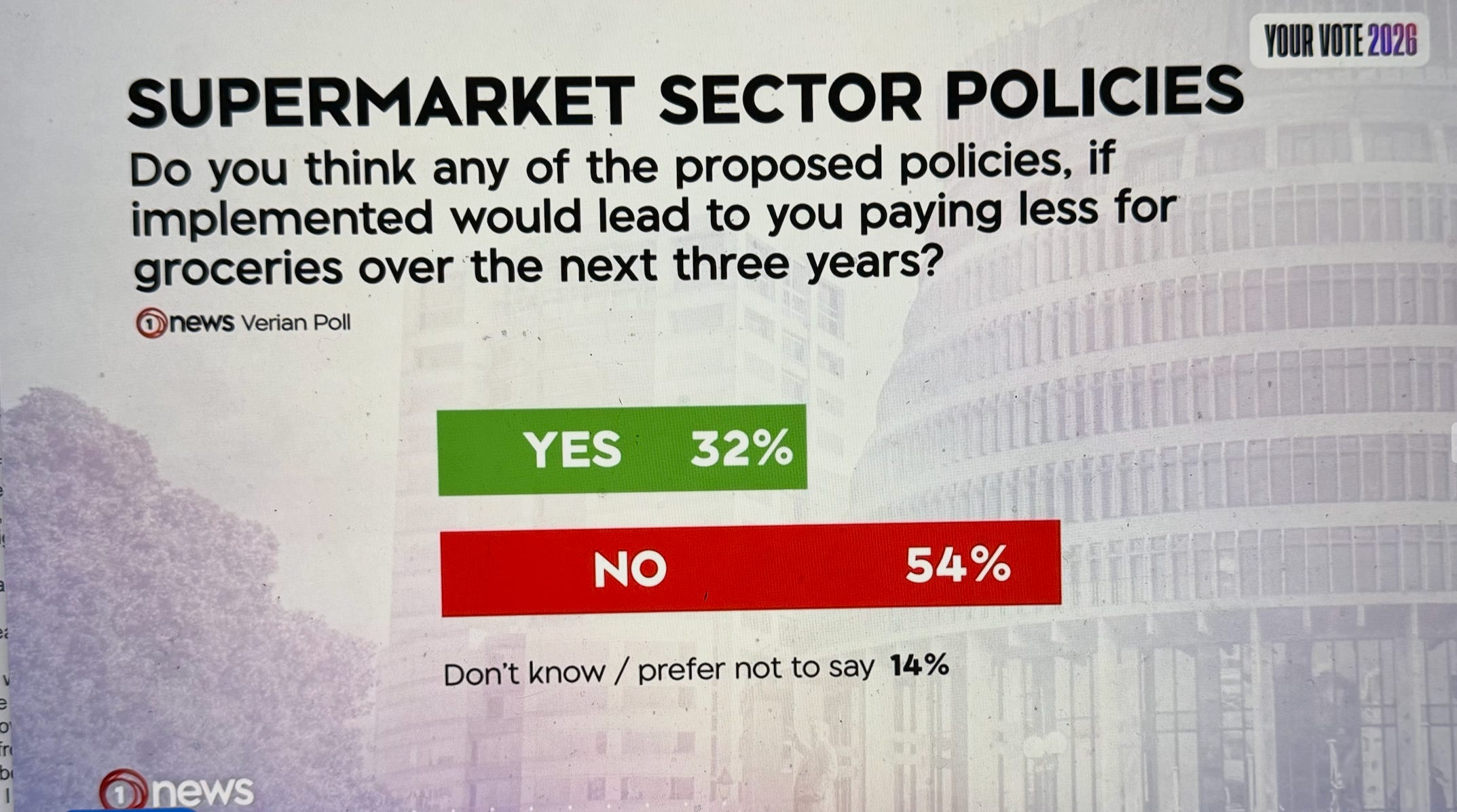
On Wednesday night I appeared on 1News talking about supermarket reform, which has become the defining policy debate of this election. The news item was built around a new Verian poll that looked like bad news for the politicians promising to shake up the grocery industry. Only 32% thought the proposed policies would lead to lower grocery prices within three years, while 54% said no and 14% didn’t know or preferred not to say.
I told 1News the supermarket policy choice “does really channel some of the zeitgeist of discontent in the electorate at the moment”, and that “these sorts of policies would have been seen as quite fringe a few years ago.” But I also pointed to an obvious credibility problem. “The public do have questions about the competency and credibility of the politicians,” I said, “especially after so many years of no progress on this.”
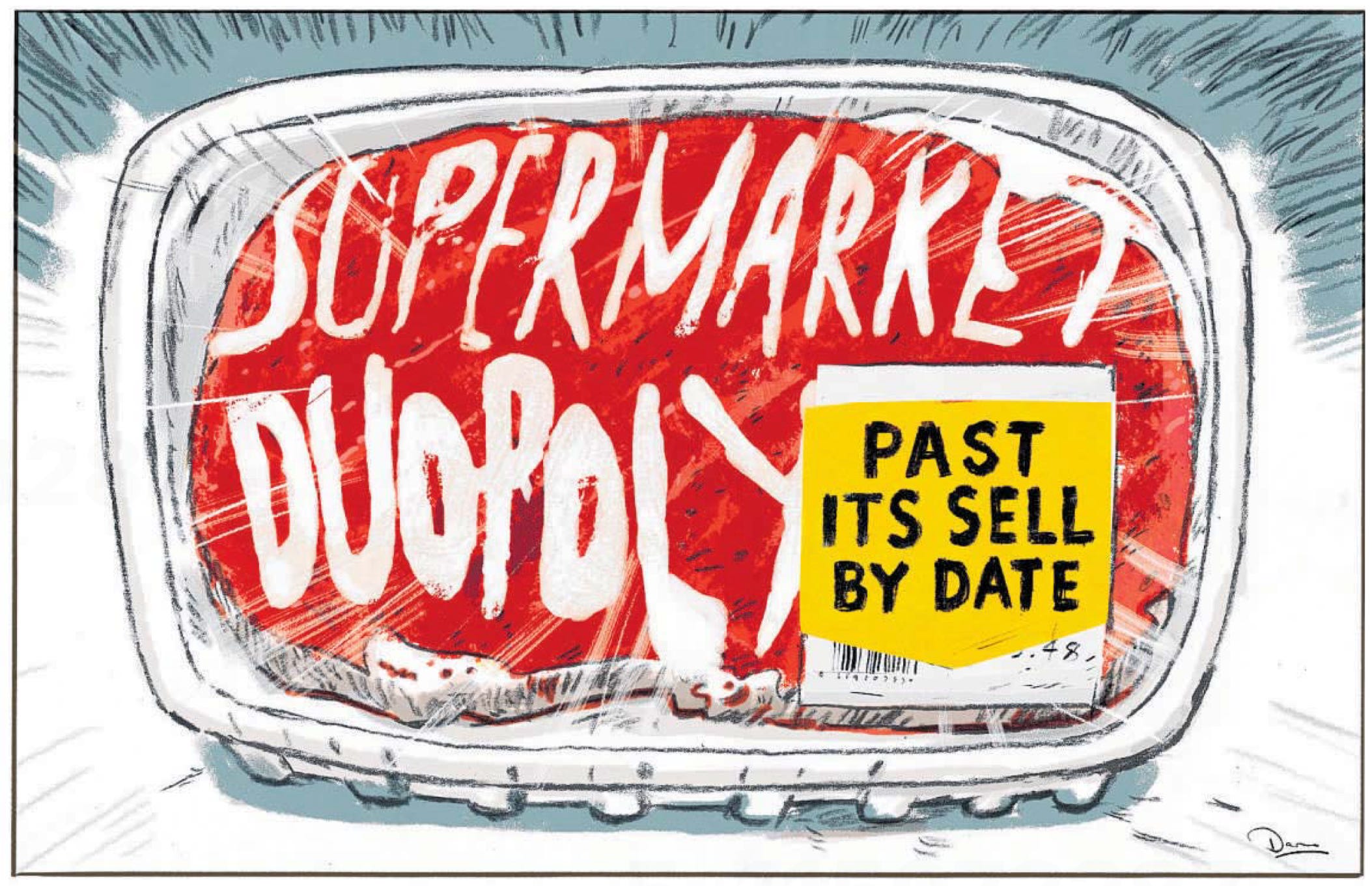
The supermarket debate has nonetheless become a radical one. Years of anger about broken markets have forced the parties to come up with structural fixes, and I think that shift should be welcomed as a sign of democracy working. I don’t read the Verian poll as undermining that. What it mainly measures is doubt that reform will reach the checkout any time soon.
The politician credibility gap
The Commerce Commission estimated the supermarket duopoly’s excess profits at around $1 million a day back in 2022. Since then, voters have watched successive governments appoint a Grocery Commissioner, whose specialist role is now due to be replaced by a regulatory committee in 2028, and hunt the world for a third player. This week The Warehouse ruled itself out of becoming that third player. Yet the Commission’s latest annual grocery report found “little observable change in core competition metrics”, with the two groups’ combined market share essentially unchanged at 82%.
Jacinda Ardern said in 2022 that she would “unlock the stockroom doors” of Woolworths and Foodstuffs, and Nicola Willis has spent well over a year promising more competition. Yet as Tom Pullar-Strecker wrote in the Post when the Commission’s report came out in June, “the supermarket duopoly is about as strong as ever.” Mike Hosking was blunter on Newstalk ZB: “No one has jawboned groceries like Nicola Willis, so her hot air outpaces any action.” Consumer NZ was picking up this scepticism well before the campaign. In its survey in April last year, 66% of people had low confidence in the Government’s grocery policies, with only 9% expressing high confidence.
Nor is there much confidence on the other side of the argument. Consumer NZ’s trust tracking found supermarkets suffered the biggest fall of any sector it measured between 2021 and 2024, with only 35% of shoppers expressing high trust in supermarket pricing and promotions.
So the politics is being driven by two kinds of distrust at once: dissatisfaction with the supermarkets and scepticism that governments can successfully reform them.
The Verian result shouldn’t be mistaken for a referendum on the reforms themselves. The question was essentially whether any of the proposed policies would leave respondents personally paying less for groceries within three years, which asks quite a lot of a voter. A policy has to get through coalition negotiations and actually work before it shows up in anyone’s grocery bill, all within a fairly short period.
Danyl McLauchlan’s cover story in this week’s Listener rates the parties’ supermarket policies against the evidence. He gives both the Foodstuffs break-up and Labour’s wholesale separation a verdict of “GOOD”, which he reserves for policies where “the mechanism is sound and the costs are honest”, though he warns that the break-up’s benefits would vanish if it raised the chains’ costs by more than 2%.
Foodstuffs’ own polling tells the same story as Verian’s. The co-operative commissioned Talbot Mills to survey 1325 people between 16 and 21 September, and its headline results were leaked to Stuff’s Jenna Lynch, who reported on them yesterday. Asked about National’s policy to investigate separating Pak’nSave and New World, 45% were in favour and only 38% opposed. When Stuff approached Foodstuffs, it confirmed the poll and shared further results. Asked whether forcing the separation would lower grocery prices, just 28% said yes and 48% said no.
So, supporting a break-up and believing it will make groceries cheaper are plainly not the same thing.
Support for National’s policy crossed party lines. National voters backed it by 58% to 34%, and a majority of Green voters were in favour. Even Act voters supported it by 45% to 43%, despite their party’s opposition, while Labour voters were evenly split. New Zealand First voters, whose party proposed the split first, were narrowly against it, by 41% to 39%.
Earlier polling found even stronger support for radical action. In September 2021, after being told of the Commerce Commission’s draft finding that competition wasn’t working well for consumers, 70% of respondents in a Phoenix Research survey for Monopoly Watch NZ supported splitting up the two supermarket groups, with only 15% opposed.
How 2026 turned into “the supermarket election”
It’s remarkable how quickly those dramatic proposed interventions have moved into the political mainstream.
In January the Herald’s Anne Gibson asked Foodstuffs North Island chief executive Chris Quin what the key election issue would be. “Hopefully,” he replied, “it will be about things other than supermarkets and grocery prices.” Instead, as a Herald editorial put it last week, “After years of governments talking around the issue while the Commerce Commission did studies, and everyone hoped an Aldi-shaped caped crusader of competition would ride to the rescue before anyone actually had to do anything – we are now awash in policies.”
New Zealand First promised in April to split Foodstuffs into separate Pak’nSave and New World/Four Square cooperatives. On 6 September the Greens went much further with KiwiMart, a $2.8 billion plan to require Woolworths and Foodstuffs to “divest at least 120 stores and distribution centre capacity into public ownership”. National adopted the Foodstuffs split in September, subject to a Commerce Commission assessment, and Labour announced a price-gouging ban the same morning and, four days later, a plan to separate the duopoly’s wholesale arms from their stores. Te Pāti Māori is backing Māori-owned supermarkets, and outside Parliament the Opportunity Party wants the Commerce Commission empowered to seek break-ups through the High Court.
Act stands almost alone in Parliament in insisting the answer is not to restructure the incumbents. Its proposal is to make it easier for another operator to enter: streamlined consenting, fewer local-government hurdles and recognition of some overseas food labels – basically deregulation and cutting of red-tape.
Until mid-September National’s official policy was relatively aligned to Act’s approach, although Willis had told the Post in July that she was looking “in detail” at structural separation. Former Act leader Richard Prebble notes on his Substack that at 2.37pm on 15 September, Commerce Minister Cameron Brewer was still describing that approach to Parliament, starting with “making it easier to consent and build supermarkets”. Nineteen hours and 46 minutes later, by his count, National gave the media seven minutes’ notice of a press conference to announce a break-up.
Gareth Hughes, the former Green MP who now heads the Wellbeing Economy Alliance Aotearoa, says in the Post: “The cost-of-living election has become the supermarket election.” Of National, New Zealand First, Labour and the Greens, he writes: “After four decades of governments reluctant to intervene directly in markets, all four parties now accept that New Zealand’s supermarket duopoly is not working and needs major structural reform.”
Consumer NZ chief executive Jon Duffy told RNZ: “What is really encouraging is that we seem to be now not having a debate around whether the government needs to step in and do something about this sector, it’s how they should do that.” As Glenn McConnell wrote in Stuff, “A once radical proposal is, thanks to the election, becoming the mainstream consensus.”
The paywall now starts partway through all Democracy Project newsletters. Please take out a paid sub if you want to support this service and access the full content, including the following sections:
“‘Broken New Zealand’ at the checkout”
“The parties finally read the room”
“A more competitive political market”.