

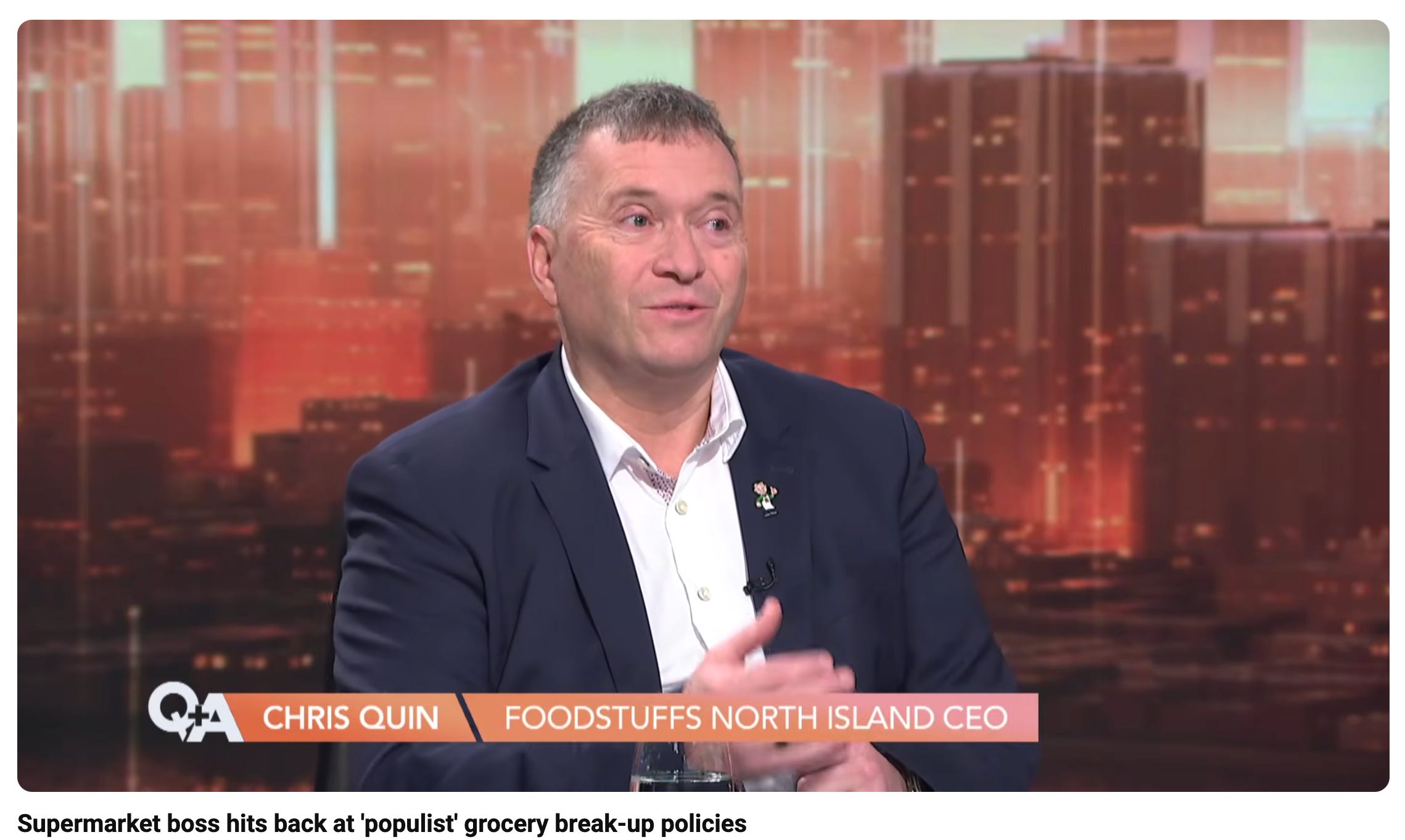
A week after National announced it would pursue the separation of Foodstuffs, 51 business figures signed an open letter asking every political party “to uphold a rules-based economy that respects private property and freedom of contract”. It was organised by the New Zealand Initiative, whose members include Foodstuffs North Island and Woolworths NZ among many other companies, and whose board includes Foodstuffs North Island chief executive Chris Quin. Quin signed the letter, as did Foodstuffs South Island chief executive Mary Devine.
National’s radical supermarket policy has clearly rattled many in business, especially incumbents who fear their privileged position in concentrated markets might be disrupted. At the moment the Act Party appears to be the beneficiary. The Post’s Anneke Smith reported on Friday that since National’s supermarket announcement, National has taken donations of just $52,000 (in declared donations of $20,000 or more) while Act has taken in $275,000.
Leader David Seymour says he has heard “vociferous reactions” from significant National donors unhappy with the supermarket policy. The supermarket fight has also become entangled with a wider argument within the political right over business and the role of the state.
In yesterday’s Democracy Briefing I argued that the shift of radical supermarket reform from the political fringe to the centre of this election is a healthy democratic response to years of public anger. I also highlighted that the polls mainly show scepticism about whether politicians will deliver. But the fightback from business is a reminder of how much power incumbents can bring to bear on policy, both in public and behind closed doors.
The lobbying counteroffensive
On the day National announced its supermarket policy, Nicola Willis warned that Foodstuffs was one of the best-resourced lobbying operations in the country and that she expected a tough fight. Newsroom’s Andrew Bevin has since documented who is involved. Foodstuffs says its in-house communications, public-affairs and marketing-communications team numbers eight. It also uses lobbying firm Thompson Lewis and corporate-affairs firm Sherson Willis.
Thompson Lewis was co-founded by GJ Thompson, who worked for Helen Clark and later took leave from the consultancy to serve as Jacinda Ardern’s chief of staff. Director Wayne Eagleson was John Key’s long-serving chief of staff. Paula Oliver was Key’s deputy chief of staff. Newsroom also notes that its senior staff include a former adviser to Nicola Willis in the current Government.
Sherson Willis brings another set of political connections. Founder Trish Sherson previously headed communications for Act. In July the company hired Andrew Ketels, who served as David Seymour’s chief of staff from 2020 to 2025 and previously advised National. Ketels is now Sherson Willis’s head of government relations. Newsroom reported that he had recently completed a short government-relations stint with Woolworths.
Ketels also has a Herald column this weekend attacking the wider vogue for interventionist election policy. His argument ranges well beyond supermarkets, across petrol regulation, data centres, KiwiSaver and student loans, but lands squarely in this debate when he writes: “Politicians are just responding to the incentives in front of them. Voters want governments to ‘do something’ about problems, even if doing nothing is the better option.”
Ketels’ column makes the case that interventionist policies being promoted as solutions to problems such as supermarket competition are populist measures likely to produce unintended consequences. The column’s byline states his role with Sherson Willis, but doesn’t mention that his firm does public relations work for Foodstuffs North Island.
Woolworths has its own network. Its advisers include lobbying firm Lillis Clark, whose directors Anna Lillis and Kenny Clark previously worked for former National finance minister Steven Joyce. Woolworths’ head of government relations, Andrew Kirton, is a former Labour Party general secretary who later served as Chris Hipkins’ chief of staff when Hipkins was prime minister.
Joyce is an interesting figure in his own right. After the Grocery Commissioner’s first report last year, he wrote in the Herald that Foodstuffs “could voluntarily agree to split their brands into two co-operatives” in return for being allowed to merge each brand’s North and South Island operations. A few months later he joined the Foodstuffs North Island board, and he also chairs NZME, publisher of the Herald.
Then there is BusinessNZ chief executive Katherine Rich, a former National MP and former longtime head of the Food and Grocery Council. BusinessNZ, whose membership includes both major supermarket groups, is opposing National’s break-up proposal. These networks run across party lines: Labour-aligned political operatives have worked for supermarket companies just as National and Act figures have.
None of these connections is evidence of wrongdoing. They matter because New Zealand still has almost no transparency around lobbying. Voters can see some ministerial diaries and political-donation disclosures, but there is no comprehensive register showing who is lobbying whom, for which clients, or what arguments and material they are putting before decision-makers.
That matters particularly because we have been here before. Earlier this year I wrote about how the previous round of supermarket reform was watered down amid extensive lobbying. During the Commerce Commission’s market study, Countdown retained Capital Government Relations, run by former Labour chief of staff Neale Jones. In January 2022 Kirton arranged a dinner between then finance minister Grant Robertson and Countdown’s managing director. The Commission’s 2021 draft had contemplated structural separation of wholesale and retail. By the final report in March 2022, that option was gone, replaced by a much more limited wholesale-access regime.
There is no smoking gun showing that the dinner or lobbying killed structural separation. The problem is that our lobbying system makes it extremely difficult to know what influence did.
The paywall now starts partway through all Democracy Project newsletters. Please take out a paid sub if you want to support this service and access the full content, including the following sections:
“Is this just anti-business populism?”
“The think tank leading the counteroffensive”
“The grocery campaign to win back the public narrative”