

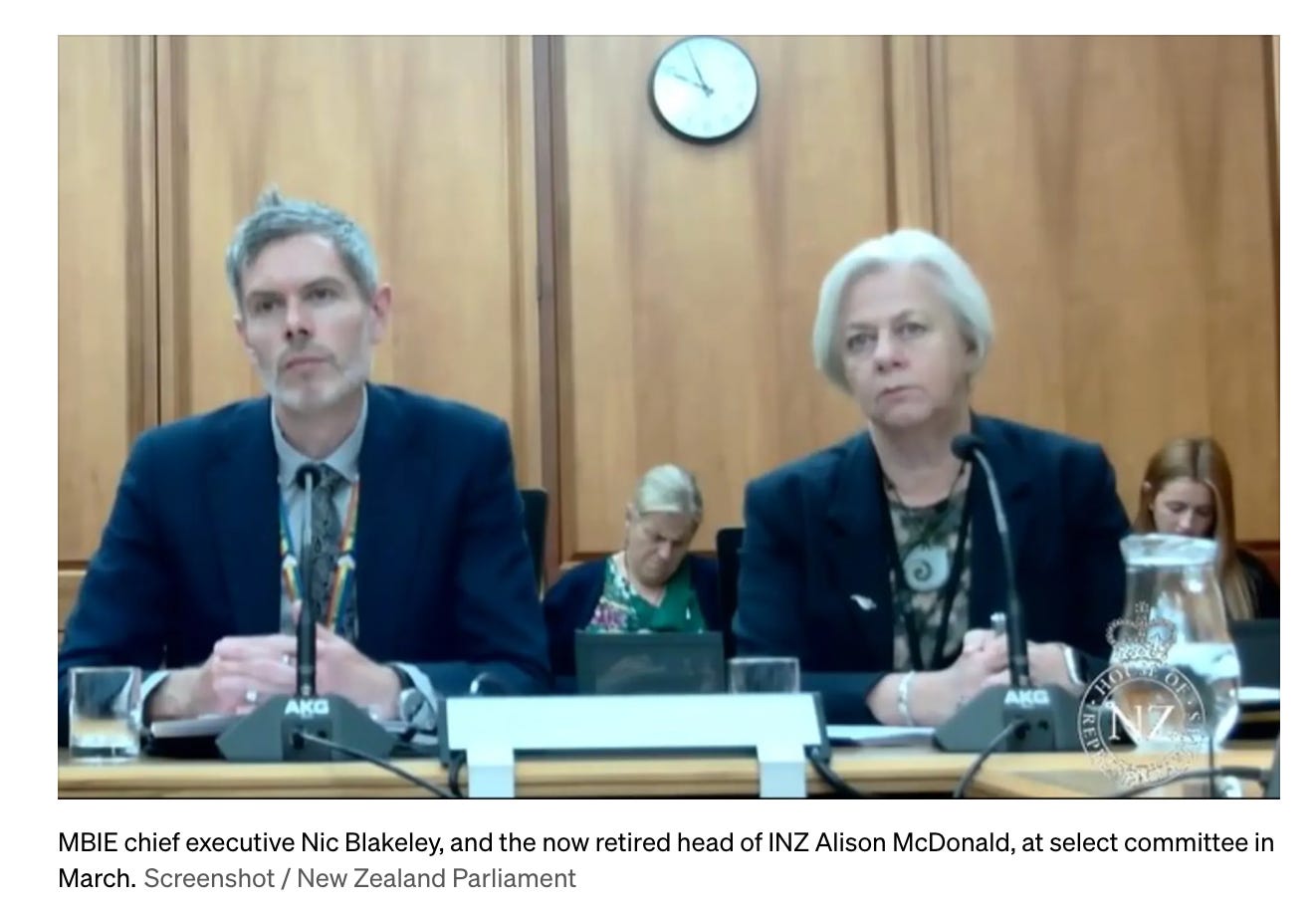
“Contempt of Parliament” sounds like an offence from another age. The conduct at the centre of this case is much easier to understand. MPs asked senior officials from MBIE about a major immigration technology project. The officials answered as if it were still being reshaped. In fact, it had already been shut down, having failed.
The Privileges Committee found that MBIE deliberately misled MPs. Chief executive Nic Blakeley offered to resign, but Public Service Commissioner Brian Roche told him to stay. The committee recommended no further sanction. Immigration Minister Erica Stanford now says she retains confidence in Blakeley.
The failed Biometric Capability Upgrade project has cost roughly $40 million. But this story is no longer mainly about an IT failure. It is about whether Parliament can get the truth from the public service, and what happens when it does not.
1. What exactly did MBIE tell MPs?
On 4 March, Labour MP Phil Twyford asked Blakeley and former Immigration New Zealand deputy chief executive Alison McDonald about delays, risks and independent reviews of the BCU project. McDonald described a programme that was changing direction. Blakeley said MBIE was “in the process of working out what the programme looks like going forward”.
The project had been ended on 9 December 2025, almost three months before that hearing. Yet neither official volunteered that elementary fact. A later written answer was scarcely clearer. It referred to extensive work leading to a “change in approach” without stating the elementary fact that the project had been cancelled.
MPs were asking about a named project. The answer they needed was that it no longer existed.
2. Was this really deliberate?
The Privileges Committee was explicit about this. Its finding was not that officials were confused or caught off guard. MBIE knew its answers were incomplete. The limited way it answered was intentional. The committee found that the officials would have been certain MPs would be left with the false impression that the project was continuing.
A finding of “contempt of Parliament” is not given lightly. Recklessness on its own is not enough. A mistake is not contempt. The committee concluded that MBIE deliberately misled the Education and Workforce Committee and, in doing so, committed a contempt of Parliament.
Its language was damning. Officials have an “absolute obligation to tell the truth”, and failing to meet it was “an insult to the entire public service”. Any later description of what happened as poor preparation has to be measured against those words.
3. Did commercial sensitivity leave officials with no alternative?
No. At the time of the select committee hearing MBIE was still negotiating final payments with its technology supplier, and some information was commercially and Budget sensitive. That limited what could safely be said in public. But it did not require officials to mislead MPs.
They could have flagged the sensitivity and asked to give evidence in private. They could have taken the question on notice and corrected the record afterwards, which is what the guidance they had not read would have told them. Blakeley later acknowledged that he knew confidential procedures existed, even if he had not seen them used at MBIE.
The most basic alternative was simply to tell MPs that commercial constraints prevented a full public answer. Instead, the constraints themselves were hidden. Commercial sensitivity explains the need for care. It does not explain the false impression.
4. Why did the Privileges Committee recommend no punishment?
MBIE had apologised, and the committee decided that its finding of contempt would be consequence enough. It recommended only that the House take note of the report.
This was the committee’s one real failure. The report is strong on what was done. It goes quiet on who did it. A formal finding matters, but the committee could have recommended a personal reprimand or another proportionate sanction. Instead, it assumed the force of its words would be sufficient.
The problem is that Roche has cited the lack of parliamentary sanction as justification for why he has chosen to keep Blakeley on. So, the committee left an enforcement vacuum and the Commissioner filled it with leniency.
The two decisions are entirely separate. The committee’s was about punishing MBIE. Roche’s was about Blakeley’s employment. But the committee made it easier for Roche to convert the issue into a management problem that can be resolved with internal staff training and a change of processes.
5. Has Roche redefined accountability out of existence?
In explaining his decision to keep Blakeley on, Roche has said that “accountability is fixing what went wrong”. The public should not buy this. Fixing the damage is remediation, and it is already part of Blakeley’s $600,000+ a year job. Redefine accountability as remedy rather than consequence, and the punishment for contempt of Parliament becomes that you keep the job and organise some staff training.
Roche’s own change of stance is revealing. In June he called the alleged behaviour surrounding the project “completely unacceptable” and “a disgrace”. If officials had breached basic standards, he said, it would be difficult for them to retain a role in the public service. He declared that if the evidence justified dismissals, he would do what was required.
Yet when the evidence arrived this week it turned out to be stronger than expected, and Roche’s response was suddenly very weak. A cross-party committee had made a formal finding of deliberate misleading and contempt. Roche’s language nevertheless softened.
Roche said of Blakeley: “I don’t think he lacked honesty at all.” In an interview on Newstalk ZB he said: “I believe Nic is part of the answer, not part of the problem” and “I believe he was badly let down by his staff. I give him the benefit of the doubt.” Those answers appear impossible to square with a finding of deliberate misleading.
Roche’s Commission recommended Blakeley for the job in December. Eight months later Roche is the only person able to remove him. Heather du Plessis-Allan put the awkward version of that to him directly, asking whether refusing the resignation spared him egg on his face, and he replied that the suggestion was completely unfair and that he stands on his own principles and integrity.
The paywall now starts partway through all Democracy Project newsletters. Please take out a paid sub if you want to support this service and access the full content, including the following sections: “6. Is six weeks in the chief executive’s job a serious defence?”, “7. Has Blakeley actually accepted the contempt finding?”, “8. Why does accountability become softer at the top?”, “9. What did Erica Stanford know, and when?”, and “10. What happens the next time officials are tempted to mislead Parliament?”.
