

This week the Government asked thousands of low-income homeowners, including families with children, to find on average another $42 a week before the state would help with their housing costs. In the same week, we learned that the minister responsible claims $1,000 a week from the taxpayer for a Wellington apartment she jointly owns and on which she lists no mortgage debt.
The timing tells you something about how power now works in New Zealand. It is hard to avoid the conclusion that New Zealand now has two quite different standards of public support. MPs get a housing payment that is generous, automatic, and barely tested. Everyone else gets forms, thresholds, stand-downs, and lectures about targeting.
The scandal here is not that anyone broke the law. Nobody did. The scandal is what the law allows, and who wrote it.
The $1,000-a-week question
Social Development Minister Louise Upston spent last week explaining why low-income homeowners should get less. Her bill lifts the threshold at which homeowners can claim the Accommodation Supplement from 30% to 40% of income, meaning thousands of households must absorb more of their housing costs before any help arrives. In the House, she said the change was about targeting support to “those who need it most,” and that taxpayer money should go to renters, “not people who are using taxpayer support to increase their own asset.”
It was a tidy line. It would have been tidier still had it not described her own situation almost exactly.
Upston earns around $320,600 a year. On top of that, she has been claiming $1,000 a week ($52,000 a year) in parliamentary accommodation allowance for an apartment in Wellington that she jointly owns and on which the pecuniary interests register records no mortgage.
Asked what her actual accommodation costs were, she declined to say. Asked whether she herself would meet the 40% threshold she is imposing on other New Zealanders, she declined to say that too. “I’m comfortable with the rules,” she told RNZ. She should be – the rules are very comfortable.
It’s a pay rise rather than a housing allowance
The optics are bad enough. But the more important question is how this allowance changed from reimbursement into entitlement.
Once, MPs who lived outside Wellington claimed back their actual and reasonable accommodation costs, against receipts. It was a reimbursement: you spent the money, you proved it, you got it back. Then, in 2009, John Key’s government switched to bulk funding. Instead of reimbursing costs, the system now hands over a flat sum: up to $36,400 a year for an ordinary MP, $52,000 for a minister. This allowance is paid regardless of what the MP actually spends, and with no receipt required.
That single change converted a cost-recovery scheme into something else entirely. An allowance you never have to account for is not a reimbursement. It is a pay rise. And because it is paid as cash against no proven expense, it can be banked straight into a property the MP already owns, turning a housing subsidy into a tool of private wealth accumulation.
This is why the mortgage detail matters. Upston is not alone in claiming the allowance while owning her Wellington property outright; several MPs do the same. The issue is not criminality. It is design. The system was changed so MPs no longer have to answer the most basic question: what did this actually cost you?
Even Chris Hipkins, who tolerated the change for years, now disowns it: claiming an allowance “when you’re not spending that money on accommodation,” he says, is “very, very hard to justify.” The Taxpayers’ Union, from the other end of the spectrum, has argued these untested perks amount to a hidden salary increase. When the Taxpayers’ Union and the Labour leader agree, the defenders are running short of company.
Paid not to live in Wellington
If you want the absurdity of the system in a single example, consider NZ First’s Andy Foster. He’s owned a house in Wellington for 26 years, during which he’s served ten terms on the Wellington City Council. He was, for a time, the Mayor of Wellington. And he has been claiming the accommodation allowance reserved for MPs based outside Wellington, because in 2025 he bought a second home in the Wairarapa, where he now intends to stand for election, and has reclassified that as his “family home.”
So the taxpayer is now subsidising a former Mayor of Wellington to maintain a residence in the very city he governed, on the basis that he doesn’t really live there anymore, while he campaigns for a seat somewhere else. As the blogger No Right Turn put it, “we’re not paying Foster to live in Wellington. Instead, we’re paying him to not live there, so he can campaign for election elsewhere.” The blog argues that this is arguably an unlawful use of parliamentary funds for a political purpose.
The whole pay and perk architecture
The accommodation allowance is only one part of a much bigger package. Andrea Vance set this out well today in the Sunday Star-Times, describing what she called a “cradle-to-grave lifestyle insulation package”. Her account of all the allowances is worth considering, because each MP perk on its own sounds reasonable yet the whole adds up to something remarkable.
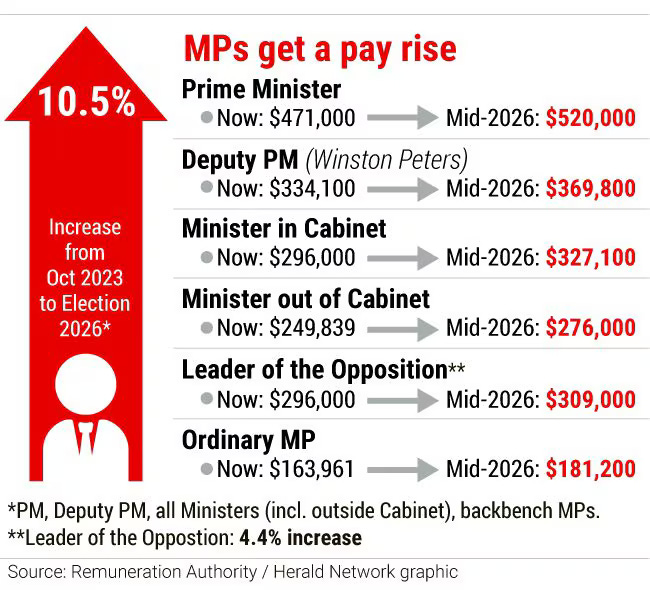
Vance’s inventory is damning. She points to the $181,200 backbench salary from July, the tax-free expense allowance, subsidised family travel, access to chauffeur-driven cars for senior ministers’ families, post-election salary continuance, and the unusually generous superannuation arrangements. Her sharpest line is on the super scheme: the taxpayer match of $2.50 for every $1, she says, “would give a private sector CFO conniptions.” On her calculation, a two-term backbencher can leave with a retirement nest egg of roughly $300,000.
Newstalk ZB’s Heather du Plessis-Allan also looked at these add-on allowances this week, and concluded: “you can add somewhere between $120,000 and $140,000 at least in perks to their base pay.”
None of this is illegal. All of it is, in the technical sense, “within the rules.” But the cumulative effect is a political class almost completely sealed off from the economic weather the rest of the country lives in. As Vance says today, “while the language of government is increasingly about discipline and telling the public to tighten their belts, the lived reality inside the political system is absolute insulation from the economic frost they are making everyone else survive.”
The paywall now starts at halfway through all Democracy Project newsletters. Please take out a paid sub if you want to support this service and access the full content, including the following sections: “Rules for thee”, “The independence dodge”, “But everyone does it”, “The distance that’s killing trust”, and “What should change”.
