

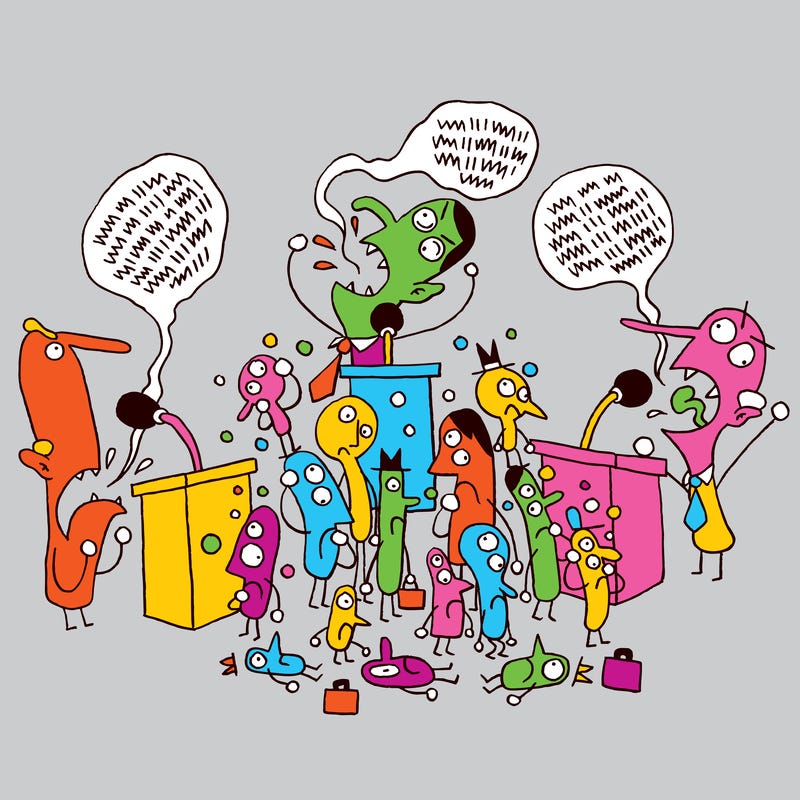
Veteran political journalist Richard Harman summed up 2025 in one bleak line: “This has been the year of our discontent. It has been an awful year at Parliament, dominated by petty point scoring and a determination to hang on to the past.”
That feels about right. We’ve watched endless parliamentary skirmishes that go nowhere, with politicians more interested in scoring hits than solving problems. And it hasn’t just been a bad year for whichever party you happen to dislike – it’s been a bad year for the entire political system, for public confidence, and for any real sense that New Zealand is heading somewhere better. The national mood is sour. The word I keep hearing is: “broken”. And in fact, I’ve been writing a series of columns on this theme of “Broken New Zealand”, which I’m also seeing versions of in many of the end-of-year commentaries.
Andrea Vance, in her end-of-year column, captured that malaise with a phrase that will probably stick: “managed decline.” She wrote that if politics had a “Spotify Wrapped” for 2025, the soundtrack “would be a joyless beat of disappointment on repeat,” with the hit single titled “Managed Decline.” National, she argued, had banked on the national vibe improving once it took office. It didn’t.
Similarly, Labour didn’t re-inspire anyone; it simply waited while the Government burned through its goodwill. The minor parties either leaked support or fed off grievance. That is a pretty accurate description of New Zealand politics in 2025: a joyless beat of disappointment on repeat.
Other commentators echoed the verdict. Longtime political journalist and editor Tracy Watkins bid “good riddance” to 2025 as “a year to forget.” Political scientist Grant Duncan was even more blunt, calling it simply “forgettable.” That might be kind – it’s actually felt more like a slog through mud. Across the spectrum, the consensus was one of stagnation and frustration, with little progress made and a public mood that turned increasingly depressed.
A Gloomy country that still looks good on paper?
One oddity of 2025 is the gap between how the country feels and how it looks in international rankings. On paper, New Zealand still seems like an overachiever. In Alexander Gillespie’s “NZ report card 2025”, published today, our country scores near the top globally for civil liberties, rule of law, low corruption, personal safety, and quality of life. We’re still high in gender equality and press freedom indexes.
But scroll down Gillespie’s report card and the picture darkens. Unemployment climbed above the OECD average. Wages rose, but not enough to outpace inflation. Housing remains unaffordable for many, with public housing supply lagging and homelessness rising. One in seven children lives in material hardship. Youth mental health is deteriorating. The prison population surged back above 10,000 inmates, and patched gang membership also passed 10,000. Net migration is way down, with tens of thousands of Kiwis choosing Australia for better opportunities.
On climate change, New Zealand slid into the “low performer” category. In areas like AI governance, innovation and competitiveness, we’re drifting instead of leading. Gillespie concludes, in that classic school-report phrasing, that New Zealand “shows great potential but needs to try harder”. It’s a polite way of describing what Vance calls “managed decline”: a country coasting on its old strengths while slowly fraying underneath.
Politics as a live-action stress test
Political commentator Ani O’Brien today described 2025 as “a live-action stress test for MMP, public patience, and the integrity of Parliamentary norms and traditions.” That gets to the heart of how politics has felt up close. She says the new three-party coalition came into the year still promising “growth”, “delivery”, and to get the country “back on track”. Instead, the economy shrank at times, unemployment grew, and most people ended the year feeling poorer. A government that sold itself as competent managers found itself defending economic numbers that look worse now than when they took office.
O’Brien says that Act and New Zealand First have often been more visible than the larger National Party, constantly tugging the Government toward their own pet projects and ideological crusades. Prime Minister Christopher Luxon’s big promise was to bring corporate discipline and clarity; but O’Brien says what the public mostly saw was a PM struggling to assert authority over two coalition partners who are both better at retail politics than he is.
Outside Parliament, protest politics became the background hum of the year according to O’Brien’s end-of-year column today. She argues that “Almost every issue including foreign conflicts, Treaty debates, climate policy, health, and education, was framed as existential, urgent, and beyond compromise”. Each side’s activists rushed to declare democracy itself under threat whenever they disliked a proposal. And many journalists eagerly amplified these crises-of-the-week according to O’Brien. Every dispute was a “constitutional crisis”, every confrontation a battle for the nation’s soul.
The public reaction wasn’t radicalisation so much as exhaustion, she argues. People are tired of being told that every bill is the end of democracy and every policy tweak is the final straw. By the end of 2025, as O’Brien observes, New Zealanders were not so much disengaged from politics as exhausted by it. Trust in institutions, media, and “anyone with power” remains abysmally low. Tempers, however, remain high. Very few people on any side feel happy or satisfied with our direction. O’Brien explicitly warns that when politics feels like permanent outrage theatre, people naturally start to suspect that nobody is actually fixing anything.
The Treaty Principles Bill and culture wars
Cultural and constitutional conflicts added more fuel to this year’s dumpster fire. The flashpoint was the Treaty Principles Bill, which dominated the first part of 2025 and poisoned much of what came after. Grant Duncan dryly notes that 2025 began with an “intense and yet fruitless debate about the principles of the Treaty of Waitangi” – a debate that “achieved nothing”. The Bill was never really intended to become law. It was a coalition bauble for Act, more about signalling than governing, yet it sucked up almost all the political oxygen in early 2025: Ratana, Waitangi Day, months of submissions and protests all orbiting around a dead-end bill.
Te Pāti Māori began the year riding high off the Treaty hīkoi and activism of late 2024. By the end of 2025, however, the party imploded. Internal factionalism, nepotism and personalism burst into public view, culminating in the surreal spectacle of MP Mariameno Kapa-Kingi going to court just to be allowed back into her own party conference. Ultimately, 2025 was a year when constitutional and identity politics were constantly stirred but never resolved. The result is a country more divided and more tired than ever.
A Year of political under-performance
If 2025 was a bad political year, it’s not because one side triumphed and the other failed. It’s because almost everyone underperformed. Most of the major players had bad years, albeit for different reasons.
On the Government side, both The Post and Newsroom produced detailed end-of-year report cards for ministers and party leaders. The broad picture is of a Cabinet that has failed to meet its own billing. Prime Minister Luxon gets credit as a capable manager for holding together a complex coalition, but he has not convinced the public he knows how to actually improve their lives – hence a score of 5/10 from The Post. Finance Minister Nicola Willis is seen as ideologically clear but politically clumsy, especially over the equal pay rollback that became one of the Government’s biggest self-inflicted wounds.
The infamous “road cone hotline” fiasco and the drawn-out uncertainty over Dunedin’s new hospital reinforced the impression of a government that is quick to cut, but slow to plan. Overall, this was a government that promised to lift New Zealand out of a slump, and instead presided over a deeper sense of stagnation and insecurity. Unsurprisingly, The Post gave some ministers some very low marks (Simon Watts 3/10, Matt Doocey 3/10, Shane Reti 4/10).
The Opposition did not exactly shine either. The Post’s rankings of Labour’s front bench, published today, gave Chris Hipkins high marks for holding his caucus together and nudging Labour back up in the polls. He’s seen as experienced, media-savvy, and tactically sharp. But beyond Hipkins, Labour’s team is mostly competent-but-uninspiring. For example, according to today’s Post, Megan Woods got a 3/10 for seeming “checked out” on energy issues, Willow-Jean Prime a 1/10 for bungling NCEA briefings, and Tangi Utikere a 3/10 for failing to land blows on local government.
Labour didn’t earn its rebound by inspiring voters with bold ideas. As Andrea Vance remarked, Labour didn’t so much “inspire its way back” as it “just waited while the Government burned through goodwill”. It was a passive, small-target strategy – perhaps smart tactically, but it contributed to the sense that no one on any side was offering real optimism or solutions.
On the left flank, the Green Party had a messy year. There were moments of momentum (at one point the Greens even polled in double digits), but these were undercut by public infighting and mini-scandals that saw yet another Green MP depart under a cloud. By year’s end, even Green loyalists admitted the term had been, in Ani O’Brien’s words, “a catastrophic one thus far” for the party’s credibility. Only Chlöe Swarbrick truly shone (6.5/10) – in many ways, she remains the Greens’ standout performer – but that wasn’t enough to offset the turmoil.
And Te Pāti Māori, as noted, went from hīkoi highs to total meltdown. Co-leader Rawiri Waititi’s bizarre refusal to attend Parliament’s Privileges Committee (over a dispute about a dressing-down he received) was singled out today by The Post as a symbolic misstep – a refusal to engage with basic parliamentary process even while denouncing it. The Post gave Waititi a score for the year of 1/10, with co-leader Debbie Ngarewa-Packer on 3/10.
Put together, all these report cards and commentary paint a bleak tableau: a political class where the best many can say is that certain MPs are “a safe pair of hands”, and where the most energetic players are often the most polarising. In many “bad years” for politics, one side’s misfortune is the other side’s gain, but not so in 2025. No party or leader emerged unscathed. The governing parties struggled to govern; the Opposition mostly abstained from offering a bold alternative; and the minor parties generated more drama than solutions.
Across the board, politics was negative and reactive – a grim struggle to manage decline, rather than a hopeful contest of new visions. As Richard Harman lamented, this was a year obsessed with the ghosts of the past and grudges of the present, with virtually nothing pointing toward a brighter future. And the public felt that acutely.
Integrity under pressure – Police, powerbrokers and unelected influence
Running through 2025 has been a crisis of confidence in institutions and their integrity. Scandals and failures piled up, further corroding trust in those in power. The most striking example late in the year was the Jevon McSkimming saga. The former Deputy Police Commissioner became the subject of a damning Independent Police Conduct Authority report, which outlined a police leadership culture where accountability was thin, conflicts of interest were mishandled, and internal oversight was weak. Yet there is little sense that ministers or senior officials are keen to treat it as a turning point for reform.
Ani O’Brien makes a broader argument about the problem of “unelected powerbrokers.” She suggests that New Zealand now lacks “a political class capable of the boldness to rein in unelected powerbrokers, the maturity to lower the temperature a bit, and the willingness to listen to the people whose votes graced them with their seats in Parliament.”
This applies not just to lobbyists and corporate interests, but to the raft of quasi-autonomous agencies, Crown entities, consultants and advisers who wield enormous influence over policy while escaping serious public scrutiny. Time and again, we see governments reluctant to challenge powerful bureaucratic and commercial interests – whether it’s big gentailer companies in the electricity sector or big consultancies embedded in the public service. At the same time, there’s a growing public sense of unfairness and inequality, and that ordinary people are being squeezed while an elite make out just fine.
A Revolt against “Managed decline”
Looking back across all this commentary, what stands out is how few people – from the centre-right to the radical left, from academic analysts to seasoned gallery journalists – think the political system is working well. The verdict on 2025 is remarkably consistent: it was a year to forget. Harman calls it “the year of our discontent.” Vance calls it “managed decline.” Duncan calls it “forgettable.” Tracy Watkins just says “good riddance.”
Underneath the labels, the story is straightforward. The economy is anaemic. Inequality feels entrenched. Public services are fraying. Politics has become angrier and more performative, but no more effective for it. The constitutional question (over the Treaty and power-sharing) has been inflamed rather than clarified. The party system is fragmented. Integrity scandals and institutional failures keep bubbling up, with too little follow-through or accountability.
Is New Zealand “broken”? Not in the literal sense, but it is certainly not in good health. And perhaps the biggest problem is that very few New Zealanders believe the current political class (whether in government or opposition) has the honesty, courage or imagination to turn things around.
A cynicism is taking hold that is dangerous for parliamentary politics. I’ve argued before that this growing cynicism amounts to a kind of popular revolt against an entrenched “oligarchy” of elites, and a feeling that no matter who is in charge, nothing really gets better for the average person. Whether or not that’s entirely fair, 2025 gave the public plenty of reason to doubt their leaders. From the McSkimming affair in the Police, to endless crises in health and housing, to the whiff of cronyism in various appointments, it felt like those in power were either unable or unwilling to deliver on their promises. It didn’t help that political debate grew increasingly shrill and performative, amplifying division rather than offering solutions.
By the final weeks of 2025, the atmosphere verged on the absurd. In Parliament’s last sitting days, government and opposition MPs staged a jovial “Christmas roast” – trading scripted barbs at each other in a mock comedy show about how dysfunctional the place had become. It was a strangely candid self-parody of the Beehive’s shambles. Meanwhile, out in the real world, people queued at foodbanks, grumbled about rising rents and grocery prices, and wondered if anyone in Wellington was actually listening.
As we file away this dismal year, the dominant public emotion is not anger or hope, but weariness. “Exhausted” is the word Ani O’Brien uses – exhausted by the constant outrage and the permanent campaign atmosphere. It’s a fitting epitaph for a year in which politics often felt like an endless cycle of recriminations, devoid of resolution. The question for 2026 is whether any politician or party is willing to confront this reality honestly: to talk bluntly about power, vested interests, inequality and institutional failure, and to offer something more than slogans and culture wars. Until that happens, the national soundtrack is likely to remain what Andrea Vance described: a joyless beat of disappointment on repeat.
Dr Bryce Edwards
Director of the Democracy Project
Further Reading: