

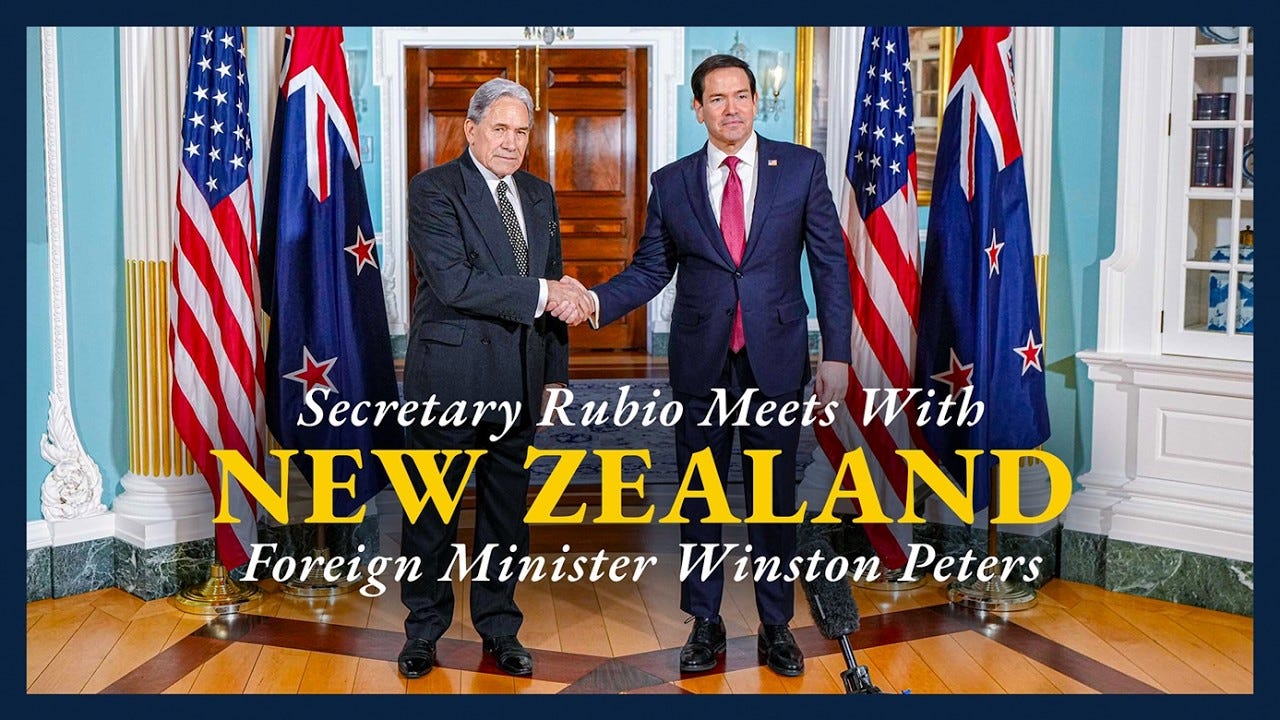
Winston Peters flew into Washington this week. He met with Donald Trump’s Secretary of State Marco Rubio yesterday. He spoke of shared values, of strategic partnerships, of the importance of the relationship between Wellington and Washington in a dangerous world.
He did this while Trump’s war against Iran was escalating dangerously, with the President publicly threatening to annihilate “a whole civilization” if Iran didn’t comply with his demands to reopen the Strait of Hormuz. Peters refused to comment to journalists about whether anyone should take Trump’s words seriously. He wouldn’t answer the question at all. But he described his relationship with Rubio and Deputy Secretary of State Chris Landau as “excellent.”
What Peters did not raise, according to Anna Fifield’s reporting, was the legality of the war. No mention of international humanitarian law. No reference to the Geneva Conventions or the protection of civilians, even as Trump was openly threatening to destroy civilian infrastructure. Peters later told journalists he “didn’t want to channel Helen Clark.”
Basically, the Middle East was burning, with the costs being borne by the rest of the world, and Peters was doing his best impression of a loyal ally.
Commenting on Peters’ trip, Robert Patman, the Otago international relations professor, was blunt, asking: “Is it strategically reading the room correctly to go to a country which has unleashed an illegal war and seek to get closer to it?” Patman warned: “If we continue that form in Washington, that will be seen as complicity and tacit support for what’s happening.”
The Case for a breakup
This week the Listener published a substantial piece by journalist Peter Bale, titled “Is it time to break up with America? Our complex relationship with the US.” It is worth reading carefully. Bale asks the right question, but he doesn’t quite follow it through.
Bale begins with the nostalgic foundation of the relationship. “Nostalgia is not a strong basis for lasting alliances,” he writes, “yet New Zealand’s ties to the United States arguably remain founded on a post-World War II combination of gratitude and envy.” It’s an astute starting point. The relationship with Washington has always mixed sentiment with hard interest. Right now, both look shaky.
He asks the crucial question directly: “What if that alliance between Washington and Wellington is a mirage, or just not worth keeping at any cost — especially as Donald Trump tears up once iron-cast alliances and international norms and institutions the US created after World War II?”
And Bale catalogues the damage. Trump calling NATO allies cowards. Essentially handing over Ukraine to Putin. Threatening Canada. Threatening Greenland. Bombing Iran in the middle of diplomatic negotiations that, by all accounts, were actually going somewhere. “Do we want to be part of erratic decision-making and illegal wars in the Middle East,” Bale asks, “even if Prime Minister Christopher Luxon says he misspoke when he endorsed ‘any actions’ to tackle Iran?”
On the costs of a potential rift, Bale is realistic. A schism might hit tourism, trade, intelligence-sharing. He quotes Professor Robert Patman of Otago University, who says: “If our relationship cooled to the point there was a rift, our policy towards the US might even come to resemble the policy we have towards China. That is to say, relations with Washington would be politically semi-detached.” He also quotes Carl Worker, a former New Zealand ambassador, who believes “Four Eyes” could work — that Australia, the UK and Canada would maintain intelligence exchanges with us, “albeit that it would not include US-sourced material.”
The technology dependency angle in Bale’s piece is important and underappreciated. Don Christie, a New Zealand tech entrepreneur, tells him: “Let’s say the government almost exclusively uses opaque products from the likes of Microsoft as part of its cybersecurity framework... there’s no guarantee right now that the US does not force backdoors... into those technologies, none whatsoever. The cloud comes under US jurisdiction, and that is very clear.”
Peter Thiel’s Palantir — whose AI targeting software helped select thousands of strikes in Iran — is already embedded in New Zealand’s Defence Force and security services. The entanglement runs deeper than most people realise.
Bale also notes the lesson from the 1980s nuclear split. When Lange’s government banned nuclear-capable warships and Washington froze New Zealand out of ANZUS, the fallout was, in retrospect, relatively modest. Five Eyes survived. The relationship, in time, recovered. The sky did not fall. Bale concludes: “The alternative would require a break with the past, a big investment in diplomacy, and a commitment to finding our own way in the world. Brrr.”
Bale flinches a bit at the end. Fair enough. But the answer to his question of “Is it time?” is clearly: “yes”.
The Disaster in plain sight
Let’s re call what’s actually happened in Iran. On February 28, the United States and Israel launched one of the largest military operations in decades. There was no UN authorisation. No convincing case for an imminent threat. And the strikes came in the middle of diplomacy. Operation Epic Fury involved hundreds of Tomahawk missiles, US stealth bombers, two hundred Israeli fighter jets, and five hundred targets. Iran’s Supreme Leader killed in the first wave. And 165 girls killed when a school was bombed in Minab.
Since then: oil above $120 a barrel. The Strait of Hormuz partially blocked. Global shipping disrupted. New Zealand facing fuel supply stress. Fertiliser prices rising, threatening food production. Airlines grounded from Dubai to Doha. Economies shaken across the world.
Trump’s vaguely stated goals — regime change, a new Iran free of the mullahs — remain nowhere near achieved. Six weeks on and the war continues, open-ended, its objectives incoherent. Luke Malpass at The Post put it plainly enough: “Trump does not appear to have achieved what seemed to be the main end of attacking the country — deposing Ayatollah Ali Khamenei, upending the regime and replacing it with one that doesn’t wish death to the US.”
What we have instead is chaos. Trump and his donors won’t really pay for that. Ordinary people will. The costs for Petrol, groceries, and freight spread fast.
The New York Times editorial board called the attack “reckless.” The Guardian’s Julian Borger wrote that it was “an unprovoked attempt at regime change… with no legal foundation, launched in the midst of diplomatic efforts to avert conflict.” Phil Goff, our former Foreign Minister, put it in the starkest terms: “The Government also knows that President Trump’s claim that the US was responding to an imminent threat is false. Like the claim in 2003 that Iraq still possessed weapons of mass destruction… there is no evidence to back the President’s claim.”
This is what New Zealand’s Government has chosen to tacitly endorse.
Peters the true believer
There’s a lazy version of this argument that treats New Zealand’s deference to Washington as pure realpolitik — the calculation that a small country can’t afford to antagonise the superpower, so you swallow your principles and keep your head down. Peters himself has been explicit about this. His famous advice to colleagues: “Don’t complain about what the United States is doing. Try to fit in and get the best deal you possibly can.”
But the realpolitik reading is too forgiving. Peters isn’t simply being strategic. He’s a genuine believer.
His alignment with Trump and the American right runs deeper than diplomatic calculation. He’s parroted Trump’s language on the World Health Organisation — calling its bureaucrats “unelected globalists” when the US withdrew. He’s met with Reform UK board members and talked openly about a shared worldview with the far-right movement upending British politics. He sacked Phil Goff as High Commissioner after Goff made cautiously critical remarks about Trump. He’s remained silent — conspicuously, repeatedly silent — on Trump’s most egregious statements: the belittling of NATO allies’ Afghanistan service, the threats against Canada, the invasion of Venezuela, the Board of Peace. When Trump suggested allied troops “stayed a little back, a little off the front lines” in Afghanistan, Goff noted that ten New Zealanders, including his own nephew, came home in coffins from that war. Peters said nothing.
When Luxon and Peters issued their joint statement on the Iran attack, they condemned “in the strongest terms Iran’s indiscriminate retaliatory attacks” while offering only mild acknowledgement that the US and Israeli strikes were “designed to prevent Iran from continuing to threaten international peace and security.” The only condemnation was directed at the country that had been bombed.
Former Prime Minister Helen Clark called this a disgrace. She was right.
This isn’t neutrality. It’s alignment dressed up as restraint. Anna Fifield has written sharply about the contrast: “When we hide behind the parapet, we harm our national interests.” She points out that Spanish Prime Minister Pedro Sánchez stood up, condemned the war explicitly, was threatened by Trump with trade sanctions, but nothing actually happened. Several European leaders who initially kept quiet have since spoken out. The sky remained in place.
The paywall now starts at halfway through all Democracy Project newsletters. Please take out a paid sub if you want to support this service and access the full content, including the following sections: “Choosing to comply”; “The 1980s lesson, revisited”; “Where New Zealand’s future actually lies”; “On defence: the wrong answer to the wrong question”; “The Answer to Bale’s question”