

Election advertising has to stop at midnight tonight, and Electoral Commission figures show more than 1.44 million New Zealanders had already voted by Wednesday. They, and everyone who votes tomorrow, will have cast their ballots without knowing who financed the outside campaigns aimed at them. RCR Media, Harry Mowbray, the Taxpayers’ Union, the Sensible Sentencing Trust and Hobson’s Pledge have spent the campaign telling voters what to do with their two ticks, and none of them has to name its funders.
The final polls suggest the overhang that some of these campaigns pushed for could still decide the result. Today’s Post/Freshwater Strategy poll has National on 26.4%, down 12 points since 2023 and close to its 2020 low, with the coalition two seats short of a majority before any overhang is counted. Wednesday’s Taxpayers’ Union–Curia poll had the two blocs tied on 60 seats each, with National’s 28.9% worth 35 seats. National won 44 electorates in 2023, and every electorate it holds beyond its party-vote entitlement adds a seat to Parliament. As the Union’s own spokesman, James Ross, said on Wednesday, overhangs “could make all the difference”.
(The “Further Analysis” section after this column looks at the $8.4 million in large donations the parties did have to declare this year, including the donors who funded the governing parties as a bloc and the money that arrived too late to be seen before people voted.)
What the outside money bought
RCR Media, the company behind the online station Reality Check Radio, says its Vote Smart 2026 campaign printed more than a million flyers and ran dozens of billboard sites, full-page newspaper advertisements and digital campaigns. Its full-page Herald advertisements, written by Don Brash and telling right-leaning voters not to party vote National, have run again and again in various forms through the final weeks of the campaign, and Act and NZ First gave written authorisation for the Brash advertisement. Mowbray, whose children founded the Zuru toy company, has said he put money into RCR’s campaign because it was promoting “the same thing that we were working on”, and gave money to social media commentators to boost their posts. The Sensible Sentencing Trust’s “Backing the gangs” billboards were withdrawn after the Greens complained that they imitated Green Party advertising, and Hobson’s Pledge put up a billboard with photos of Chris Hipkins, Willie Jackson and Rawiri Waititi asking “who would really be in control?”, as the Post’s Harriet Laughton reported.
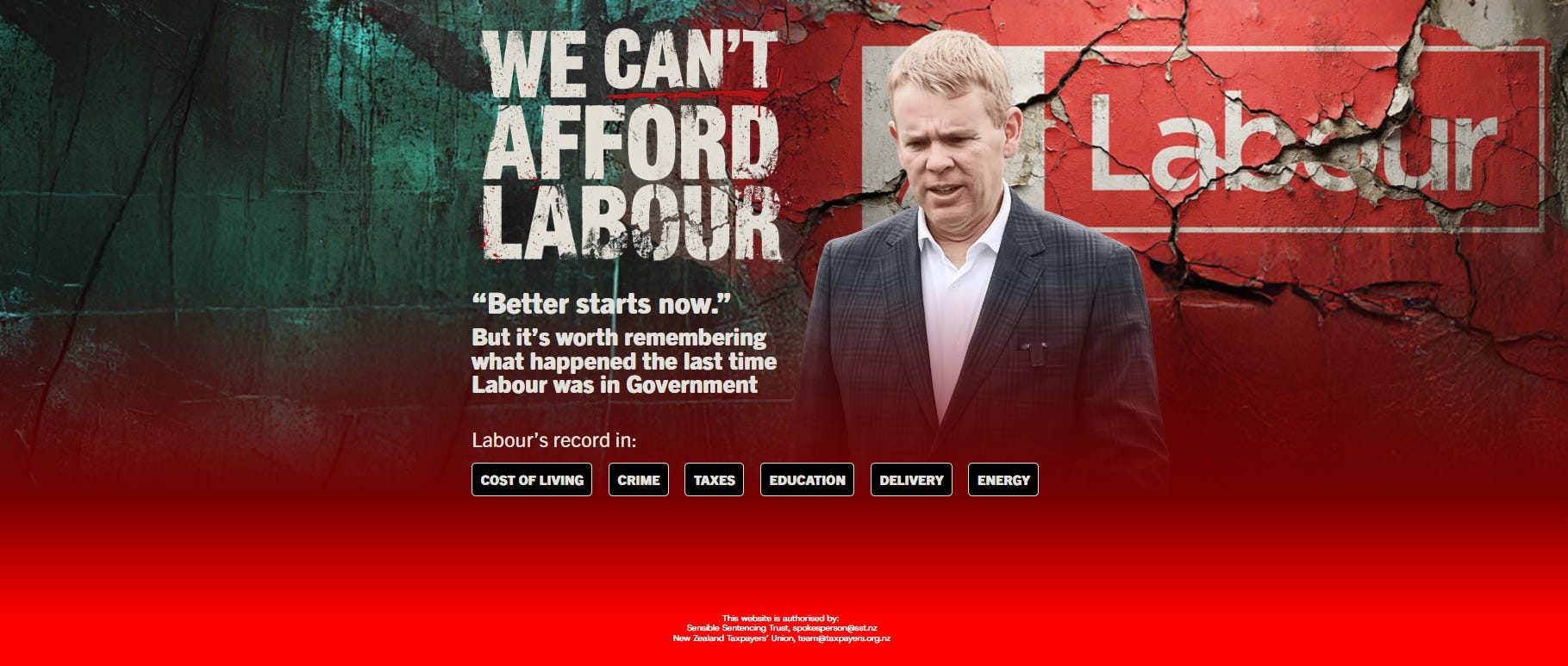
The Taxpayers’ Union, whose annual review promised to “do everything in our power to ensure that Labour does not return to office”, has run its “We Can’t Afford Labour” campaign since mid-October, including an AI-generated video in which Hipkins breaks into homes and takes people’s wallets. In a fundraising email to supporters on Wednesday, Jordan Williams, the Union’s executive director, wrote: “Right now, we’re still short about $34,000 on what we are legally allowed to spend on campaign-related costs.” He also wrote: “$100, for example, puts our ‘We Can’t Afford Labour’ ads in front of 10,000 targeted voters.” Taken at face value, one lobby group had spent or committed about $390,000 of its $424,000 limit with days of the campaign to go.
Mowbray told the Post he believed the campaign “was working and was successful”, but the Post’s Andrea Vance reported today that the Freshwater poll shows the split-vote push “failed to shift the electorate”. Two-thirds of likely Act voters and 42% of likely NZ First voters intended to back another party’s candidate, or an independent, in their electorate, the poll found, compared with 72% of each party’s voters who split their vote in 2023, when NZ First stood in fewer electorates. Any National overhang is therefore likely to come mainly from National’s own slump in the party vote rather than from voters taking Brash’s advice.
What promoters don’t have to disclose
“Third party promoters do not need to declare donations or loans to their campaign,” as the Electoral Commission put it when it published the 2023 returns. Each of this year’s 25 registered promoters can spend up to $424,000, and only those spending more than $100,000 must file a return, which isn’t due until 9 March 2027 and lists expenses rather than donors.
Reality Check Radio, which streams online rather than broadcasting, went quiet in April 2024, saying it had run short of money, and said it needed another $480,000 from donors before it could return. It later resumed, but a station that had to appeal to its listeners to keep going is unlikely to have paid for a million flyers out of its own funds. RCR says Mowbray made a contribution, that others gave amounts “of the same scale or greater”, and that Vote Smart was “conceived, developed and is managed independently by RCR Media”.
Mowbray told Newsroom’s Jonathan Milne that RCR’s Claire Deeks had asked him for $300,000: “I said, Claire, I don’t have bloody $300,000.” He also told Milne that the wealthy people he gathered when setting up Split Your Vote regarded being able to give anonymously as important if they were going to donate. Stuff has reported that he spent around $17,000 on his own campaign, the limit for an unregistered promoter, but his money to RCR doesn’t count against that limit. Police are making enquiries into his Split Your Vote website after a referral from the Commission that followed a complaint from National. Mowbray told the Post he thinks he was referred because he missed a deadline to reply, and no finding has been made.
The links between the groups
The website wecantaffordlabour.nz is authorised jointly by the Taxpayers’ Union and the Sensible Sentencing Trust, and five of its six topic links go to the Union’s website. Yet when the Greens called the Trust a Taxpayers’ Union “astroturf group”, its spokesperson Louise Parsons told RNZ, “We certainly aren’t TPU at all.” A Union spokesperson told RNZ the Union had not created the Trust’s billboards, although the same RNZ report noted that they were made by The Campaign Company, which is owned by Williams. Bermuda Corporate Trustee Limited, a New Zealand company of which Williams is one of two directors, holds 98% of The Campaign Company’s shares, and public records don’t show whose interests the trustee company holds them for. Hobson’s Pledge, whose trustee and authorised representative is Brash, paid the company $34,500 in 2023, according to its expense return.
The Union’s AI advertisement told viewers that “independent tax experts” had described Labour’s capital gains tax as a “money grab on our nest eggs”. In its response to the complaints, published with the Advertising Standards Authority’s full decision, the Union said this referred to analyses by Matthew Gilligan and Troy Bowker, and that the phrase was “a rhetorical summary of the criticism, rather than a purported verbatim quotation from either author”. The Electoral Commission’s register shows that Bowker, a Wellington businessman presented to viewers as an independent expert, has given $125,000 to Act and NZ First this year. The ASA didn’t uphold the complaints, although a minority of its board found the “$18 billion in unfunded promises” claim was “a factual statement that had not been adequately substantiated and was therefore misleading”. TVNZ, which doesn’t take election advertising through automated programmatic bookings, “paused activity” on the deal once it was notified of the complaint, and told the ASA it had since blocked the Union from booking that way for the rest of the election period.
The Union’s polls, including Wednesday’s, are run by Curia Market Research, owned by David Farrar, who co-founded the Taxpayers’ Union and whose clients include National, and Curia’s website lists 2026 polls for the Sensible Sentencing Trust and the Free Speech Union as well. The Herald reports the Taxpayers’ Union–Curia poll, and it live-streamed the Union’s electorate debates, which were billed as the launch of new polls, on pages labelled as advertorial, as a Democracy Briefing in September examined. Williams’ email used Wednesday’s poll result, a tie between the blocs, to ask supporters for money for targeted advertising. Under the Electoral Act, the cost of conducting an opinion poll is not an advertising expense, so commissioning these polls doesn’t count against anyone’s spending limit, although paying to publicise the results can.
A complaint lodged today
Grant McLachlan, an investigative writer who was once an Act researcher and has worked for both Act and National, including as a campaign director, today added to a complaint he lodged with the Electoral Commission on 27 October about whether Mowbray’s website needed authorisation from the parties it promoted. In 2021 he told RNZ’s Ruth Hill that Act had “weaponised” astroturf groups and that senior Act figures had been closely involved when the Sensible Sentencing Trust started, and claimed the Taxpayers’ Union had prepared the ground for Act at the 2020 election. Williams told RNZ it was “ridiculous” to suggest the Union spoke for any party, and the Trust’s founder, Garth McVicar, said he did not believe its cause had been hijacked.
His new complaint ranges across the links between several promoters, and the people it names haven’t yet had the chance to respond. Its most concrete requests concern the We Can’t Afford Labour website, which the Taxpayers’ Union and the Sensible Sentencing Trust authorise together. McLachlan asks the Commission to find out what that joint campaign cost, who paid for it and how the two promoters divided the costs, and to obtain the booking records for promoters’ newspaper, billboard and digital advertising, which could establish who commissioned particular advertisements and when.
He also asks it to tell promoters to preserve their contracts, invoices and messages, and publishers and billboard owners their booking records, before the regulated period ends tonight. A joint campaign is lawful, and McLachlan says he has no figures for 2026 spending and does not claim that any promoter has exceeded its $424,000 limit.
The complaint also identifies a gap in section 204D of the Electoral Act, which bars an unregistered promoter from any arrangement to circumvent its $17,000 limit but doesn’t mention the $424,000 limit for registered promoters. McLachlan argues that Parliament can’t have meant to leave large promoters free to split their campaigns, while accepting that a court might read the section more narrowly, and asks the Commission to report on the gap. Because returns aren’t due until March, he wrote, “Voters will have voted without knowing who paid.”
What the next Parliament should do
In 2023 the Independent Electoral Review recommended that promoters spending more than $100,000 disclose donors giving more than $30,000, keep their campaign money in a separate bank account and face stronger rules against colluding with parties, but none of those recommendations has been adopted. As I have argued in Democracy Briefings since the Review reported, tightening the rules for parties while leaving promoters alone moves the money to the outside groups.
When Transparency International NZ surveyed the parties in October, Labour had promised that “third-party campaigners would disclose donations on the same terms as parties”, while National, Act and NZ First had announced no policy on it. Those three are the parties most of these campaigns were trying to keep in government, and if tomorrow’s count produces a majority resting partly on overhang seats, they will owe some of their power to campaigns whose funders voters were never allowed to see.
The next Parliament should require promoters that spend more than $100,000 to name their large donors before polling day, with the same rule covering union campaigns such as the PSA’s “Change the Government”, and should extend the rule against splitting campaigns to evade spending limits to registered promoters, as McLachlan’s complaint argues, and it should do so early in the term, before money for the 2029 campaign starts flowing to the outside groups.
Dr Bryce Edwards
Director of the Democracy Project
In today’s Further Analysis section after this column: the $8.4 million in large donations the parties declared this year, the donors who backed National, Act and NZ First as a bloc, what some donors say they get for their money, and the donations that didn’t have to be declared before polling day. See: “The $8.4 million the parties had to declare”.
Paid subscriptions fund this research.
