

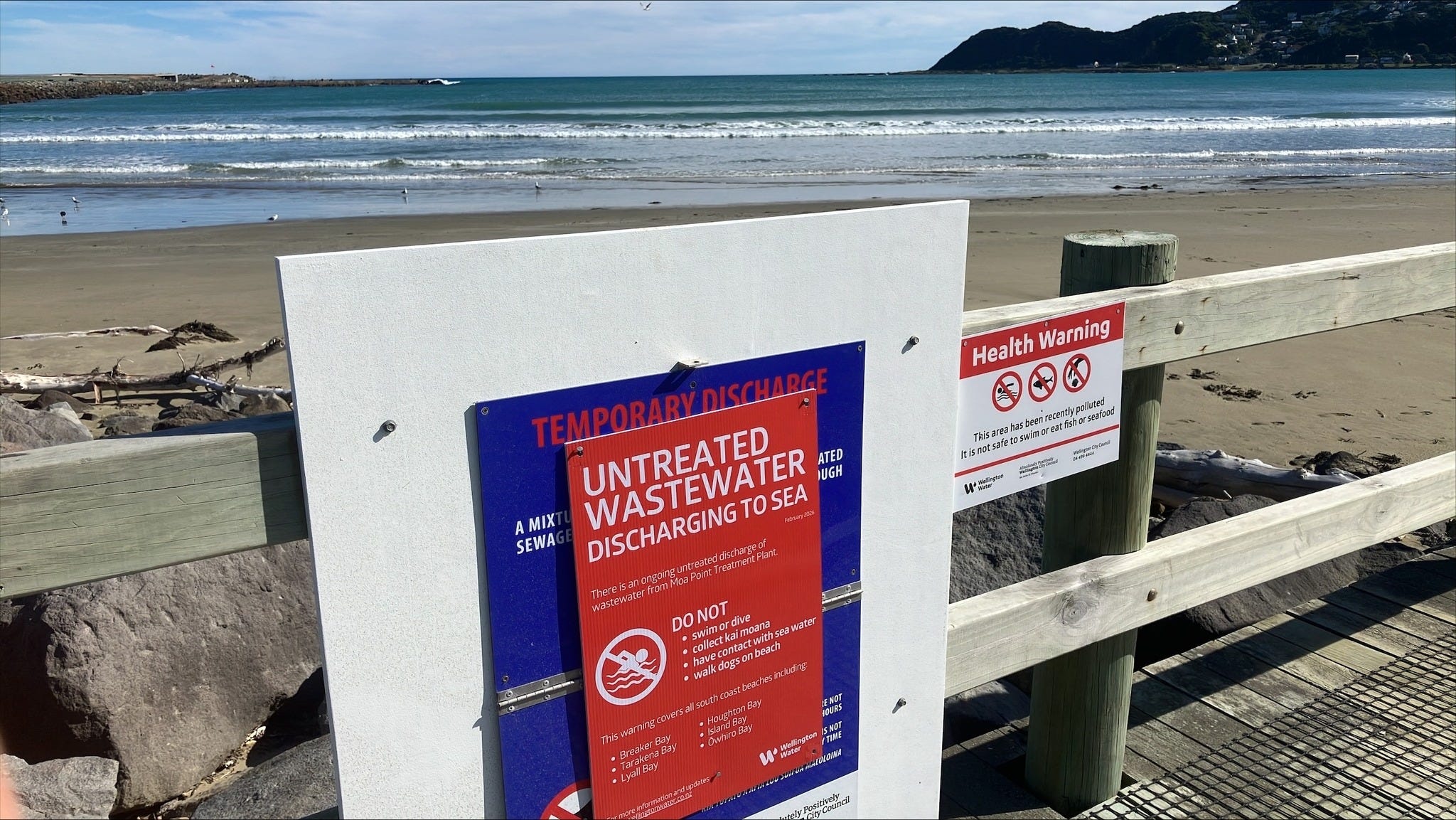
At the height of summer, during the Waitangi Day long weekend, approximately 70 million litres of raw untreated sewage have been pouring into the sea off Wellington’s south coast every day. Not from some Victorian-era outfall that predated modern treatment. From the catastrophic failure of the city’s primary wastewater plant at Moa Point, built in 1998 to end exactly this kind of dumping.
Toilet paper and worse have been spotted swirling in the surf at Tarakena Bay. The smell is unmistakable. Surfers who remember the days before the long outfall pipe was built in 1998 are having flashbacks. Jamie McCaskill from Wellington Boardriders told RNZ about talking to older surfers who recalled “raw sewage, smells on the rocks, on the wall, surfing in barrels with turds in the waves.”
Welcome back to the bad old days. As Andrea Vance wrote in The Post today: “Absolute scorcher of a day, one of the very few in a sh*t summer, and what do we get? Sh*t. Actually. Washing up on the closed beaches we can’t use because Wellington’s harbour is once again swimming in sewage.”
This is not a freak accident. This is the predictable culmination of decades of infrastructure neglect, governance failure, and accountability avoidance. The Moa Point disaster is the most vivid case yet of what I’ve been calling “Broken New Zealand”: a country where public institutions have been hollowed out, private contractors enriched, and basic services left to rot while politicians look the other way.
What Actually happened
In the early hours of Wednesday, during heavy rain and while remedial work was underway at the Moa Point wastewater treatment plant, something went catastrophically wrong. The 1.8km outfall pipe that normally sends treated wastewater deep into Cook Strait backed up. Sewage flooded back into the plant, inundating the facility and destroying critical equipment.
Wellington Water chief executive Pat Dougherty fronted the media with a grim assessment. Asked to rate the failure on a scale of 1 to 100, he gave it “a 90” and added: “I can imagine there’s something worse, but I just can’t quite think of it at the moment.”
The scale of the flooding is hard to comprehend. Dougherty described the scene: “We have a scrubber room at the bottom of the plant. It’s the size of an Olympic swimming pool, and it’s three metres deep in wastewater.” Between 60 and 70 percent of the plant was flooded. Eighty percent of equipment was damaged. Some of it, Dougherty said, “will probably be a write-off, and we may not be able to source from within New Zealand.”
At its peak, 3,300 litres of water and sewage per second was flowing through a short 5-metre pipe directly into Tarakena Bay, just off the coast. The long outfall pipe that would at least disperse the waste further out to sea couldn’t be used because the pumps were destroyed.
Repairs will take months. Beaches could be closed for weeks, possibly longer. Wellington’s brief summer window, already nearly over, has been ruined for anyone who lives near or loves the South Coast.
Mayor Andrew Little called it “a catastrophic failure” and “an environmental disaster.” He added: “It beggars belief in this day and age that there could be such a catastrophic failure.” However, what has happened was entirely predictable.
Years of warnings ignored
The Moa Point plant has been non-compliant with its resource consent conditions for almost every month since January 2024. Wellington Water Committee papers from December show the facility passed compliance checks in only two months out of 24. Issues included unconsented discharges, odour problems, and multiple faecal coliform exceedances. Of the four Veolia-run plants in the region, Moa Point was the only one that never achieved a single “green” rating in that period.
This was not a secret. The warnings were documented, reported, and ignored.
A 2021 review commissioned by Wellington Water itself painted a damning picture of the plants’ operations. It found “understaffed plants, inexperienced operators and a lack of executive oversight, leaving frontline teams to deal with complex process failures on their own.” The same review found that the contractor operating the plants, Veolia, “failed to carry out basic asset management, including regular maintenance.”
Equipment was described as “obsolete and outdated and prone to failure.” Spare parts were hard to source, with long delivery times. There was “no clear responsibility for monitoring critical equipment or leading renewal programmes.”
A follow-up 2023 report from engineering firm Stantec focused specifically on Moa Point and warned that the plant was “highly exposed” during upgrade work that reduced its capacity. The report predicted increased bypass events where partially treated or untreated wastewater would be discharged into the ocean.
Vance noted the irony: “To layer irony onto irony, the plant meant to treat wastewater became a giant sewage geyser in the middle of an upgrade.”
The catastrophe happened while they were supposedly fixing the problems.
Wellington Water Committee chair Ros Connelly was blunt about what this represents: “the chickens coming home to roost after decades of underinvestment in water infrastructure.”
This is true, but underinvestment is only part of the story. The other part is who was responsible for operating these plants, and why they kept the contract despite years of documented failure.
The Veolia problem
Veolia is a French multinational that was contracted in 2017 to operate Wellington’s four wastewater treatment plants: Moa Point, Seaview, Western, and Porirua. The contract is worth approximately $17 million per year over ten years, roughly $170 million in total. When Veolia won the work, they promised “international capability and excellence.”
Independent reviewers found those promises largely unmet.
The 2021 review was triggered by an incident at the Porirua plant where a member of the public, not plant staff, spotted discoloured water near the outfall. That was the tipping point after what the report described as “repeated failures to lift performance.” Wellington Water had already issued multiple warnings, infringement notices, and abatement notices to Veolia over the previous 18 months.
The review condemned not just Veolia’s operations but the dysfunctional relationship between Veolia and Wellington Water. Trust had “evaporated, undermining problem-solving.” Veolia staff described their treatment as a “master-slave relationship.”
Despite all this, the review recommended retaining Veolia. Why? Because of “the high costs and risks in terminating the $170 million contract.” Too big to fire.
As Vance put it in her Post column today: “This French-owned company turns pooh to gold. It also manages services for councils across the country, including Auckland, Whanganui, Ruapehu, Central Hawke’s Bay, and Queenstown.”
And Veolia’s track record extends beyond Wellington. In Queenstown, a 2023 cryptosporidium outbreak led to a months-long boil water notice. A malfunctioning sewage disposal field saw partially treated, toxic sewage discharged for months into the protected Kawarau River, prompting the Environment Court to order an urgent fix. The Seaview plant in Lower Hutt is notorious for lingering odour problems dating back years. Just last month, partially treated sewage was released into the ocean after a mechanical failure there.
Yet despite this record, Wellington Water has confirmed that all existing contracts, including Veolia’s, will roll over to the new Tiaki Wai regional water entity when it takes over in the middle of this year.
Ratepayers might reasonably ask: why are we locked into contracts with companies that consistently underperform? Why does failure get rewarded with contract renewal?
Not just Wellington
It would be comforting to treat this as a Wellington problem, the inevitable result of the capital’s notoriously dysfunctional council politics. But the infrastructure crisis extends far beyond the Moa Point plant.
Vance laid out the national picture starkly: “Across New Zealand, water infrastructure is a multi-billion dollar fiasco of epic proportions.”
Consider the evidence put forward by Vance: Wellington loses 45% of treated water to leaks before it even reaches taps. Auckland’s systems overflow during heavy rain, regularly closing beaches. Christchurch’s Bromley facility has been plagued by odour crises. Dunedin has had elevated lead levels in its water. Nationally, 22% of all water leaks away before reaching households.
And the worst example remains Havelock North in 2016, where contaminated water killed four people. That was nearly a decade ago. The lessons were supposedly learned. Yet here we are.
Kara Puketapu-Dentice, chief executive of Taranaki Whānui, put it plainly to RNZ: “It is like we have got Third World infrastructure in a First World country and our environment is suffering because of that.” She’s right to be angry. We all should be.
Who should be held accountable?
Mayor Andrew Little has promised an investigation and pledged to make the findings public. But in the same breath, he claimed: “There’s been nothing indicated to me in the time I’ve been mayor or even before that that is a plant that’s at risk.” This is hard to square with the documented record of non-compliance, the scathing reviews, and the years of warnings.
Finance Minister Nicola Willis said “someone will need to be held accountable” and asked the obvious questions: “Is this because the plant wasn’t constructed properly? Were there not enough checks and balances put in place? Has it been an operational error? What’s caused this?”
Good questions. But accountability in New Zealand has a way of being diffused until no one is responsible. Reviews are commissioned. Lessons are learned. And then it happens again somewhere else.
The political context makes genuine accountability even less likely. The previous government’s Three Waters reforms, which would have consolidated water management into larger regional entities with greater capacity, were repealed. The replacement, “Local Water Done Well,” creates 42 separate entities instead of 10. Meanwhile, the current Government is capping council rate increases at around 4 percent, limiting local authorities’ ability to fund the very upgrades needed to prevent disasters like this. At the same time, Vance points out today that planning rules are being eased to turbocharge housing growth, leaving councils to manage thousands of new homes on top of crumbling water systems.
There are also serious questions about Wellington Water’s own governance. Reports last year revealed the organisation was overpaying contractors, sometimes by multiples of what other councils paid for similar work.
Nick Leggett’s role warrants particular scrutiny. He’s Wellington Water’s Board Chair, who simultaneously serves as CEO of Infrastructure New Zealand, an industry lobby group whose members include Veolia NZ. As I argued in my March 2025 column on Wellington Water, the conflict of interest is glaring: the man chairing the body that spends ratepayer money on infrastructure also leads the organisation that represents the companies receiving that money. These issues deserve deeper examination in a subsequent column.
But the pattern is already clear. Warnings ignored. Maintenance deferred. Contracts with underperforming companies protected. And when disaster finally strikes, a scramble to assign blame that somehow never results in anyone facing real consequences.
The Environmental cost
While the political blame game plays out, the environmental damage continues.
Dr Christopher Cornwall, a senior lecturer in marine biology at Victoria University, warned that the sewage spill has the potential to be “a large ecological disaster that would take many years to reverse.” The worst-case scenario involves the destruction of the native kelp forests that marine life depends on. Pāua, he noted, are especially sensitive and “lose their ability to grasp onto the reef when exposed to fresh water from the sewage, causing death.”
The Taputeranga Marine Reserve, one of the best in the country, sits directly in the impact zone. The Department of Conservation has warned that mussels, kina, pāua, sponges, fish, and penguins could all be at risk.
This is what decades of neglect and deferred maintenance produces. Not just closed beaches and ruined summers, but potential long-term damage to ecosystems that took generations to develop.
The sewage will eventually stop flowing. The beaches will eventually reopen. Politicians will express concern and promise reviews. And unless something fundamental changes, we will be here again in a few years, asking the same questions about a different infrastructure failure in a different part of the country.
This is “Broken New Zealand”: Infrastructure neglected, warnings ignored, vested interests protected, accountability avoided, and ordinary people left to deal with the consequences, whether that’s sewage on their beaches, lead in their water, or the knowledge that the systems they depend on are held together with good luck and deferred maintenance.
The question is whether anyone will be held responsible this time. Based on past experience, I wouldn’t count on it.
Dr Bryce Edwards
Director of the Democracy Project
Further Reading: