

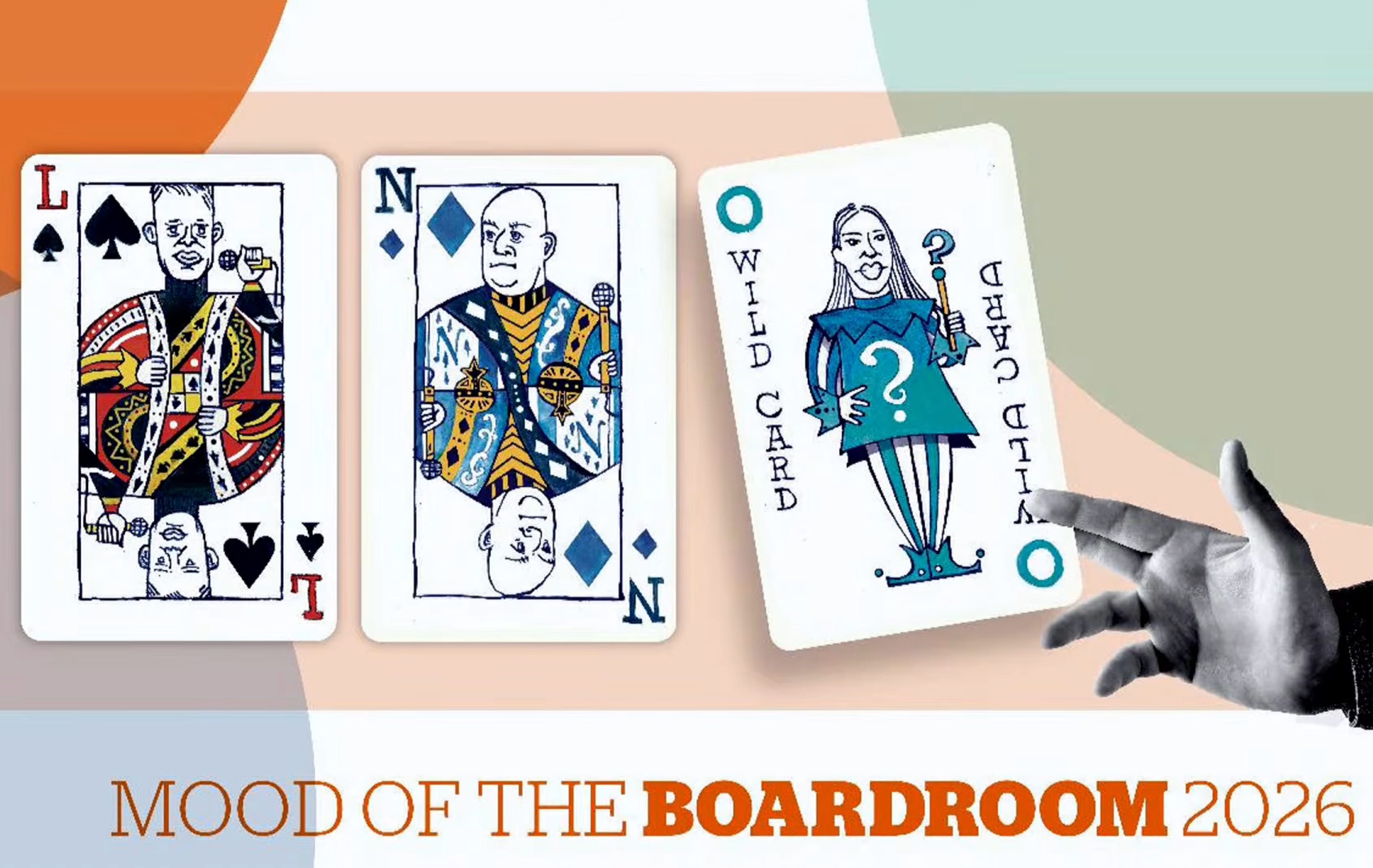
Business leaders are hard to impress this election. In the Herald’s annual “Mood of the Boardroom” survey, they give poor or middling marks to almost the whole political class, including the two former business executives running the Government’s economic policy, and several ratings are among the worst in the survey’s records. Competence and delivery obviously count, but the comments also show some respondents marking politicians down for taking on business interests.
This year’s survey, released on Thursday, of 150 business leaders (130 chief executives, 12 company chairs and the heads of eight business organisations) ran from 21 September to 16 October. They rated politicians out of 5 and answered questions about coalitions.
Two former executives, lukewarm marks
Writing from the big-business right, the New Zealand Initiative’s Oliver Hartwich points out that Christopher Luxon ran Air New Zealand and Nicola Willis was a senior Fonterra executive before they entered politics. “Rather than cheerleading for the National leadership,” he writes, “the business community gave them a mixed, even lukewarm, evaluation.”
Just 11 of the 27 ministers score 3/5 or more, led by Erica Stanford (4.38) for the third year in a row and Todd McClay (4.12), credited with the India trade deal. Luxon ranks 13th, on 2.93/5, after coming 15th last year. In the survey’s results back to 2014, no other prime minister has ranked lower than Jacinda Ardern’s 12th in 2022, although her score of 2.30 was lower than Luxon’s. Willis ranks ninth, on 3.17/5. Finance ministers are usually the boardroom’s favourite or second-favourite minister, and Willis’ placings over the last two years are the lowest for a Finance Minister in those records.
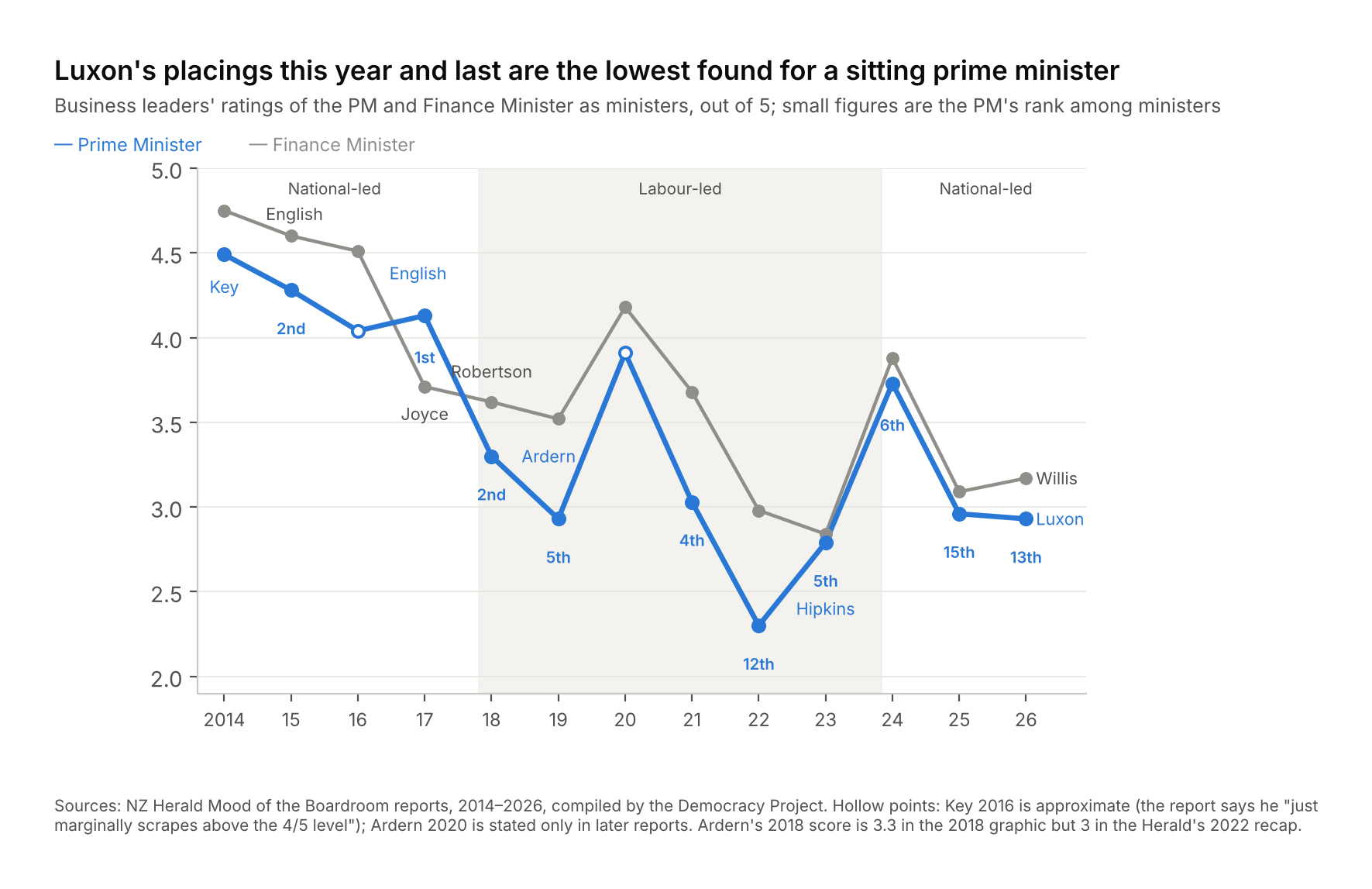
Luxon does best for promoting New Zealand business internationally (4.31), but scores only 2.12 for his ability to unite the country behind a national ambition. Willis does better on other measures. Some 74% say she is a credible Finance Minister, and 60% named her as someone they would trust to manage the economy through another global shock, narrowly ahead of Luxon on 57%.
Marked down for taking on business
The low marks come even as business optimism about the economy is improving, with the survey’s measure at its highest since 2016. One company chairperson was blunt about Willis: “Beating up on the banks, gentailers, Foodstuffs and other successful New Zealand businesses is cheap politics and not in the country’s interests.”
Hartwich links better marks to both better ministers and “fewer anti-business policies”. But his own examples of what irritates business include Willis’ moves on banks, power companies and Foodstuffs, and those businesses and their customers do not necessarily want the same things. A minister could receive a worse survey score for a reform that benefits the public. Hartwich, of course, heads a think tank funded by its business members, and its chair, Roger Partridge, has disclosed that these include Foodstuffs and Woolworths.
Labour: Edmonds and McAnulty stand out
Business leaders still prefer Luxon by a wide margin. Asked who would best drive growth as Prime Minister, 65% chose Luxon and just 3% Chris Hipkins. Luxon also leads on trustworthiness (3.49 to 2.57), although Hipkins beats him on political management, by 3.23 to 2.31.
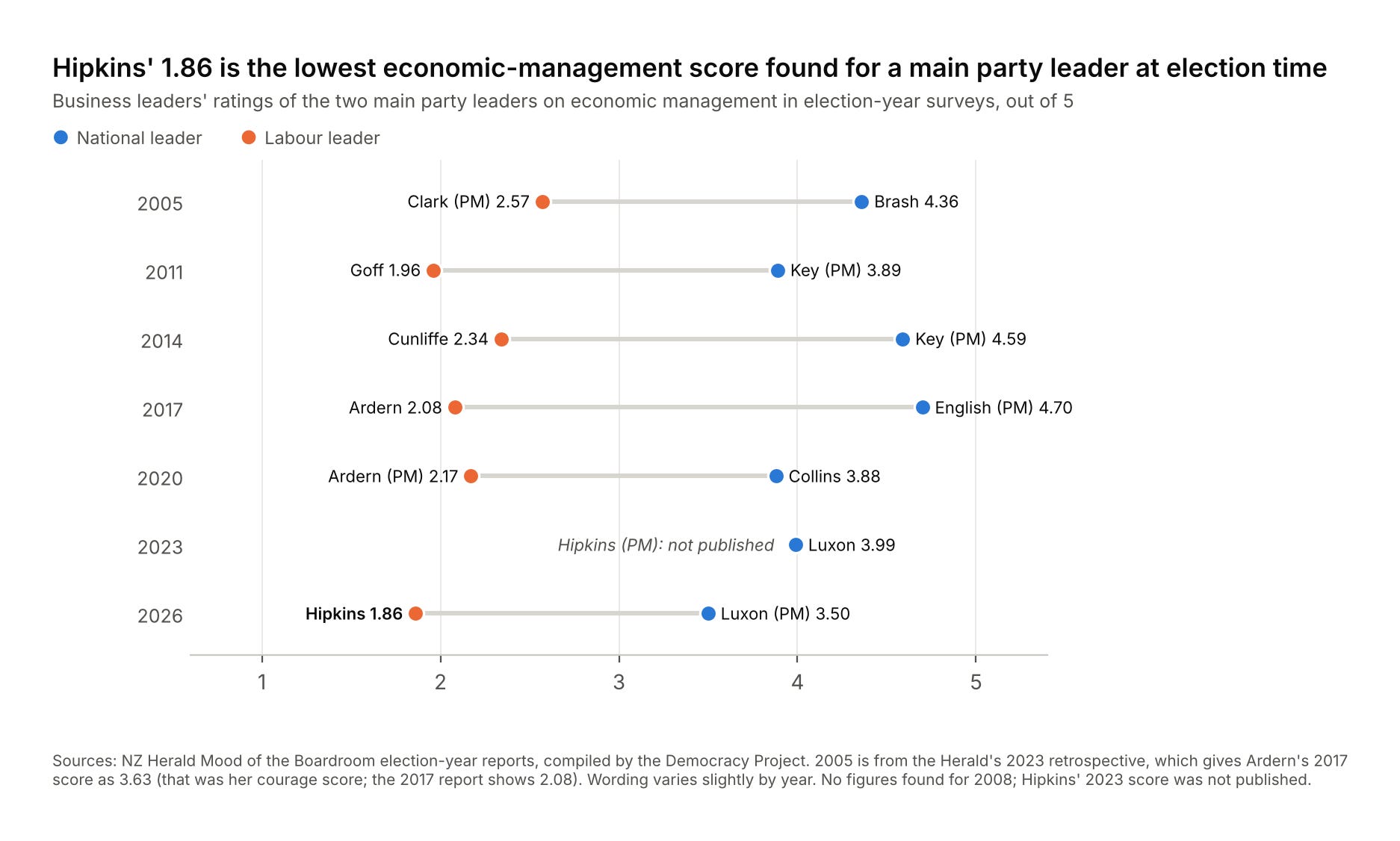
Hipkins scores 2.14 for his performance as Labour leader, after 2.01 last year, the lowest for a Leader of the Opposition in those records. The biggest gap is on economic management, where Luxon scores 3.5 and Hipkins 1.86. No main party leader scored lower in the five earlier election surveys with comparable figures, going back to 2005. The previous low was Phil Goff’s 1.96 in 2011, and Jacinda Ardern scored just 2.08 in 2017, weeks before she became Prime Minister.
Voters see Hipkins differently. In a Post/Freshwater Strategy poll, 41% trusted him to make the right decisions about the economy, compared with 32% for Luxon. But only 12% of business leaders think he has built the cross-party relationships needed for a cohesive alternative government.
Barbara Edmonds and Kieran McAnulty are the exceptions. Edmonds tops Labour’s frontbench on 3.39, with McAnulty close behind on 3.31. Some 55% regard Edmonds as a credible Finance Minister, little changed from 53% last year, and she told the survey launch: “Credibility should be earned, not assumed. So let me earn it.” Business has rated a Labour finance minister highly before: in 2020, during the pandemic, 91% judged Grant Robertson credible. But as Graham Skellern reports, some respondents doubt she could resist pressure from further left, which suggests part of her appeal is as a possible brake on the left.
The smaller parties
Act is business’ second-favourite party, with 30% saying it has the best policy mix, and 59% say David Seymour has made the Government more business-friendly. But its Treaty politics draws criticism, including from Hayden Wilson of Dentons, a sponsor of the report. Winston Peters falls from second among ministers to seventh, and only 13% think he should have a stint as Prime Minister if NZ First holds the balance of power. “Winston is now in the Trump-Biden twilight zone. He needs to gracefully step aside,” wrote one respondent.
The Greens have lost ground. Just 26% think Chlöe Swarbrick and Marama Davidson have positioned the party as a credible partner in a Labour-led government, down from 47% for James Shaw and Davidson in 2023, and no respondent says it of Te Pāti Māori’s co-leaders. Opportunity gets a better hearing. Some 41% think Qiulae Wong has positioned it as a credible coalition partner, and 46% think Luxon was wrong to rule it out.
A warning for the next government
National likes to think of itself as the party of business, but it has lost much of its standing in the boardroom. Its leaders’ rankings have fallen since 2024, and the share of business leaders saying it has the best policy mix has dropped from 70% in 2023 to 53%. Comments like the chairperson’s suggest some of this comes from the times National took on business, over supermarkets, banks and power companies.
Yet the supermarket plan has more public support than opposition. A Talbot Mills poll commissioned by Foodstuffs itself found 45% in favour and 38% against. Whoever forms the next government will face the same choice, and politicians who challenge business interests can expect to be marked down for it in next year’s survey.
In today’s “Further Analysis” below after the paywall (“What business thinks of the parties’ election policies“), I look at the 99 election policies business leaders scored in the Mood of the Boardroom report, the opposition ideas they like, and why the country’s biggest companies rate National’s supermarket plan below Labour’s capital gains tax.
Paid subscriptions fund this research.
———————————————
