

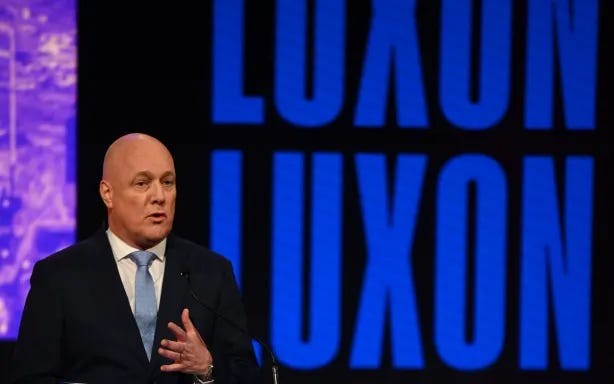
Christopher Luxon has two more head-to-head debates with Chris Hipkins before voting begins, on Three next Wednesday and on Stuff the following Tuesday. And he goes into them knowing that last night’s TVNZ debate was one of his better performances. The Herald’s Thomas Coughlan thought Luxon “actually put in a good performance tonight, maybe his best”, before adding however that “even when Luxon is at his best, he still loses.” TVNZ’s studio panel of undecided voters split 49% for Hipkins and 24% for Luxon.
Most commentators gave the debate to Hipkins on points, and it exposed problems that Luxon will carry through the last month of the campaign. The most useful question now is what last night’s debate told us about how Luxon and National are going. Here’s my list of standout issues and questions that arose from Luxon’s performance in leaders debate that will have an ongoing impact on the campaign and the election outcome.
1. Can Luxon win an election about the cost of living?
BusinessDesk’s Dileepa Fonseka noted that Luxon “was at his best on the issues of education and then law and order where Hipkins was forced to backtrack on previous stances.” But as Fonseka went on to say, “The difficulty for Luxon is that those last two issues are not the ones around which this election is principally being fought.”
He cites September’s Ipsos Issues Monitor, which had inflation and the cost of living as a concern for 63% of voters and healthcare for 44%, with education “so much further down the list”. National would rather fight on school results, gangs, consenting reform and the India trade deal, while voters seem set on an election about groceries, power bills, healthcare and whether their own lives are getting any easier.
Hipkins reached for what Fonseka called “the well-worn simple one asked by political parties of the centre: are you actually better off than you were three years ago?” When Tame put the same question to Luxon, he said people were “better off than they would have been if Chris had stayed in charge”, while acknowledging that the last three years had been very challenging. Fonseka thought Luxon “potentially had a point”, but Hipkins “was also able to rattle off a definitive wishlist of what he planned to do about the issue”.
Maurice Williamson, the former National minister, called Luxon’s answer bland on Duncan Garner’s post-debate show. In Williamson’s view most New Zealanders feel worse off than they did three years ago, much of it for reasons outside the Government’s control such as fuel prices, and a finance minister should admit as much and promise to get them back. His argument was that the Government should acknowledge what people feel before explaining what it has done and why things should improve. That might be a better starting point than trying to convince households the recovery has already arrived.
Health shows why that admission has become so hard for Luxon. RNZ’s Farah Hancock recalls that in the 2023 TVNZ debate he called it “quite outrageous” to suggest there was “no crisis” in health. But yesterday it was Hipkins who used the word, six times about staffing and hospitals, while Luxon preferred to say the system “is challenged”. Having described a crisis in opposition, he now has to persuade voters it is being fixed.
The Post’s Henry Cooke thought Luxon “has a strong story to tell on the perils of Labour’s planned cancellation of Investment Boost”, but that choosing the Coronet Peak ski field to illustrate it “was not wise”, because “A lot of Kiwis cannot afford to go to Queenstown to ski”. The Herald’s Audrey Young also pointed out that Investment Boost “was funded in last year’s Budget by cancelling pay equity claims of largely low-paid women who work in places such as rest homes.” Coughlan found that Luxon’s “habitual clumsiness didn’t help him”, citing the way he “celebrated interest rates going down. Rates are down from where they were under Labour, but they’re heading up.”
As seen above with Maurice Williamson, some of the sharper criticism of Luxon after the debate came from the political right. Similarly, broadcaster Chris Lynch complains Luxon’s instinct “is to explain the economy like a chief executive explaining the quarterly numbers. There is logic behind what he says, but politics requires something more than competence. People need to believe you understand what their lives actually feel like.” Lynch contrasts that with Hipkins’ account of watching shoppers put items back at the supermarket checkout, which he says “felt genuine” and turned “an economic argument into something human”.
2. Can Luxon attack Labour’s costings without his own?
National has spent weeks warning, on billboards and through its spokespeople, about Labour’s “nine new taxes”, yet Newsroom’s Marc Daalder counted Luxon using the phrase “just once, in his opening remarks”. Luxon preferred to call Labour’s promises unfunded, four times by RNZ’s count, and Newsroom’s Mark Jennings reported that “Tame told him several times to stop it but Luxon largely ignored him.” Daalder wondered whether the tax attacks were “proving less effective than National had hoped” and, if so, “what will the party replace such a core plank of its campaign with?”
The likeliest replacement is the question of how Labour would pay for its promises, which seemed to work on part of TVNZ’s panel. Newsroom’s Mark Jennings reported that this apparently worked with at least some of TVNZ’s selected voter panel. A senior production executive told him women had moved from favouring Hipkins towards Luxon. Why? “Money,” she said. “They believed him when he said, ‘Where is the money coming from?’”
Fonseka, though, described it as “a question Luxon repeatedly tried to inject into the debate, but one which could just as readily be asked of him: how will the next Government afford the promises of the 2026 election campaign?” National still hasn’t published a fiscal plan, and Coughlan suggests that as a result “Luxon may very well have lost on the issue of fiscal credibility.” Economist Brad Olsen made the same point on TVNZ’s Breakfast today: “It’s pretty hard for anyone to figure out where they’re going because we don’t have it.”
3. Are National’s own voters with Luxon?
Vote Compass, which surveyed 6467 viewers about the debate, had Hipkins ahead by 44% to 25%. As 1News’ James Ball reported, “while Hipkins had the support of 86% of Labour voters, only 66% - just under two-thirds - of National supporters picked Luxon.” Act supporters gave Luxon 54%, and NZ First supporters split three ways, with 34% for Luxon, 33% saying neither and 22% for Hipkins. These result suggest Luxon struggled to rally even the voters who already lean his way.
For a party on 25.9% in RNZ’s Reid Research poll, which Fonseka calls “its weakest result in years”, a soft base is a serious problem, even if the 1News-Verian poll had National on a healthier 29%. Coughlan has already raised the leadership question: “With Luxon’s leadership a perennial issue, yesterday’s debate does make you wonder whether an ex-staffer like Chris Bishop or Nicola Willis, with their decades of policy experience, might have done a better job.”
The Herald’s Shayne Currie wrote that Luxon “grew into the debate and finished much more strongly”, but on Breakfast, political commentator Esther Robinson set a harder test: “the question really is not who won the debate, but whether National and Labour are able to bring more voters back from those minor parties. I’m not sure last night did enough to do that.”
The paywall now starts partway through all Democracy Project newsletters. Please take out a paid sub if you want to support this service and access the full content, including the following sections:
4. How firm is the Opportunity rule-out?
5. Can Luxon give a straight answer?
6. What happens next?