

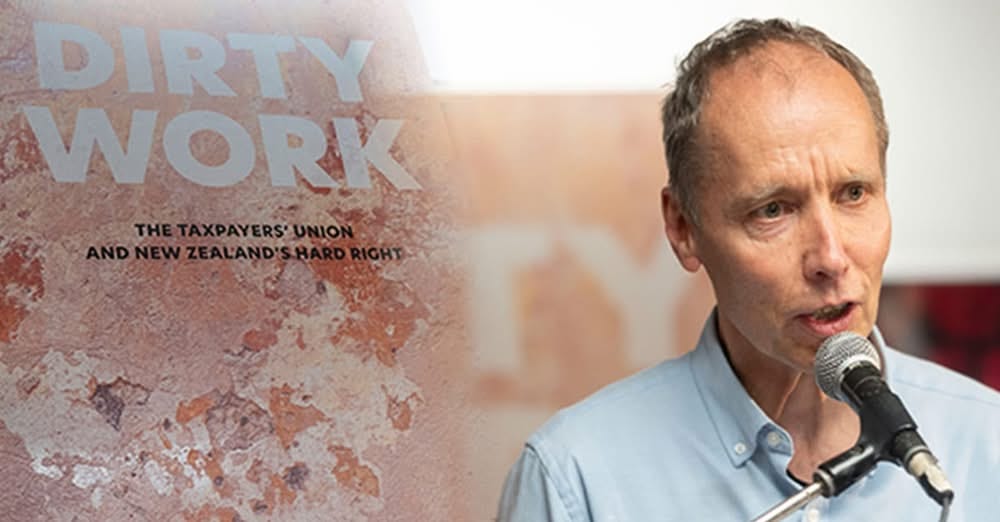
Nicky Hager’s new book, Dirty Work: The Taxpayers’ Union and New Zealand’s Hard Right, was launched last night in Wellington. Copies sold out within about 20 minutes, and the rest of the country won’t be able to buy one until it hits bookshops tomorrow. In the meantime, a handful of copies are being passed around Parliament and the Beehive, and everyone else is relying on second-hand accounts.
So here’s a chapter-by-chapter guide to what’s in it. This is the first of a number of Democracy Briefings I’ll write on the book. It’s a bit different in format from my usual columns, with my own reactions woven through a summary of what Hager alleges. Later I’ll publish a second column on the reaction, including the Taxpayers’ Union’s fightback and Hager’s responses.
I should say where I’m coming from. In 2015 I gave expert evidence in Hager’s legal challenge to the police raid on his home, describing Dirty Politics as “a work of public importance”. Before Hit & Run came out in 2017, I wrote that “the real value of Hager’s work is that it enhances the democratic process.” I still think that. But I’ve never thought his work should be taken on trust, and that matters more with this book than with his others.
Preface: The book Jordan Williams summoned into existence
In July 2023 the Union issued a defensive press release about a book it believed he was preparing. He says there was no such book, or even a plan for one. But the publicity prompted a former insider to contact him. Others followed.
Dirty Work rests principally on interviews with former staff and associates, most of whom, Hager says, are National Party members. Some supplied internal papers. He presents them as people troubled by methods and behaviour they had witnessed on their own side of politics.
That makes this a different kind of investigation from the large documentary leaks behind The Hollow Men and Dirty Politics, the earlier books in what Hager calls a trilogy. Some claims rest on former employees’ recollections, others on documents and public records. At points, Hager draws his own conclusions from that material.
Chapter One: Roll, Jordan, Roll
The book opens at Alan Gibbs’s property overlooking the Kaipara Harbour, where wealthy supporters gathered to celebrate the Union’s tenth anniversary in November 2023. The new National–Act–New Zealand First government had just taken office. British Conservative peer Daniel Hannan praised Williams and his Stop Three Waters campaign, borrowing the refrain “Roll, Jordan, roll”.
Hager then rewinds to Williams’s political education under Don Brash, Simon Lusk, Cameron Slater and Stephen Franks. The 2011 Vote for Change campaign against MMP becomes an early model for his subsequent work: a small, professionally organised political operation presented as a broader public movement.
The day after the February 2011 Christchurch earthquake, Williams contacted Slater about preparing the public for spending cuts to pay for the rebuild. In the exchange Hager recounts, their discussion moved through public-sector wages, arts funding, Working for Families and interest-free student loans. Williams urged Slater to consider “what sacrificial lambs we can slaughter”.
In Hager’s account, the Union’s foundation in 2013 gave these politics a more respectable vehicle. Stories about supposedly absurd spending could undermine confidence in public provision and prepare the ground for much larger cuts. Hager quotes former campaigns manager Louis Houlbrooke from the Union’s tenth-anniversary book: “Politics is as much about emotion as logic.” Houlbrooke argued that people often found small amounts easier to relate to than millions or billions.
Hager contrasts the repeated attacks on arts funding with the Union’s limited campaigning against the favourable electricity arrangements enjoyed by Rio Tinto’s aluminium smelter. This is because on the day of the Union’s launch, Farrar cited the $30 million subsidy to Rio Tinto, the smelter’s owner, as an example of government waste he had been working on for years. Hager says the Union then did almost nothing about it for 11 years. This is the question that has concerned me in examining “Broken New Zealand”: which costs to the public attract sustained outrage, and which powerful interests escape it?
Chapter Two: False and Spiteful Words
Hager notes that the saga of the Conservative Party leader Colin Craig is mostly remembered as a battle between “two unlikeable men”. He treats it as a guide to Williams’ character, and leans heavily on the court record to make his case. In late 2014, Williams assured Craig’s former press secretary Rachel MacGregor that he would keep her allegations confidential. He then shared them with Conservative Party officials, embellishing some along the way, and fed anonymous posts to Whale Oil under the name “Concerned Conservative”. Justice Sarah Katz found that his claim to have seen sexually explicit texts from Craig was untrue. MacGregor had asked him in writing not to use her material against Craig, and he launched his campaign the next day.
Williams won a $1.27 million jury award in his defamation case against Craig, one of the largest defamation awards in New Zealand history. Justice Katz set it aside as a miscarriage of justice. Hager writes that Williams ultimately didn’t receive a dollar, and instead made a payment to Craig and apologised.
The second theme is Williams’ attitude to women. Former staff say he loudly rated women’s looks in the office and commented on colleagues’ bodies, and Hager says a striking number of them used the word “gross”. Hager also claims the Union’s board paid out at least one sexual harassment case against Williams, which is the book’s most serious allegation. Williams and chair Ruth Richardson categorically deny it, and Richardson says “there have been no claims, let alone settlements”. Hager says he has two solid sources. I’ll look at that dispute properly in my next column.
Chapter Three: Using Racism as a Political Tool
This is the book’s central political chapter. Hager argues that Stop Three Waters transformed the Union from a relatively modest pressure group into a substantial campaigning force.
For its first eight years, the Union had much less impact than Williams and Farrar wanted. Staff told Hager that its “subscribed supporters” were mostly people who had clicked on a petition. By 2021, staff say, Williams was bored and wanted more influence and more money.
On 30 June 2021, staff scanning the week’s news for subjects they could beat up into stories spotted a government announcement about funding for council water services. Nobody expected much. The Stop Three Waters campaign launched on 28 September, and it took off. The petition went from 1,325 signatures on day one to more than 100,000 by December. Hager says 70,000 of those arrived in the five weeks in which the Union began its “asset grab” and co-governance rhetoric. The Union’s supporter list jumped from 60,000 to more than 150,000.
One former staff member recalls Williams watching the numbers climb and asking, “How can we make money from this?” By 2022, another said, money was “pouring in like a pokie machine”, and Williams was constantly refreshing the online banking.
Hager also describes an internal fight in 2022. He says Farrar wanted the Union to weigh in more on Māori issues, and staff pushed back, saying that wasn’t the Union’s mission. Staff told Hager that chair Ashley Church resigned because he disagreed, and his successor, Laurence Kubiak, later wrote that co-governance had been “huge for us”. Farrar says Hager is wrong on both counts. He denies pushing the Union towards Māori issues, and says Church had resigned before the mission statement was changed.
Hager says Hobson’s Pledge paid Williams’ Campaign Company $60,000 a month during 2023. Staff say Williams used income from those ads to buy a Jaguar, which is owned by the Campaign Company but used only by him.
This matters most for the parties. Hager argues that in his first six years in Parliament, David Seymour steered clear of race politics. He campaigned instead on housing, education, youth crime and euthanasia, and even appeared on Dancing with the Stars. When Brash asked him to join a campaign against the He Puapua report, Seymour said no. Brash told an associate that Seymour’s reason was that “there are not enough votes in race”. Once the Union showed there were votes and money in it, Hager says, Act followed, all the way to a referendum on the Treaty.
Christopher Luxon initially resisted Williams’s attempts to make Three Waters primarily about Māori involvement. In an October 2021 podcast interview, Luxon explained that iwi representation on a group involved in appointments did not amount to direct control of water operations. Hager follows Luxon’s subsequent shift towards campaigning against co-governance, arguing that pressure from the Union and its allies helped bring it about.
The paywall now starts partway through all Democracy Project newsletters. Please take out a paid sub if you want to support this service and access the full content, including the following sections:
Chapter Four: The Jordan Williams Show
Chapter Five: The Apprentice
Chapter Six: Big Tobacco and the Taxpayers’ Union
Chapter Seven: Follow the Money
Chapter Eight: Who Supports the Taxpayers’ Union?
Afterword: The media as enablers