

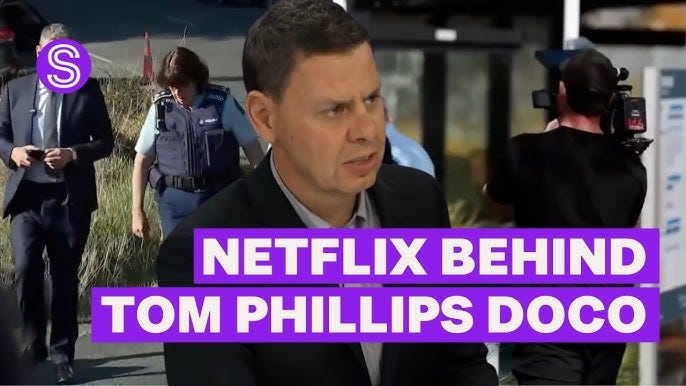
There is something rather dystopian about a public police force collaborating with a global streaming giant to turn an unfolding family tragedy into carefully produced entertainment. That is what the controversy over the Netflix documentary on the Tom Phillips case has become: a debate about whether New Zealand Police crossed a line when they entered into formal arrangements with commercial filmmakers while a highly sensitive investigation was still live.
It has taken good journalism to drag the full picture into view. This week, Stuff’s Paddy Gower and RNZ’s Sam Sherwood published the missing emails and secured the Police Commissioner’s belated admissions. What they revealed was a timeline that makes uncomfortable reading for anyone who still believes police-media relations should be arms-length and even-handed.
How the new Police Commissioner signed up with the Netflix doco
Richard Chambers was publicly announced as the new Police Commissioner on 20 November 2024. The very next day, producer Karen Rutherford (a former Newshub journalist) emailed him about a proposed documentary. Two days later, Chambers replied that he’d “love to catch up over a meal.” By 28 November, his first full week in the job, he was sitting privately with Rutherford and Dame Julie Christie at Police National Headquarters.
None of this was in the 300-page OIA release police put out last week.
The emails only surfaced after Gower pressed further. Chambers initially told journalists he had learned about the documentary from police media staff “in late 2024, very soon after my term as Commissioner began.” Three and a half hours later, he corrected himself: actually, Rutherford had told him directly before he was even sworn in. He blamed the omission on an unnamed staffer. He insisted he had “no intention of hiding anything.”
Friends in the right places
Rutherford’s November emails are revealing in other ways. She told Chambers that Police Minister Mark Mitchell was already aware of the project, and that Christie, described explicitly as “a friend” of the minister, was having “a proper debrief” with him. Mitchell later issued a short statement saying Christie had talked about the documentary at “social occasions.”
Obviously, none of this is illegal. But it’s certainly striking that the commissioner was brought into the project before he’d started the job, the producer was a friend of the Minister, and the journalist had a 14-year professional relationship with the incoming commissioner. All of it is the kind of access and influence that ordinary journalists or members of the public simply do not have.
Christie is the sole owner of Natural History NZ, the production company behind the deal. She is one of New Zealand’s most successful television producers — the former newspaper sub-editor who built Touchdown and took reality formats worldwide. Rutherford, the on-the-ground producer, had covered the Phillips saga for years. Their access to the Tom Phillips police operations was extraordinary: embedded with the operation, given sensitive operational briefings, present at the scene the morning after Phillips was killed. Other media were kept behind the cordon.
“The kind of talk that’s happening between all the reporters is why is this allowed to happen?” one journalist told the NZ Herald’s Shayne Currie at the time. “We’re here for the public interest. They’re there to make money. Why would the police be giving them such access? Maybe it’s because the police are able to control the narrative somewhat.”
The Revolving door
Juli Clausen, the director of media and strategic communications, was the key liaison with Christie. Their correspondence runs to hundreds of pages. The tone is warm, accommodating, eager. Christie texts Clausen: “I swear u r a saint!” Clausen tells Christie she has “made a judgment to share more with just u so u can have some sense of what’s coming.” Reading the correspondence, you could easily forget one of them works for the state.
Then there is Cas Carter, the executive director of media and communications. And Claire Trevett — formerly the NZ Herald’s political editor — who moved into police communications and was acting in Carter’s role for part of this period. Trevett advised internally that police should put out “no further comment beyond emphasising there was no access to anything involving the children and police have strong control over the content.”
Therefore, Trevett went from asking hard questions of the Prime Minister to drafting lines designed to shut down questions about the police. That trajectory tells its own story.
“Everything discoverable so maybe ask for a call”
On 21 April, Christie asked Clausen if she could message the officer in charge of the investigation directly. Clausen told her to “go direct.” Then added: “Everything discoverable so maybe ask for a call.”
That is disturbing: a senior police communications official, advising a commercial documentary producer to avoid putting things in writing because written communications are subject to the Official Information Act. In any other context, it might prompt calls for an investigation, not just a review.
The OIA handling throughout has been shambolic. Police initially refused to name Netflix as the platform, citing concerns about “unreasonably prejudicing the commercial position” of the streamer. It took an Ombudsman investigation — prompted by Gower’s complaint — to force them to reveal it. When police eventually conceded, they admitted they had been citing the wrong company: they were supposedly protecting NHNZ’s commercial position, not Netflix’s. They apologised — but only after 24 hours of further questioning, and only after the error had already been published.
There is a pattern here. Information damaging to police interests was consistently absent from what was initially made public, and consistently only emerged under pressure from persistent journalists. The OIA exists precisely to prevent this.
The paywall now starts at halfway through all Democracy Project newsletters. Please take out a paid sub if you want to support this service and access the full content, including the following sections: “The Police veto”, “The Children nobody mentioned”, “We have been here before”, “The review that reviews itself”, and “Policing as content strategy”