

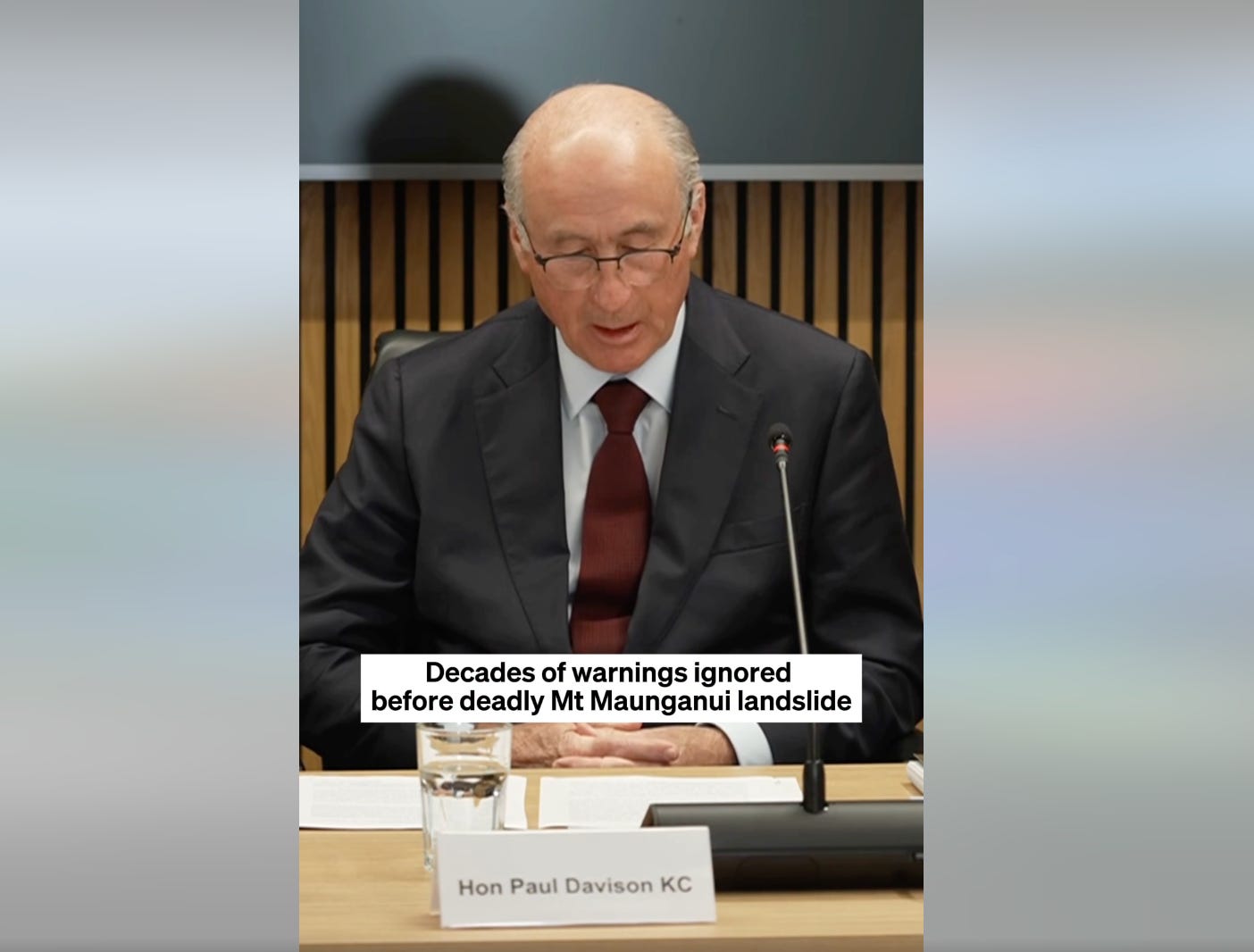
Paul Davison’s report into the Mount Maunganui landslide is brutal. Six people died in January, and his central finding is that they didn’t need to. Yet almost a week after its release, remarkably little has happened to anyone responsible for the council that failed them.
According to the investigation by High Court judge Paul Davison KC, Tauranga City Council had been warned about the landslide danger for 27 years. Consultants repeatedly identified the slope that eventually collapsed. In 2006, one assessment estimated that a large slip could put about 30 campers in its path and kill 21 of them.
Then, in 2023 and again in 2025, experts recommended a relatively simple Trigger Action Response Plan. Had it been put in place, Davison concludes, campers would probably have been evacuated. “The loss of life could in all likelihood have been averted.”
Davison’s language elsewhere is just as stark: “This was not a hazard that was unknown, hidden, or beyond the reach of foresight.” For more than two decades, he says, “one competent consultant after another” identified it.
Davison sums up what happened to all of these reports in a single phrase. Warnings about a risk to life were, he says “received, filed, discussed, forwarded — and then left”. Despite such scathing conclusions, the public response has been surprisingly muted. A handful of broadcasters and columnists have been scathing, and the Post has editorialised. Beyond that there has been very little.
“Systemic failure” is an explanation, not an excuse
Davison’s central finding is that this was a systemic failure. He was careful about blame. The review makes no finding that any individual did anything deliberately wrong, or that anyone’s acts or omissions caused the deaths. “The failure was not the fault of any one person,” he concluded. “It was the failure of a system that enabled an identified risk to life to remain unowned, un-escalated and unmanaged.”
Davison is right, and the evidence in his report overwhelmingly supports the description that this was an organisational failing. The problem comes when “systemic” starts being treated as though it means nobody can be personally accountable.
Andrea Vance put this sharply in the Sunday Star-Times: “That is the neat trick of management in the modern public service. The system failed, so nobody is to blame.” Her argument is that systems don’t build themselves. They are designed and defended by particular executives, who are paid to do exactly that. And she draws a line from the failures at Tauranga to what she calls the “industrialised consulting complex” that has hollowed out local government. The result is councils with plenty of purchased expertise and steadily less ability to do anything with it. Davison’s own finding supports her. Successive restructures, he wrote, dispersed the people who held the institutional memory, and continuity of that knowledge was treated as expendable.
The Post’s editorial yesterday made the obvious point: accountability now tends to land on systems rather than on the well-paid people who run them: “It is high time that systemic failure, while an acceptable explanation, is not considered an excuse for lack of accountability.”
Who at the council knew there was a problem?
One of the strangest parts of the aftermath to the report has been the parade of former Tauranga leaders saying, in effect: nobody told us about all the reports warning of the landslide dangers. For example, Stuart Crosby, mayor for 12 years, doesn’t recall the landslide warnings reaching him. Nor does former mayor Greg Brownless. Tenby Powell says he was never briefed on the risk. Anne Tolley says the commission that governed Tauranga from 2021 to 2024 never received the reports identifying a risk to life.
Perhaps all of them are telling the truth. If so, this is not much of a defence for the council. It would mean Tauranga City Council spent more than two decades commissioning experts to investigate hazards capable of killing large numbers of people without getting that information to the people elected or employed to govern the city.
In this regard there is the story uncovered by Herald investigative reporter Michael Morrah. A June 2025 geohazard report was attached to the agenda for a meeting involving Tauranga councillors and the Mauao Trust. The report identified a high risk to life from rockfall around the campground and again raised a Trigger Action Response Plan. It was provided to Deputy Mayor Jen Scoular and councillors Hemi Rolleston, Rod Taylor and Hautapu Baker. But they all say that they didn’t read it because the meeting where it was supposed to be discussed was cancelled, and then for some reason the following meeting didn’t discuss it.
Scoular now describes that as “very strange”. She also makes a pointed observation about Grenfell: “As a governor of the organisation, I should be able to have faith the organisation has systems to manage risk. The CEO is accountable, as Marty has said, for the performance of the organisation.”
In contrast, former deputy mayor Larry Baldock has dismissed calls for Grenfell’s resignation as “a bit crazy”. He justifies this with the observation that “hindsight is a wonderful thing”. Yet as Davison points out in his report, the Council had plenty of foresight of the disaster, with multiple reports on it over 27 years.
The paywall now starts partway through all Democracy Project newsletters. Please take out a paid sub if you want to support this service and access the full content, including the following sections: “The buck stops nowhere”, “The political response”, “Haven’t we been here before?”, “Broken New Zealand”, and “Nobody owned the risk”.
